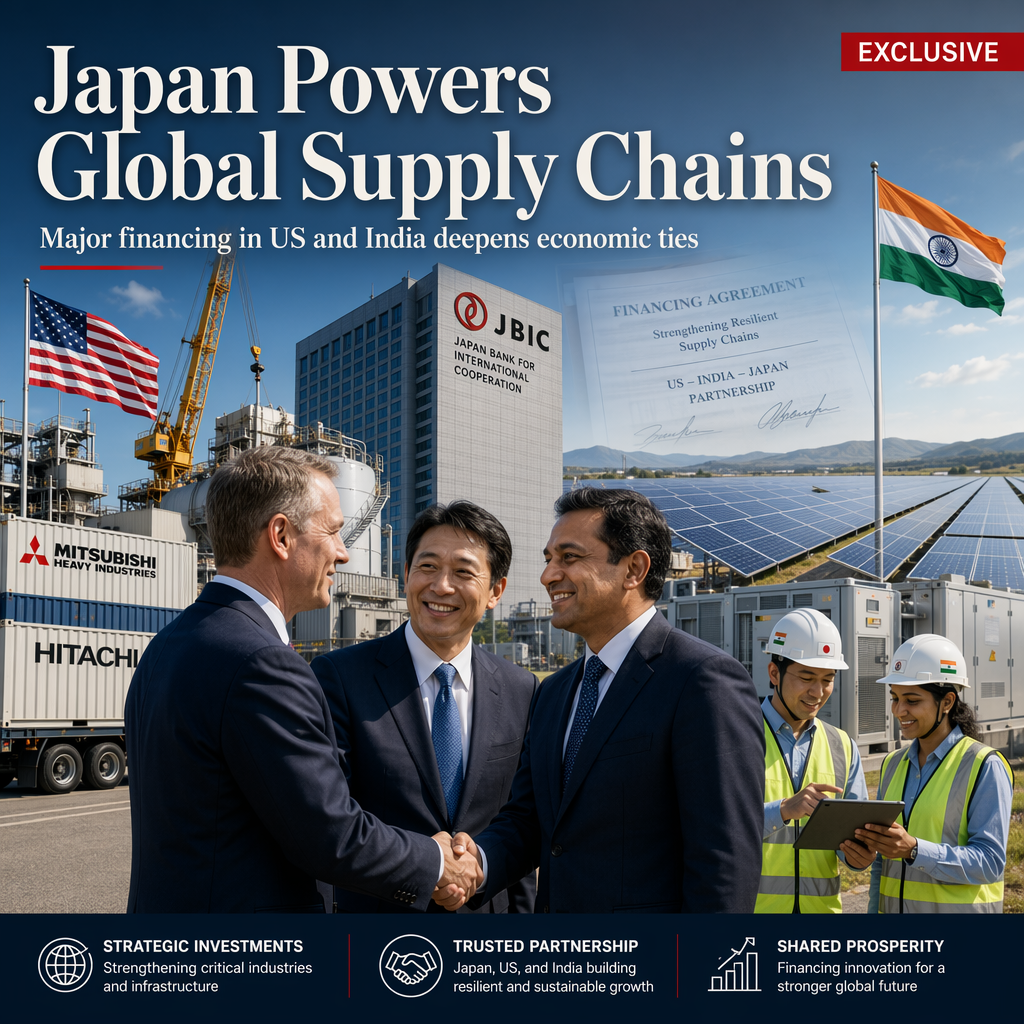
Japan is intensifying its efforts to secure critical supply chains and economic security through significant financial initiatives in both the United States and India. The Japan Bank for International Cooperation (JBIC) has sharply increased its exposure to the U.S. market, shifting its focus from emerging markets to supporting economic security and supply chains. This strategic pivot is evidenced by JBIC's recent high-profile deals, including a $1.6 billion financing package for U.S. projects and a $2.4 billion loan to Mitsubishi for a U.S. gas supplier deal, underscoring the bank's expanded mandate and its pivotal role in reinforcing the bilateral economic relationship between Japan and the United States [1].
Simultaneously, Japan is set to provide trade insurance on a 100 billion yen ($616 million) syndicated loan to Reliance Industries in India. This initiative aims to bolster India's domestic production of solar power equipment and batteries, sectors where Reliance Industries is actively investing. The trade insurance, offered by Japan, is designed to mitigate financial risks for Japanese companies participating in the project, thereby encouraging greater cooperation and investment in India's renewable energy and battery supply chains [2].
The syndicated loan, backed by Japanese trade insurance, is expected to reduce risk for lenders and potentially enable more favorable lending terms for Reliance Industries as it expands its solar and battery production. This move aligns with India's ambitious targets to increase renewable energy capacity and Japan's broader strategy to secure stable supply chains for critical materials and technologies. The cooperation also aims to strengthen economic ties between Japan and India, with India viewed as a key partner in the Indo-Pacific region [2].
These developments reflect a broader shift in Japanese government policy, with JBIC and other state-backed initiatives playing a central role in supporting large-scale investments that underpin Japan's economic security policies and deepen ties with major economies such as the United States and India [1][2].
CONCLUSION
Japan is actively leveraging state-backed financing and trade insurance to reinforce global supply chains and economic security, with major initiatives in both the U.S. and India. These moves are expected to deepen economic ties and create new opportunities for Japanese companies in critical sectors such as energy and technology. The market impact is high, reflecting Japan's strategic commitment to securing its economic interests abroad.