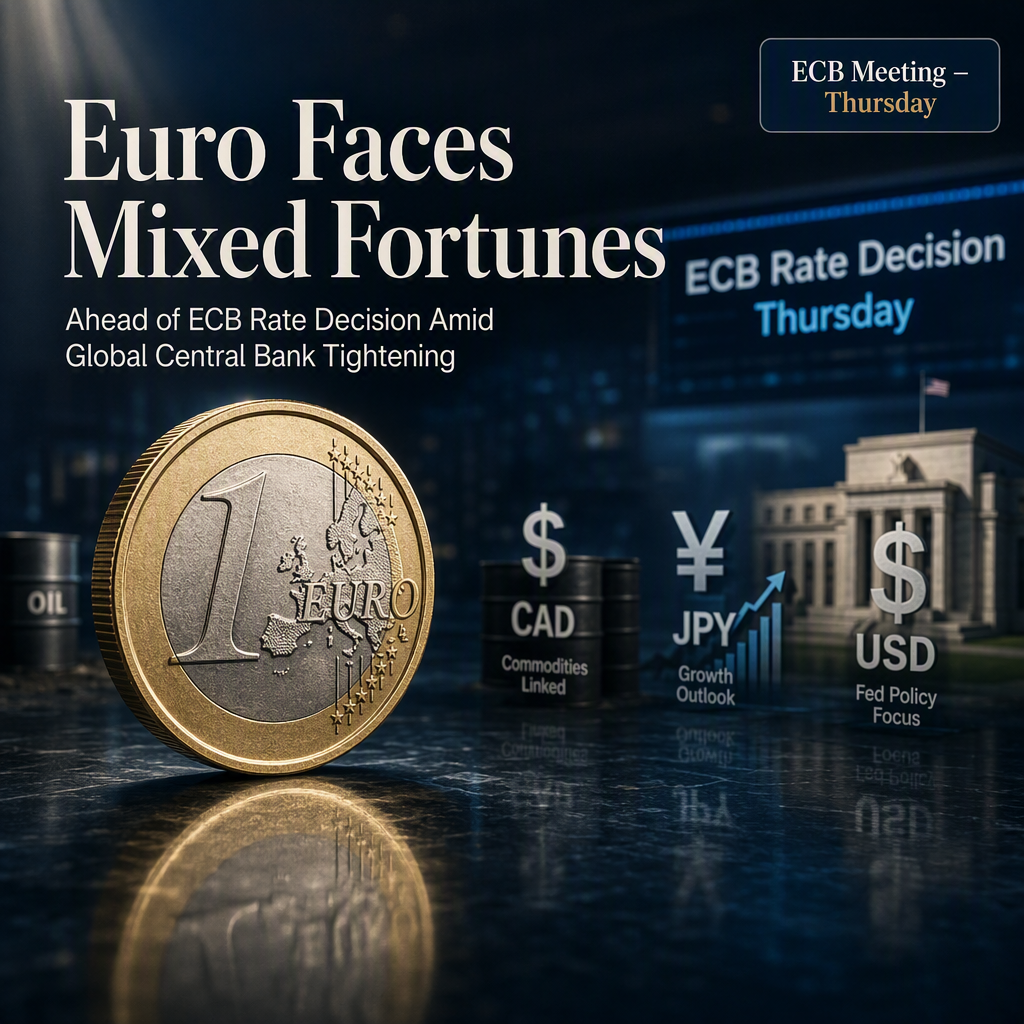
The Euro (EUR) is experiencing divergent performance across major currency pairs ahead of the European Central Bank's (ECB) highly anticipated policy meeting on Thursday. Against the Canadian Dollar (CAD), EUR/CAD rebounded to around 1.6030 during European trading hours after two days of losses, supported by expectations of a 25-basis-point ECB rate hike, which traders have fully priced in following Eurozone inflation rising above 3% in August [1]. ING's Carsten Brzeski described the expected move as 'another insurance rate hike,' or a 'dovish rate hike' [1]. However, elevated oil prices—driven by geopolitical tensions following a US strike on Iranian tankers and subsequent retaliatory actions by Tehran—could bolster the CAD and restrain further EUR/CAD upside [1].
In contrast, the Euro continues to underperform against the Japanese Yen (JPY), falling 0.27% to near 178.50 and approaching a 10-month low of 177.85 [2]. The JPY has been the strongest major currency this week, supported by market expectations that the Bank of Japan (BoJ) will continue its monetary tightening cycle, possibly with a 50-basis-point hike at its September 18 meeting. Deutsche Bank analysts cite Japan’s wage data as reinforcing the case for further BoJ tightening, while Rabobank notes intensified market chatter about a larger hike [2].
Against the US Dollar (USD), EUR/USD remains near 1.1600, described by ING’s Chris Turner as mid-range since April. ING expects a dovish ECB hike that will not validate additional tightening priced by markets, and sees limited justification for EUR/USD to break above resistance at 1.1640/45. ING prefers a 1.15 end-September target, anticipating a Fed hike [3]. The Euro's terms-of-trade deterioration is cited as a factor that should weigh on EUR/USD, though the pair has held up relatively well [3].
Across all sources, anticipation is high for the ECB's Thursday announcement, with consensus pointing to a 25-basis-point hike. However, analyst opinions diverge on whether this move will be sufficiently hawkish to drive further Euro strength, especially given competing central bank actions and commodity price influences [1][2][3].
CONCLUSION
The Euro's outlook remains uncertain ahead of the ECB's policy meeting, with a 25-basis-point hike widely expected but seen by some analysts as insufficiently hawkish to drive sustained gains. While EUR/CAD has rebounded on ECB expectations, elevated oil prices and BoJ tightening are weighing on EUR's performance against CAD and JPY, respectively. ING forecasts limited upside for EUR/USD, targeting 1.15 by end-September, suggesting that broader market sentiment is cautious and reactive to central bank developments.