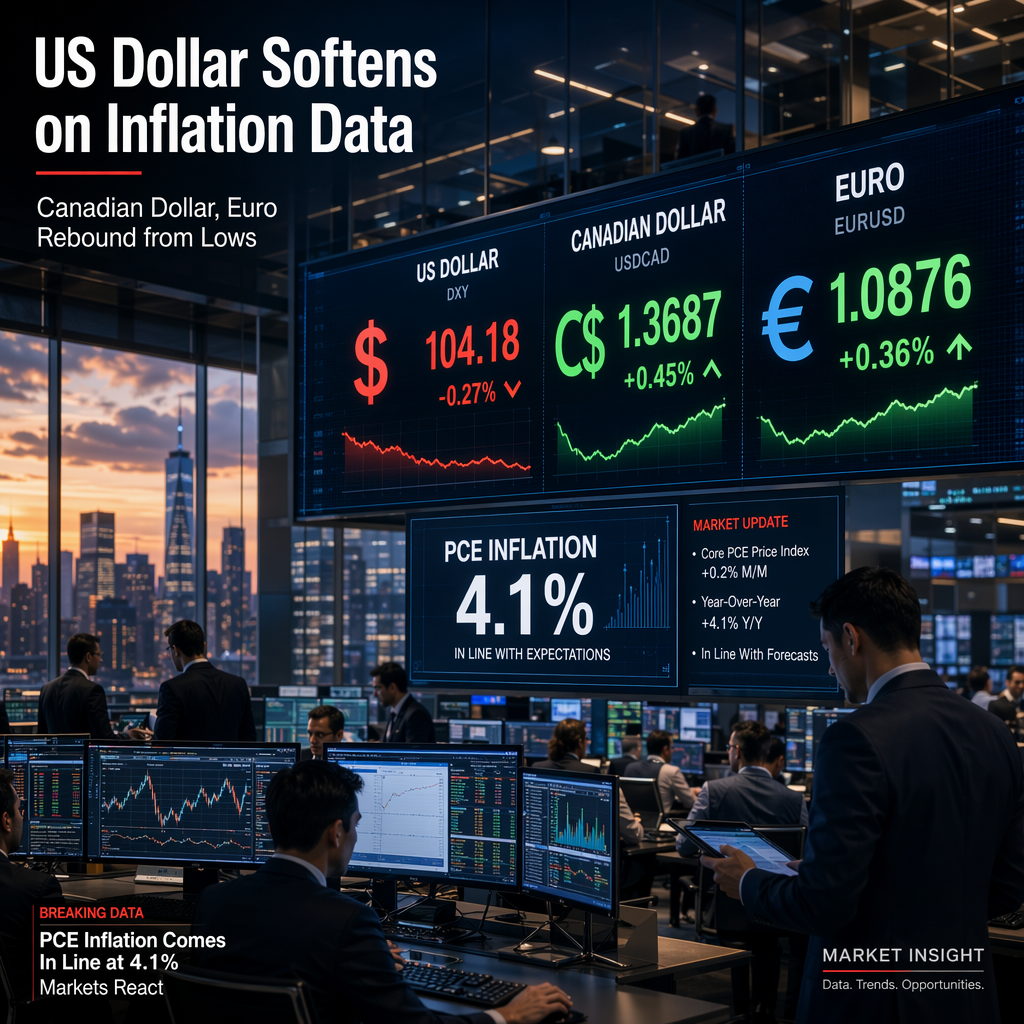
On Thursday, the US Dollar (USD) experienced a modest pullback following the release of the Personal Consumption Expenditures (PCE) Price Index, the Federal Reserve's preferred inflation gauge. Headline PCE inflation accelerated to 4.1% year-over-year (YoY) in May, matching market expectations and marking its highest annual reading since April 2023, while the core PCE Price Index increased by 3.4% YoY, also in line with forecasts. On a monthly basis, core PCE held steady at 0.3% [1][2]. The US Dollar Index (DXY), which tracks the Greenback against a basket of six major currencies, traded around 101.45–101.50, down 0.12% on the day after touching an intraday high of 101.75, reflecting the modest easing in the US Dollar after the inflation release [1][2].
The Canadian Dollar (CAD) recovered as Oil prices rebounded, with West Texas Intermediate (WTI) Oil up 1.05% on the day, trading around $70.50 per barrel. This improvement in Oil prices, Canada's main export, supported the CAD and contributed to the pullback in USD/CAD, which traded around 1.4205, down 0.21% on the day after recently reaching its highest level in 14 months [1]. The CAD was the strongest against the New Zealand Dollar among major currencies today [1].
The Euro (EUR) also stabilized near thirteen-month lows against the US Dollar, with EUR/USD trading around 1.1362 after rebounding from recent lows. The in-line inflation data and stable core readings prompted a modest recovery in the Euro as traders digested a heavy batch of US economic data [2].
Other US economic indicators released included Personal Income and Personal Spending, both rising 0.7% month-over-month (MoM), highlighting continued resilience in the US economy [1]. Initial Jobless Claims declined to 215,000, beating expectations of 225,000 and down from the previous week's revised reading of 227,000, pointing to a resilient labor market [1][2]. Durable Goods Orders fell 4.5% in May, matching forecasts after April's strong increase [1]. The US economy expanded at an annualized pace of 2.1% in the first quarter, revised up from the previous estimate of 1.6% [2].
Markets pared expectations for a September Fed rate hike, with the probability easing to 62% from 67% before the release, according to the CME FedWatch Tool [2]. Despite the modest USD weakness, expectations that the Fed could keep a restrictive policy stance continue to provide underlying support for the Greenback. Commerzbank analyst Michael Pfister noted that the recent surge in USD/CAD may have gone too far, suggesting that both market expectations for additional Fed tightening and the previous decline in Oil prices have likely been overstated. Substantially more negative Canada-specific developments would be needed for USD/CAD to extend its advance significantly beyond recent highs [1].
Analysts believe that strong GDP data, sticky inflation, and a resilient labor market reinforce the view that the Fed can keep monetary policy restrictive for longer, or even raise interest rates if needed, which could limit the downside in the US Dollar and cap any meaningful recovery in the Euro [2].
CONCLUSION
The US Dollar eased modestly after in-line PCE inflation data, prompting recoveries in both the Canadian Dollar and Euro from recent lows. While market expectations for a September Fed rate hike have softened, strong US economic data and resilient labor conditions continue to support the Greenback. Analysts suggest that further USD strength may require more negative developments, especially for Canada, and that the Fed's restrictive stance could limit upside for other major currencies.