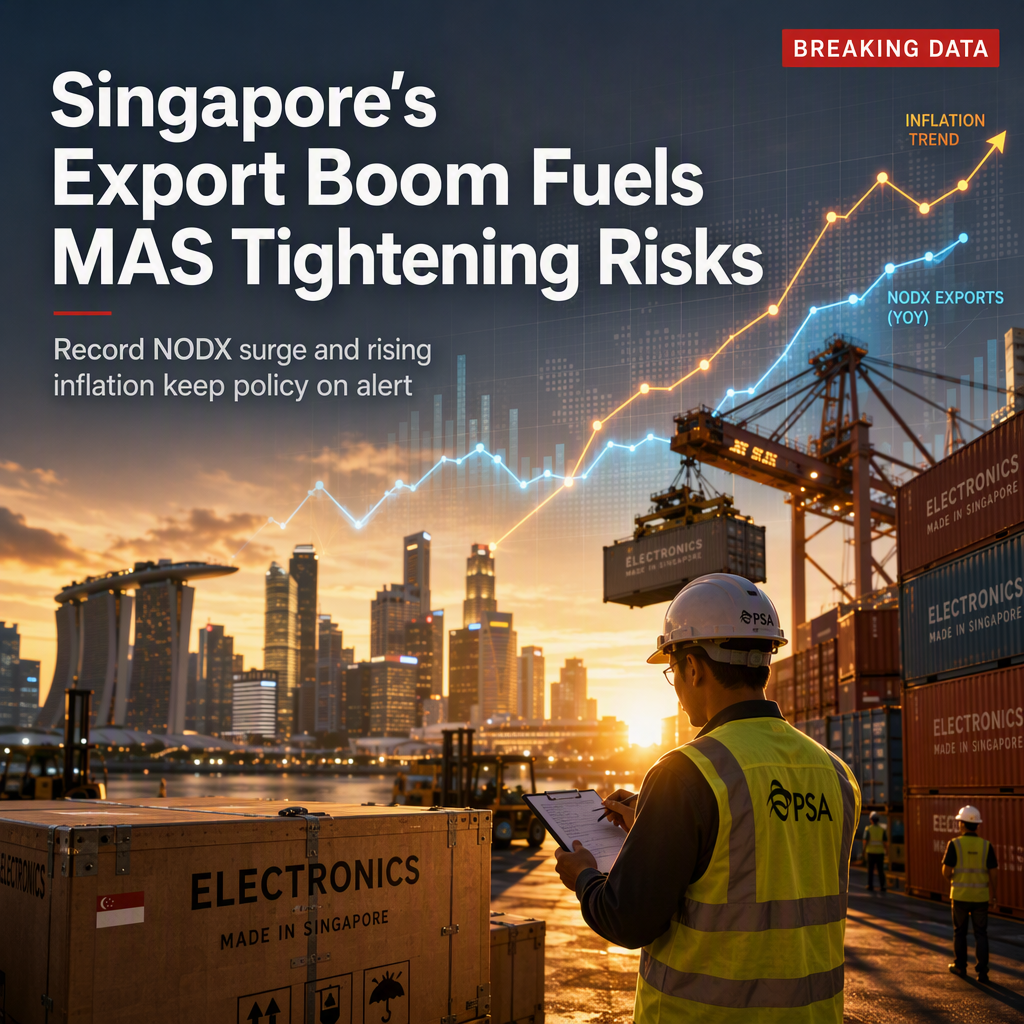
Singapore's August non-oil domestic exports (NODX) recorded a remarkable year-on-year surge of 46.2%, significantly exceeding Bloomberg's consensus estimate of 35.1% and up from 24.1% in July. This marks the strongest NODX growth since October 1998, with the electronics sector as the primary driver and a notable recovery in non-electronic exports as well. Year-to-date, NODX has climbed 22.4%, far surpassing the government's full-year forecast of 14-16% [1].
Commerzbank analysts Henry Hao and Moses Lim attribute the robust export performance to surging electronics and strong AI-related demand. They anticipate NODX growth to remain firm in the near term, supported by ongoing consumer electronics launches and AI trends, though the pace is expected to moderate as base effects become less favorable. Electronics are projected to continue offsetting weakness in other sectors [1].
Attention is now shifting to Singapore's August CPI release, scheduled for 23 September. Headline inflation is forecast to rise to 2.3% year-on-year from 2.2% in July, while core inflation (excluding private transport and accommodation) is expected to increase to 2.2% from 2.0%. If realized, this would represent the highest core inflation reading in nearly two years, raising the risk of further monetary tightening by the Monetary Authority of Singapore (MAS) [1].
In the foreign exchange market, USD/SGD remained steady around 1.2760 but rose 0.7% last week, driven by broad US dollar strength and elevated global oil prices [1].
CONCLUSION
Singapore's export momentum and rising inflation are fueling expectations of potential MAS tightening. The strong NODX performance and anticipated CPI uptick suggest continued economic resilience, though market participants are closely watching inflation data for policy signals. The USD/SGD's recent gains reflect broader dollar strength and global oil price trends.