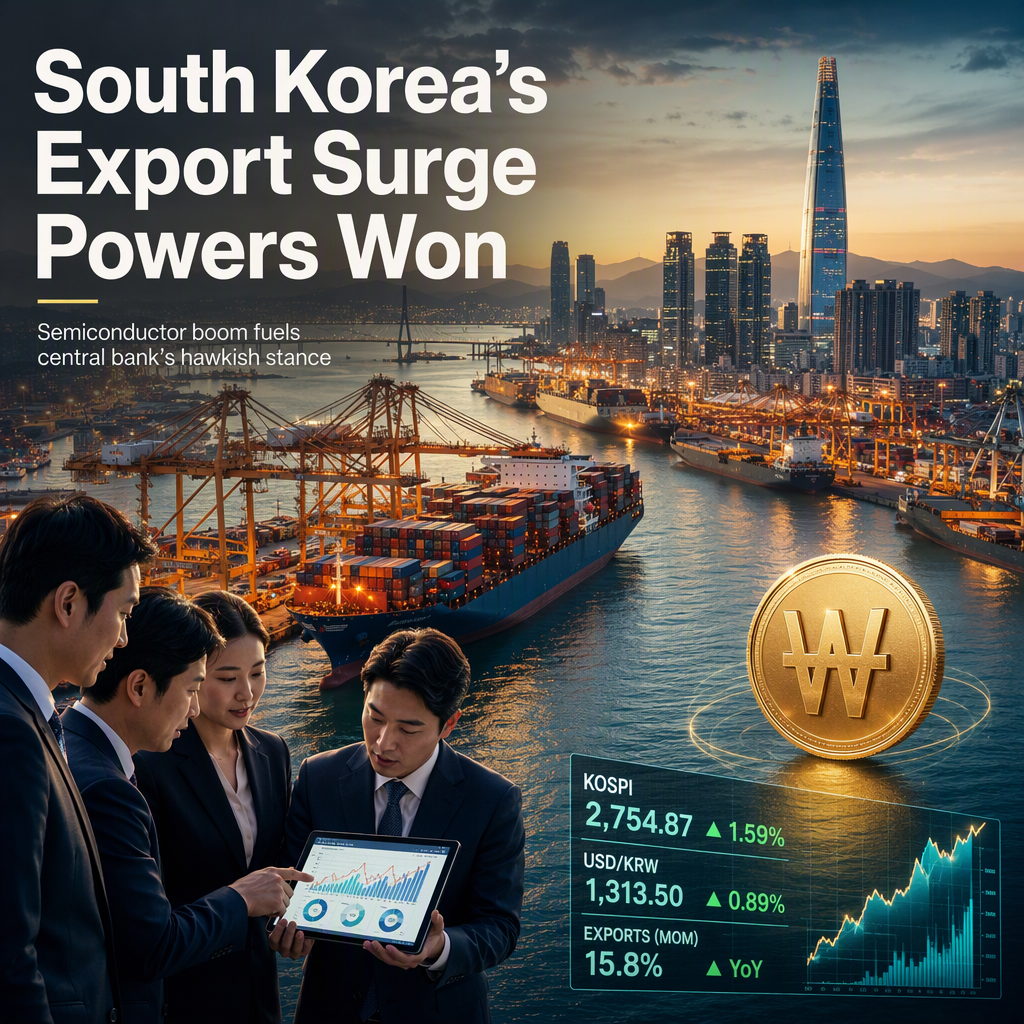
South Korea's exports for the first 20 days of September surged by 78.3% year-on-year, compared to 56.0% in August, marking a record high and extending nine consecutive months of double-digit growth. This export boom was led by a remarkable 259% increase in semiconductor exports, according to Commerzbank [1]. The robust export performance reinforces the Bank of Korea's (BoK) confidence in the country's economic growth, as reflected in the August meeting minutes, where the Monetary Policy Committee expressed optimism about the economy's resilience to further monetary tightening aimed at curbing inflationary pressures [1].
Despite the strong growth, recent stability in the South Korean won (KRW) is expected to reduce the immediate need for additional rate hikes. As a result, the BoK is anticipated to maintain its hawkish bias while keeping the policy rate unchanged at 3.0% during its upcoming meeting on 22 October, allowing policymakers more time to evaluate the delayed effects of previous tightening measures on economic activity [1].
In the foreign exchange market, the USD/KRW pair fell by 1.1% to 1,371 yesterday, marking its first decline in six sessions. This movement was attributed to lower global crude oil prices and exporter dollar selling ahead of the Chuseok holiday on 25 September [1]. Separately, the BoK conducted a test of 24-hour KRW settlement with four local banks participating, representing a significant step toward liberalizing the KRW market and improving access for foreign investors. Enhanced accessibility is seen as crucial for South Korea's potential reclassification to developed market status, as MSCI has previously cited restrictions in the KRW market as a major constraint [1].
CONCLUSION
South Korea's record export growth, particularly in semiconductors, has strengthened the won and supported the Bank of Korea's hawkish policy stance. The central bank is expected to keep rates steady at 3.0% while monitoring the effects of past tightening. Ongoing efforts to liberalize the KRW market may further enhance South Korea's appeal to foreign investors and support its developed market ambitions.