
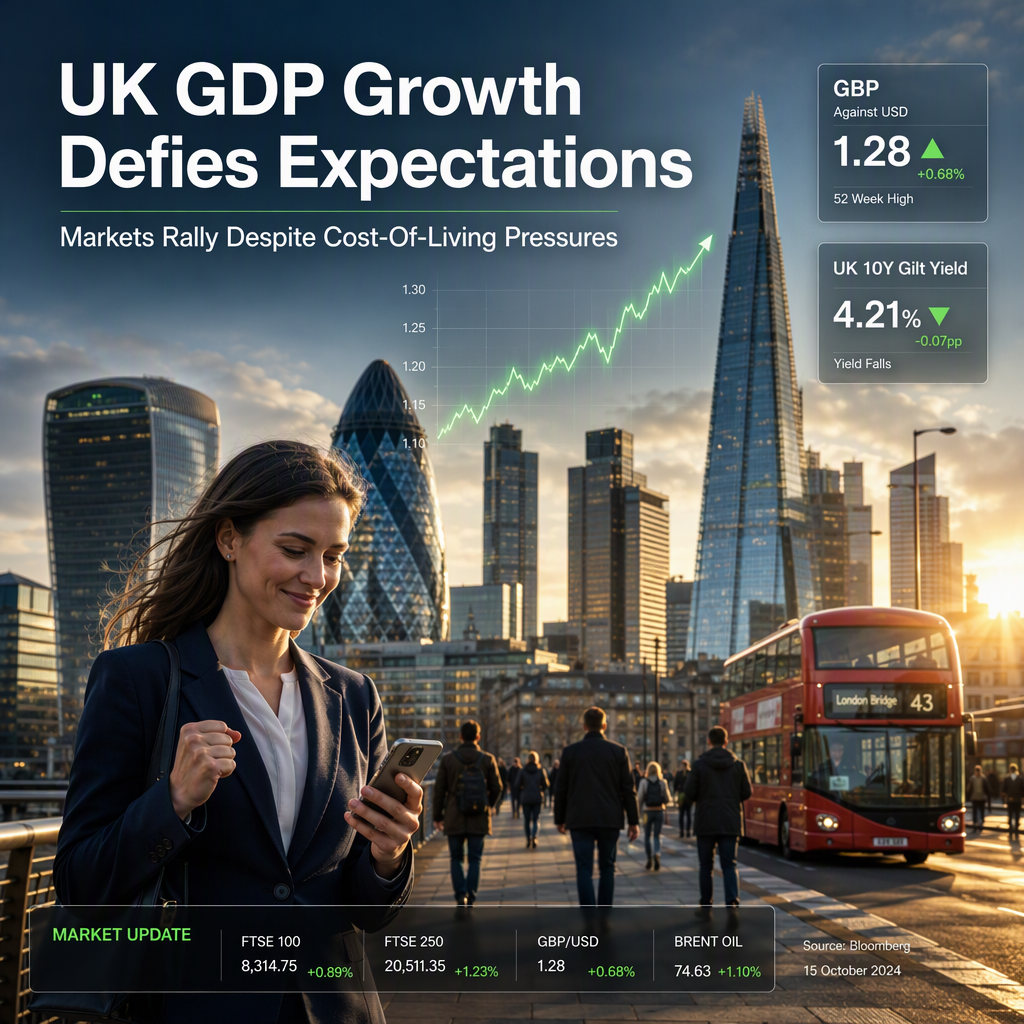
The United Kingdom's economy grew by 0.1% in August 2026, outperforming economists' expectations, which had forecast a 0.1% contraction for the month. This growth comes despite ongoing challenges from a cost-of-living crisis driven by persistent inflation and rising energy costs following the Russia-Ukraine and Iran wars [1]. Production was the main driver, increasing by 0.8%, while the services sector showed no growth and construction output declined by 0.2% [1].
On an annual basis, GDP expanded by 2.1% in August, exceeding the anticipated 1.7% growth and marking the highest year-on-year GDP reading since August 2022, according to the Office for National Statistics [1]. However, the monthly growth rate indicates a slowdown compared to the 0.4% month-on-month increase seen in June and July [1].
Market reactions were positive following the release of the GDP data. The British pound rose 0.4% against the U.S. dollar, and yields on UK government bonds (gilts) fell across the curve, with the benchmark 10-year gilt yield dropping 9 basis points to 5.3364% [1].
Looking ahead, the UK government is set to unveil its Autumn Budget later in October. The government faces the challenge of adhering to fiscal rules aimed at controlling public debt while also addressing the impact of rising consumer costs [1].
CONCLUSION
UK GDP growth in August exceeded expectations, providing a positive surprise to markets and boosting the British pound. Despite ongoing economic challenges, the annual growth rate is the highest in over a year. The upcoming Autumn Budget will be closely watched as policymakers balance fiscal discipline with measures to ease the cost-of-living crisis.