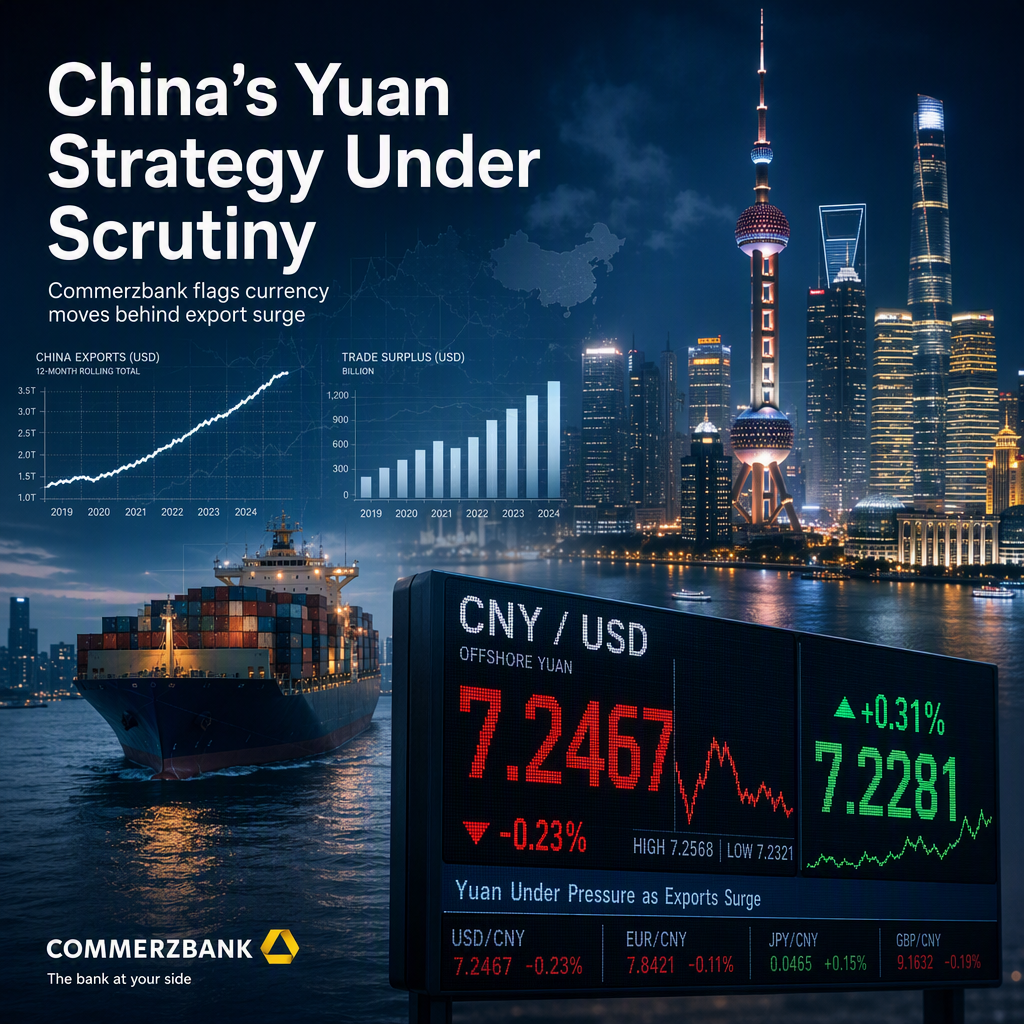
Commerzbank’s Volkmar Baur has raised concerns regarding the Chinese Yuan’s (CNY) undervaluation and its impact on China’s export performance and trade surplus. Baur challenges recent internal analyses that downplay the effect of the CNY’s exchange rate on exports, arguing that China’s exchange-rate management and gold purchases suggest a deliberate strategy to weaken the currency [1].
Between 2019 and the end of 2025, China’s real exports increased by 47%, while global trade grew by only 15% during the same period, indicating that China has gained significant market share globally. Over this timeframe, China’s trade surplus surged from approximately USD 400 billion to USD 1,180 billion [1]. Specifically, in manufactured goods, China’s trade surplus in 2025 represented 1.75% of global gross domestic product (GDP), a figure that surpasses the combined best years of Germany and Japan, historically the world’s top exporters [1].
Baur notes that, unlike the German D-Mark or Japanese Yen, which appreciated sharply against the US dollar in the late 1980s, the real exchange rate of the CNY depreciated by about 10% on a trade-weighted basis between 2019 and 2025, and by as much as 22% against the euro [1]. He acknowledges that not all of China’s export gains can be attributed solely to the undervalued CNY, as other factors such as the creation of new global export markets by China also play a role. However, Baur emphasizes that a roughly 20% real exchange-rate advantage is unlikely to be neutral for global trade flows, suggesting that currency policy has had a significant effect on supply and demand [1].
No specific market reactions or forward-looking analyst opinions beyond Baur’s critique are provided in the article [1].
CONCLUSION
Commerzbank’s analysis highlights the significant role of the Chinese Yuan’s depreciation in boosting China’s export market share and trade surplus since 2019. The findings suggest that China’s exchange-rate policy has had a notable impact on global trade flows, raising questions about the sustainability and fairness of these gains.