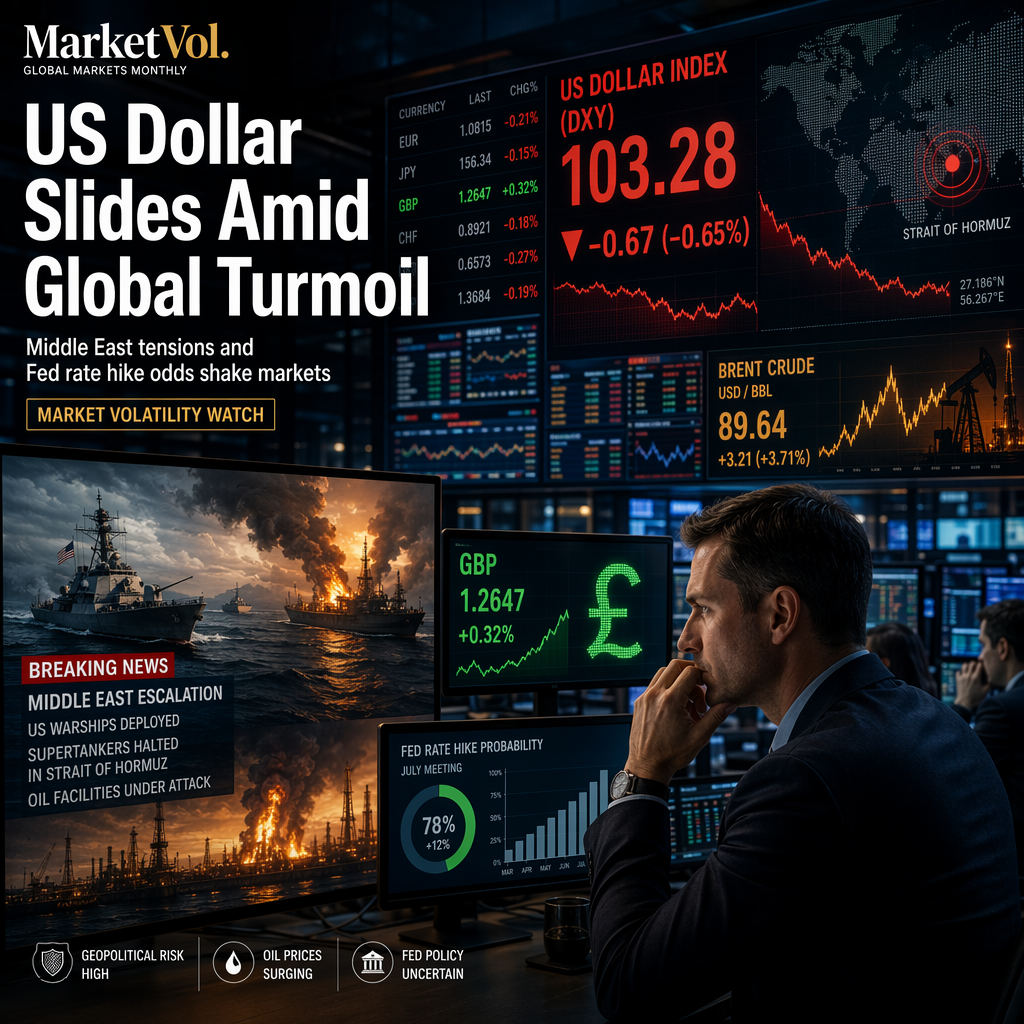
The US Dollar Index (DXY), which tracks the value of the US Dollar against six major currencies, declined to around 101.20 during the Asian session on Tuesday after two days of gains, despite an increase in safe-haven demand due to escalating tensions in the Middle East [1]. Over 50,000 US service members are currently deployed across the region, and the US Central Command (CENTCOM) announced new precision strikes on Iranian military targets [1][2]. Iran’s Islamic Revolutionary Guards Corps (IRGC) reported disabling two 'offending supertankers' in the Strait of Hormuz and warned that cooperation with the US would delay the reopening of the waterway and trigger a global energy crisis [1][2]. US President Donald Trump stated that Washington was reinstating a naval blockade on Tehran and would ensure the Strait of Hormuz remained open for a fee, following recent missile and drone strikes [2].
The heightened tensions have driven oil prices higher, raising concerns that energy-driven inflation could force the Federal Reserve (Fed) to keep interest rates elevated [1]. Market expectations have shifted, with the CME FedWatch Tool now indicating a 51% probability of a Fed rate hike in September, compared to a 23% chance that rates will remain unchanged [1]. Traders are closely watching Tuesday’s US June Consumer Price Index (CPI) report, with analysts expecting a 0.1% month-on-month decline in headline inflation but a persistent 0.3% increase in the core reading [1]. Federal Reserve Chair Kevin Warsh is also set to deliver congressional testimony, which market participants will scrutinize for signals on the Fed’s policy direction [1].
In the currency markets, the British Pound (GBP) strengthened above 1.3350 against the US Dollar, trading around 1.3360 during the Asian session on Tuesday [2]. However, the potential for further gains in GBP/USD may be limited by fears of an escalating US-Iran conflict, which could boost demand for the safe-haven US Dollar [2]. Meanwhile, traders have increased bets that the Bank of England (BoE) will need to raise interest rates this year to control inflation, with BoE Chief Economist Huw Pill stating that rates are likely to rise to prevent inflation from becoming entrenched [2].
CONCLUSION
Escalating US-Iran tensions and the risk of a global energy crisis have heightened market volatility, driving oil prices higher and shifting expectations toward a more hawkish Federal Reserve stance. While the US Dollar Index has slipped, safe-haven demand and the upcoming US CPI report could influence its direction. The British Pound has strengthened, but further gains may be capped by geopolitical risks and US Dollar strength.