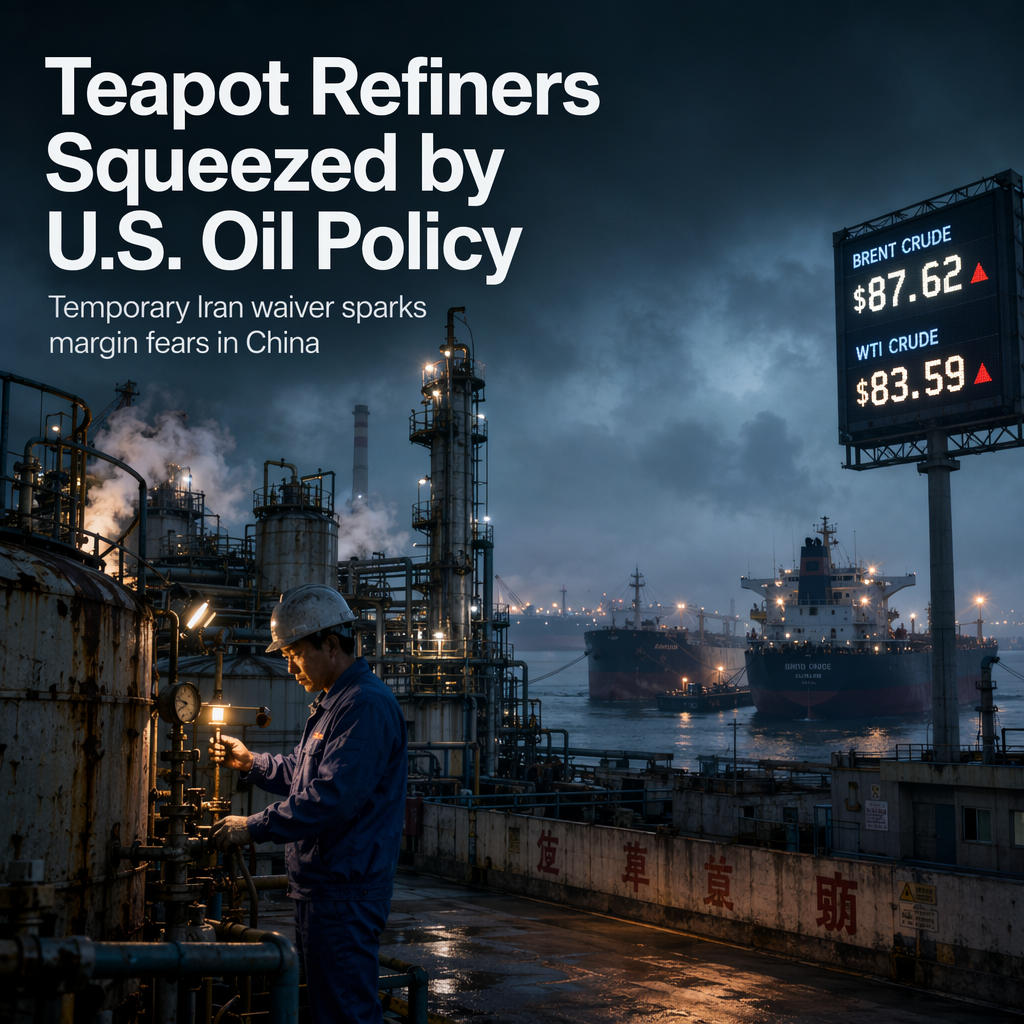
The U.S. has granted only a temporary waiver on sanctions for Iranian oil, a move that is set to squeeze China's small, independent refiners, commonly referred to as 'teapots' [1]. Previously, these refiners benefited from steep discounts on Iranian crude due to sanctions pressure, but the waiver has led to higher prices for Iranian oil, eroding the cost advantage for these price-sensitive players [1].
Market analysts highlight that the narrowing of Iranian crude discounts will disproportionately impact China's teapots, which lack the scale and financial resources of state-owned oil giants to absorb increased input costs [1]. A Shanghai-based oil market analyst stated, 'Without the deep discounts, many of these refiners will struggle to maintain profitability. Some may be forced to reduce runs or seek alternative, possibly less optimal, crudes' [1]. The temporary nature of the waiver has also introduced additional uncertainty, complicating purchase planning and risk hedging for these refiners [1].
Technical indicators suggest that if the supply of cheap Iranian crude diminishes, independent refinery margins in Shandong could fall below key support levels observed earlier in the year [1]. Market participants are monitoring potential price spikes in alternative crude grades, such as Russian ESPO and West African crudes, which could benefit from the supply gap [1].
The prospect of tighter margins has negatively affected sentiment in the Chinese oil product market. Traders warn that if teapots reduce their operations, it could lead to lower diesel and gasoline exports from China, tightening regional supply and potentially impacting domestic fuel prices and export competitiveness [1]. Overall, while the U.S. sanction waiver offers short-term relief, it has heightened medium-term risks for China's teapot refiners, increasing market volatility and reducing arbitrage opportunities [1].
CONCLUSION
The U.S. temporary waiver on Iranian oil sanctions has created both short-term relief and medium-term challenges for China's teapot refiners, primarily by narrowing their profit margins and increasing market uncertainty. Market participants are bracing for potential supply shifts and tighter regional fuel markets as these refiners adjust to the new landscape.