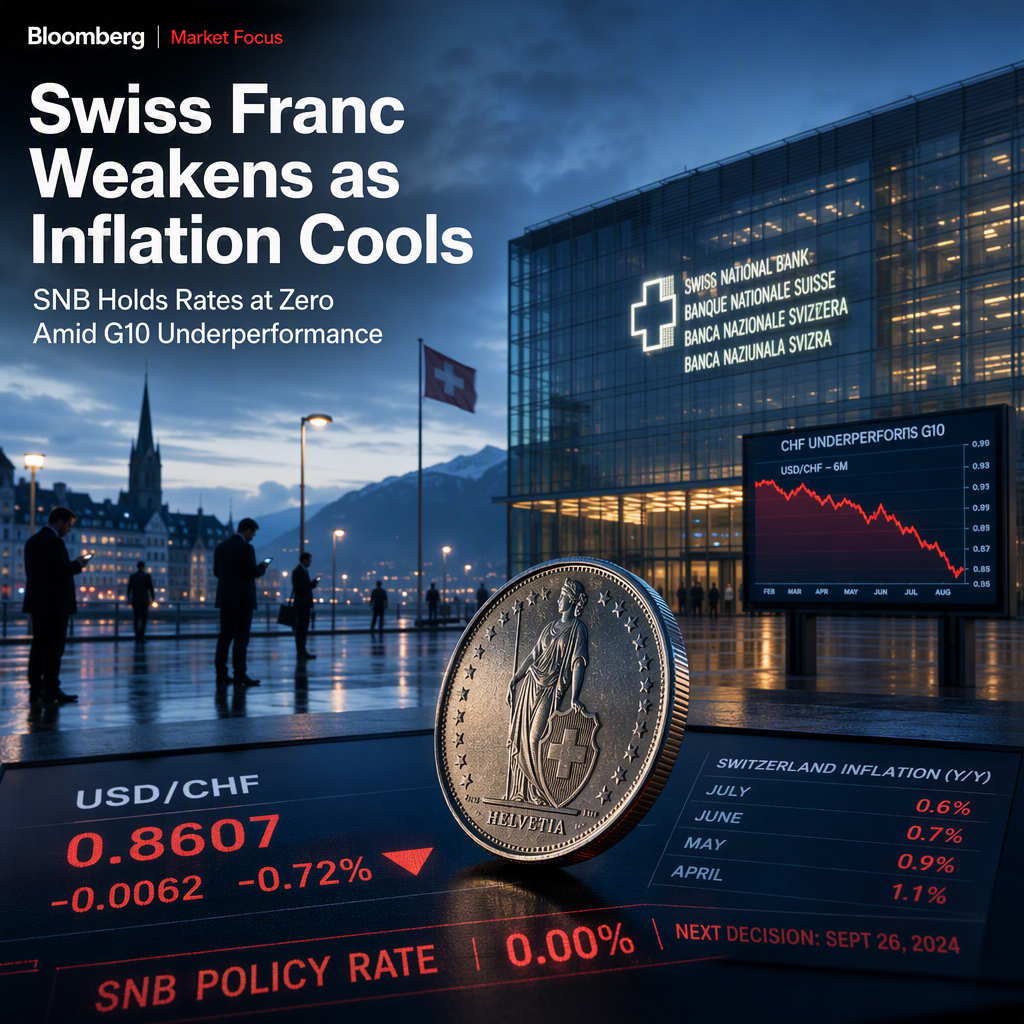
The Swiss Franc (CHF) weakened as July inflation data revealed a slowdown to 0.4%, down from 0.5% in the previous month, marking the lowest level in four months [1]. This cooling in consumer prices contrasts with the Swiss National Bank's (SNB) earlier expectations of a modest near-term inflation pickup, following its decision to keep policy rates at 0% [1]. Strategists at Brown Brothers Harriman emphasized that the muted inflation print underscores the absence of inflationary pressure in the Swiss economy, giving the SNB 'plenty of room to keep rates at 0.00% for some time,' which they describe as an ongoing drag for the CHF [1]. As a result, CHF has been the worst performing G10 currency so far this quarter [1].
The USD/CHF currency pair traded around 0.8100 during Asian hours on Tuesday, showing little movement after two days of gains, but with potential for further appreciation as the Swiss Franc faces headwinds from subdued domestic inflation and a firmly anchored policy rate [1]. Looking ahead, the SNB is expected to keep borrowing costs unchanged through the end of the year, with additional rate cuts considered only as a contingency in the absence of severe stress within the Swiss banking sector [1].
Market participants are also recalibrating their expectations for global monetary policy. The US Dollar (USD) stabilized amid ongoing diplomatic uncertainty, and traders are currently pricing in a roughly 65% probability of a 25-basis-point rate hike at the Federal Reserve's upcoming September meeting, according to the CME FedWatch tool [1].
Geopolitical tensions, particularly between the US and Iran, have contributed to market uncertainty, but the main driver for the Swiss Franc remains the domestic inflation outlook and the SNB's dovish stance [1].
CONCLUSION
The Swiss Franc's weakness is primarily attributed to cooling inflation and the SNB's commitment to maintaining zero interest rates, making CHF the worst performing G10 currency this quarter. With inflation subdued and no immediate policy changes expected, the Franc is likely to remain under pressure in the near term.