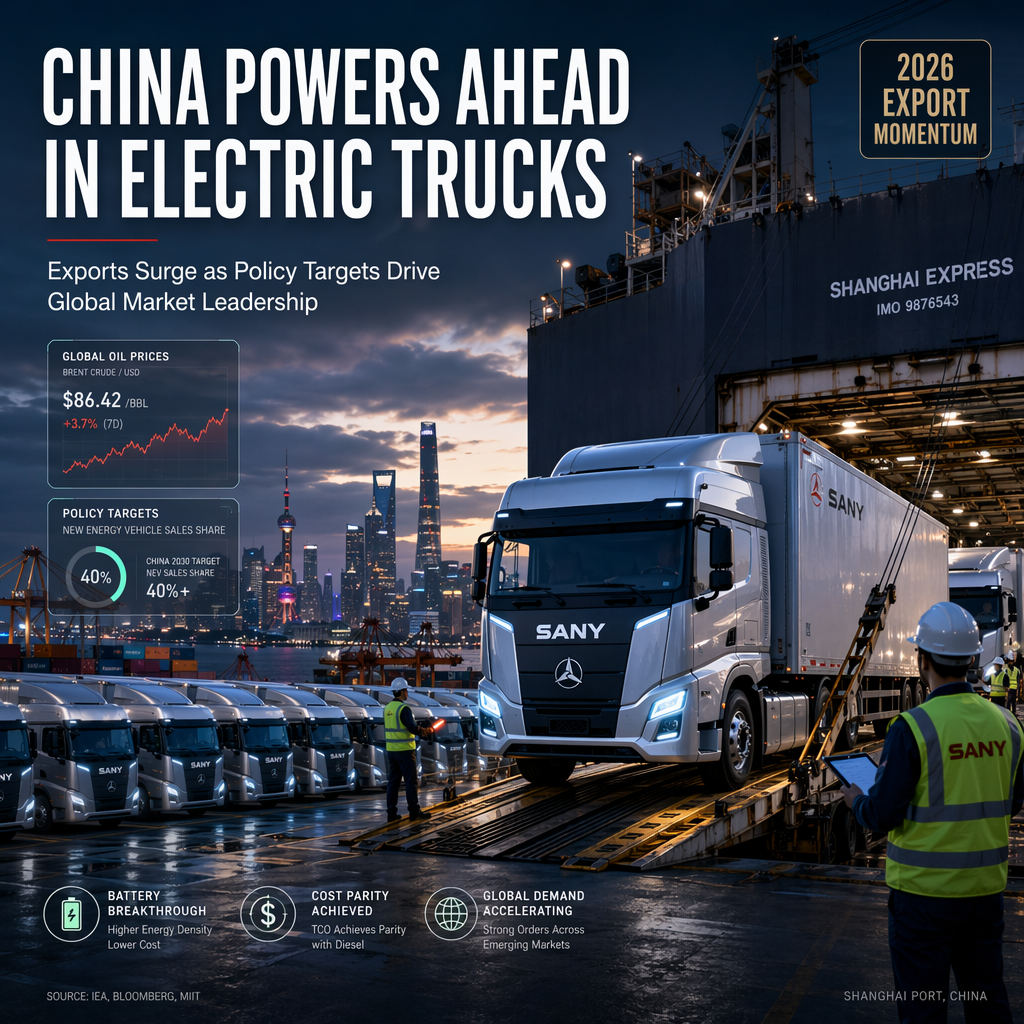
China is intensifying its efforts to replicate its electric vehicle (EV) success in the truck sector, driven by surging shipping and oil costs and new government policy targets. Sany, a Chinese manufacturer, reported that an overseas buyer requested expedited shipment of approximately 880 electric trucks by the end of June 2026, citing immediate demand due to recent global events, according to Michael Yue, general manager of Sany Heavy Industry's electric truck division [1]. The International Energy Agency (IEA) noted that, globally, electric trucks typically cost at least twice as much as diesel trucks, but in China, operational cost advantages and declining battery prices have helped the total cost of ownership for battery-powered heavy freight trucks reach parity with diesel alternatives over five years [1].
China's Ministry of Transport recently set a target for new energy heavy trucks to account for 40% of new truck sales by 2030, with a specific goal for more than 80% of trucks on shorter routes around Beijing to be electric [1]. This mirrors China's earlier push in the passenger car market, where new energy vehicles (NEVs) surpassed the 2025 goal of 20% market share well ahead of schedule, reaching over 60% of new passenger car sales by 2024, and potentially climbing to 80% soon, according to BYD Executive Vice President Stella Li [1].
The IEA reported that about a quarter of trucks sold in China last year were electric, contributing to a doubling of global electric truck sales to over 400,000 vehicles [1]. However, outside China, adoption remains limited due to higher costs, despite growing interest from both established automotive companies and start-ups [1].
The rapid policy support and export momentum suggest that China is poised to become a dominant force in the global electric truck market, leveraging its manufacturing scale and cost advantages [1].
CONCLUSION
China's aggressive policy targets and cost advantages are accelerating the adoption and export of electric trucks, positioning the country as a leader in the sector. While global adoption faces cost barriers, China's rapid progress and export activity are likely to have significant market implications.