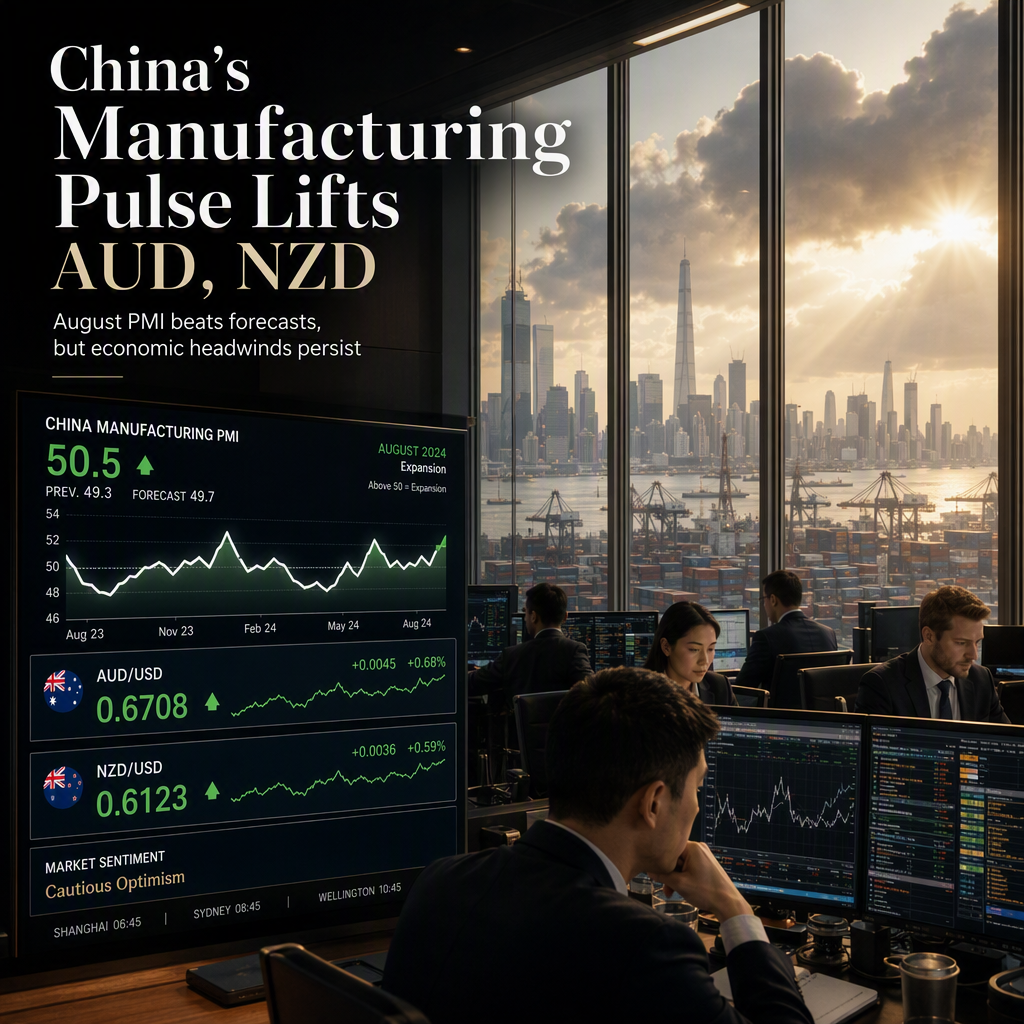
China's official Manufacturing Purchasing Managers' Index (PMI) rose to 49.8 in August, up from 49.2 in July and surpassing market expectations of 49.7, according to data from the National Bureau of Statistics released Monday [1][2][3][4]. The Non-Manufacturing PMI held steady at 49.0, unchanged from the previous month [1][2][3]. Despite the improvement, the manufacturing sector remained in contraction territory for the second consecutive month, reflecting ongoing economic challenges in China such as slowing growth, weak domestic demand, and a persistent property slump [4].
The modest uptick in China's PMI provided minor support to the New Zealand Dollar (NZD), with NZD/USD paring some daily losses and trading around 0.5910 during Asian hours [1]. However, the pair remained subdued for a second day, as New Zealand's own economic sentiment weakened: the ANZ Business Confidence Index fell to 53.7 in August from 56.1, and the Activity Outlook dropped to 48.2 from 49.3 [1]. Market participants are cautious ahead of the Reserve Bank of New Zealand's (RBNZ) upcoming monetary policy decision, where consensus expects a 25-basis-point rate hike following a similar move in May [1]. TD Securities noted that the hawkish July RBNZ rate hike led to a sharp reduction in short NZD positions, and recent data has not shifted market expectations away from further tightening [1].
The Australian Dollar (AUD) also saw little movement in response to the Chinese PMI data, with AUD/USD trading around 0.7160 and holding steady after opening at a bearish gap [2][3]. The pair extended its advance above both the nine-day and 50-day Exponential Moving Averages, suggesting a bullish near-term bias, though strategists at UOB Group flagged fading momentum as the pair approached key resistance [2]. Australia's TD-MI Inflation Gauge rose to 4.8% year-over-year in August, up from 4% in July, but the monthly reading declined to 0.5% from 1% [2].
Both the NZD and AUD faced potential headwinds from the US Dollar, which could strengthen following hawkish remarks by Federal Reserve Chair Kevin Warsh at the Jackson Hole symposium. Warsh stated that policymakers "have work to do" if inflation does not move toward target at a sufficient pace, prompting the CME FedWatch tool to show a 57.5% probability of at least a 25-basis-point Fed rate hike at the September 15–16 meeting, up from 35% prior to his comments [1][2].
Chinese policymakers have pledged to introduce new policy measures to support the economy, with economists expecting further fiscal spending and monetary easing, though the scale of such support is likely to be limited [4].
CONCLUSION
China's manufacturing PMI improvement in August offered only modest support to the Australian and New Zealand Dollars, as both currencies remain sensitive to broader economic and central bank developments. While the data beat expectations, persistent economic headwinds in China and hawkish signals from the US Federal Reserve continue to temper market optimism. Investors remain cautious, awaiting further policy signals from both Chinese and Antipodean central banks.