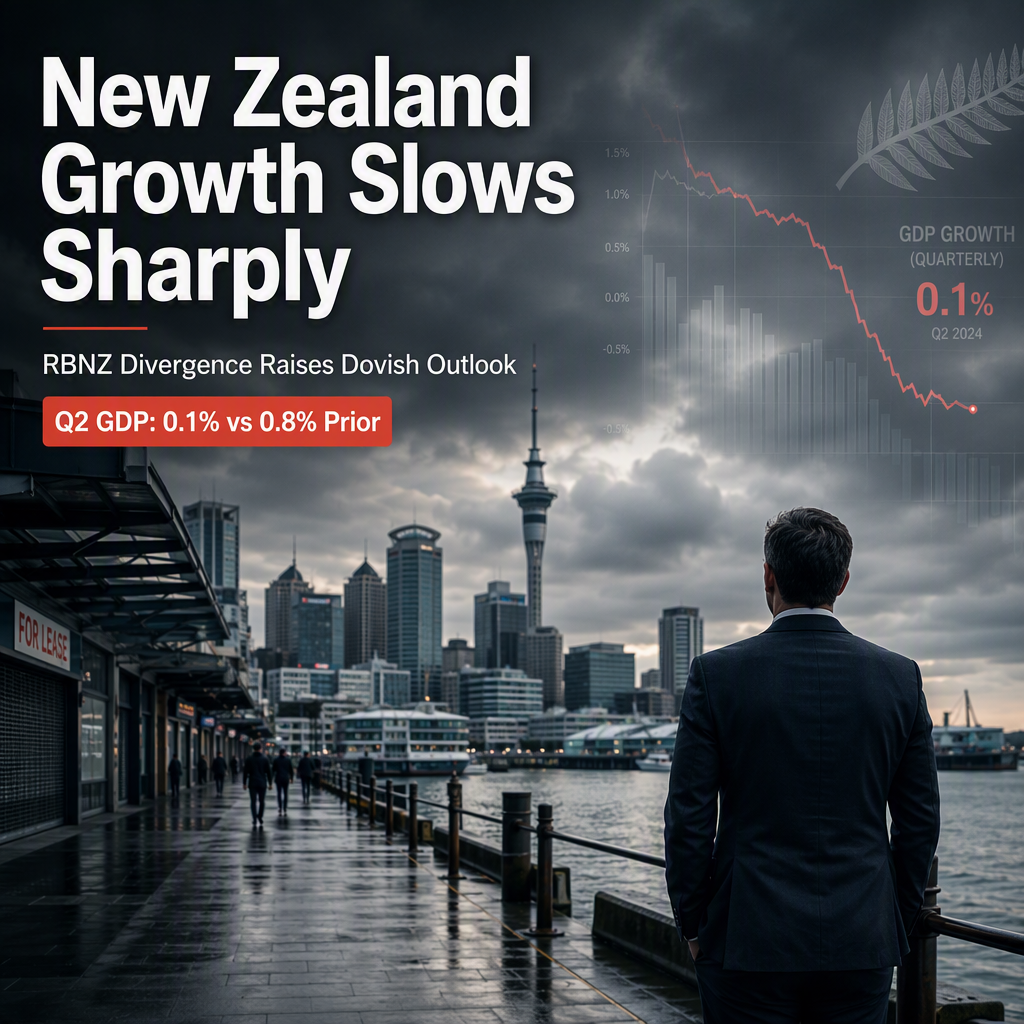
New Zealand's economic growth is expected to slow significantly in the second quarter, with production-based real GDP projected at just 0.1% quarter-on-quarter, compared to 0.8% in the first quarter. The Reserve Bank of New Zealand (RBNZ) itself forecasts Q2 GDP at 0%, highlighting the sharp deceleration in growth momentum [1]. This slowdown is attributed to reduced domestic spending, as higher fuel prices, elevated uncertainty, and declining house prices have weighed on real incomes and overall demand [1].
Despite the weak Q2 outlook, leading indicators suggest a potential recovery in the third quarter, offering some optimism for the near-term economic trajectory [1]. However, the RBNZ has noted that 'spare capacity remains in the economy, particularly in the labour market,' indicating ongoing slack and subdued inflationary pressures [1].
On the monetary policy front, there is a notable divergence between market expectations and the RBNZ's own projections. The swaps curve implies a policy rate of 4.25% over the next two years, while the RBNZ projects the policy rate, currently at 2.75%, to peak at around 3.25% in 2028. This projected peak would remain below the top end of the RBNZ's nominal neutral range estimate of 2.3% to 4.1% [1]. This gap leaves ample room for a dovish repricing, which could act as a drag on the New Zealand Dollar [1].
CONCLUSION
New Zealand's Q2 GDP is set for a sharp slowdown, with weak domestic demand and ongoing economic slack. The divergence between market rate expectations and the RBNZ's projections suggests potential for dovish repricing, which may weigh on the New Zealand Dollar in the near term.