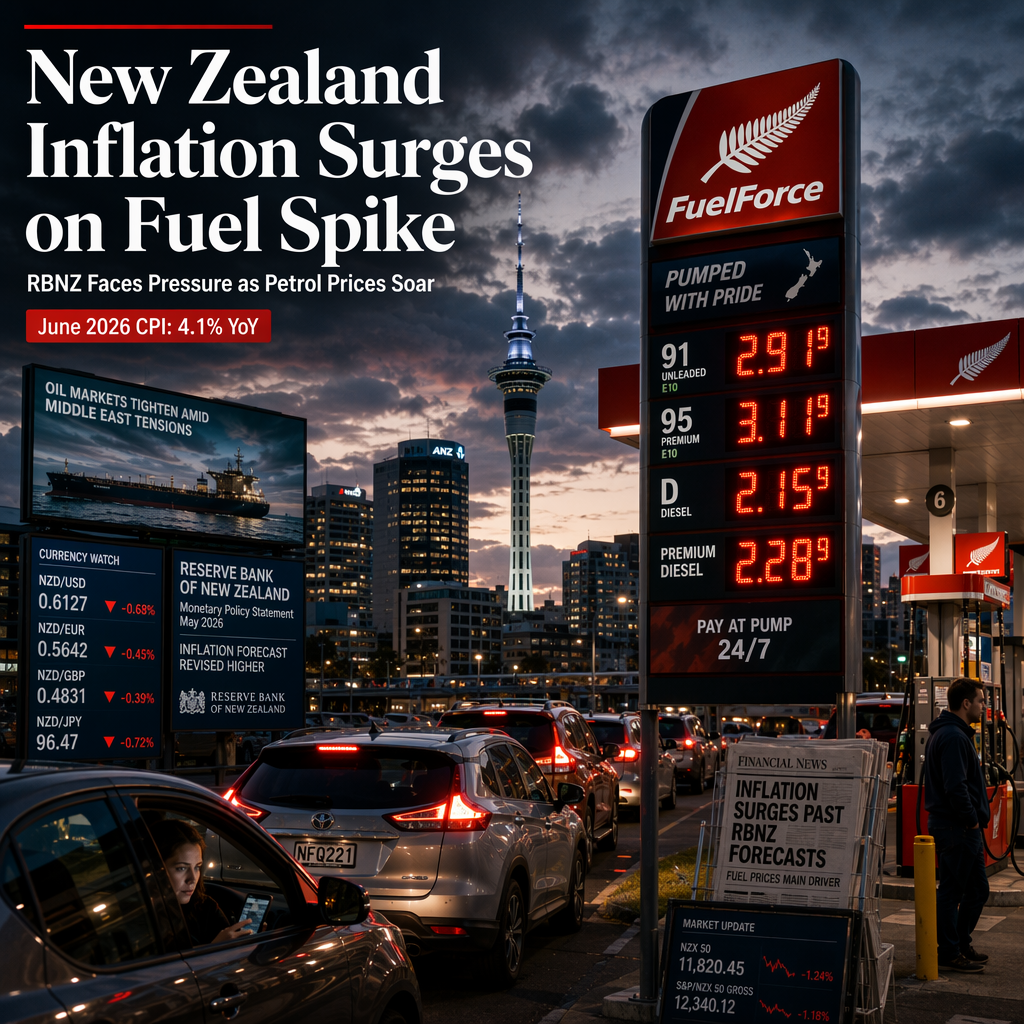
New Zealand's inflation rate for the June 2026 quarter exceeded both market and central bank expectations, with the Consumer Price Index (CPI) rising 4.1% year-over-year, compared to a 4.0% forecast and up from 3.1% in the previous quarter [1][2]. This annual increase also surpassed the Reserve Bank of New Zealand's (RBNZ) own forecast of 3.9% [2]. On a quarterly basis, CPI climbed 1.5%, outpacing the 1.4% forecast and marking the fastest quarterly rise since September 2023 [1][2]. Petrol prices were identified as the main driver, surging 27.5% over the year and accounting for nearly a quarter of the total annual inflation, while diesel prices jumped 71% [2]. Excluding fuel, annual inflation would have been a more subdued 2.9% [2].
The RBNZ had anticipated inflationary pressures and raised its key interest rate to 2.50% on July 8, 2026, its first hike since May 2023, in part to preempt the impact of rising prices [2]. Despite this move, the hotter-than-expected inflation print increases pressure on the central bank to maintain a cautious stance regarding future rate cuts or consider further tightening [2]. The next major policy update from the RBNZ is scheduled for September 2, 2026 [2].
Market reaction was notable, with the New Zealand dollar (NZD) initially rallying on the inflation news before paring gains as underlying inflation measures, which exclude volatile fuel prices, appeared more subdued [1][2]. This suggests that while headline inflation is elevated, core inflation remains less concerning, potentially tempering expectations for aggressive future rate hikes [2].
The surge in fuel prices is linked to ongoing geopolitical tensions in the Middle East, particularly the conflict involving the United States, Israel, and Iran, which has disrupted oil shipments through the Strait of Hormuz and driven global energy prices higher [1][2]. Stats NZ reported that fuel prices rose in April but declined in May and June, indicating that the peak impact may have passed [2].
CONCLUSION
New Zealand's inflation has surged past both market and central bank forecasts, primarily due to a sharp rise in fuel prices linked to Middle East tensions. While the RBNZ has already raised rates in anticipation, the latest data increases pressure to remain vigilant. However, easing fuel prices and subdued core inflation may limit the need for further aggressive tightening.