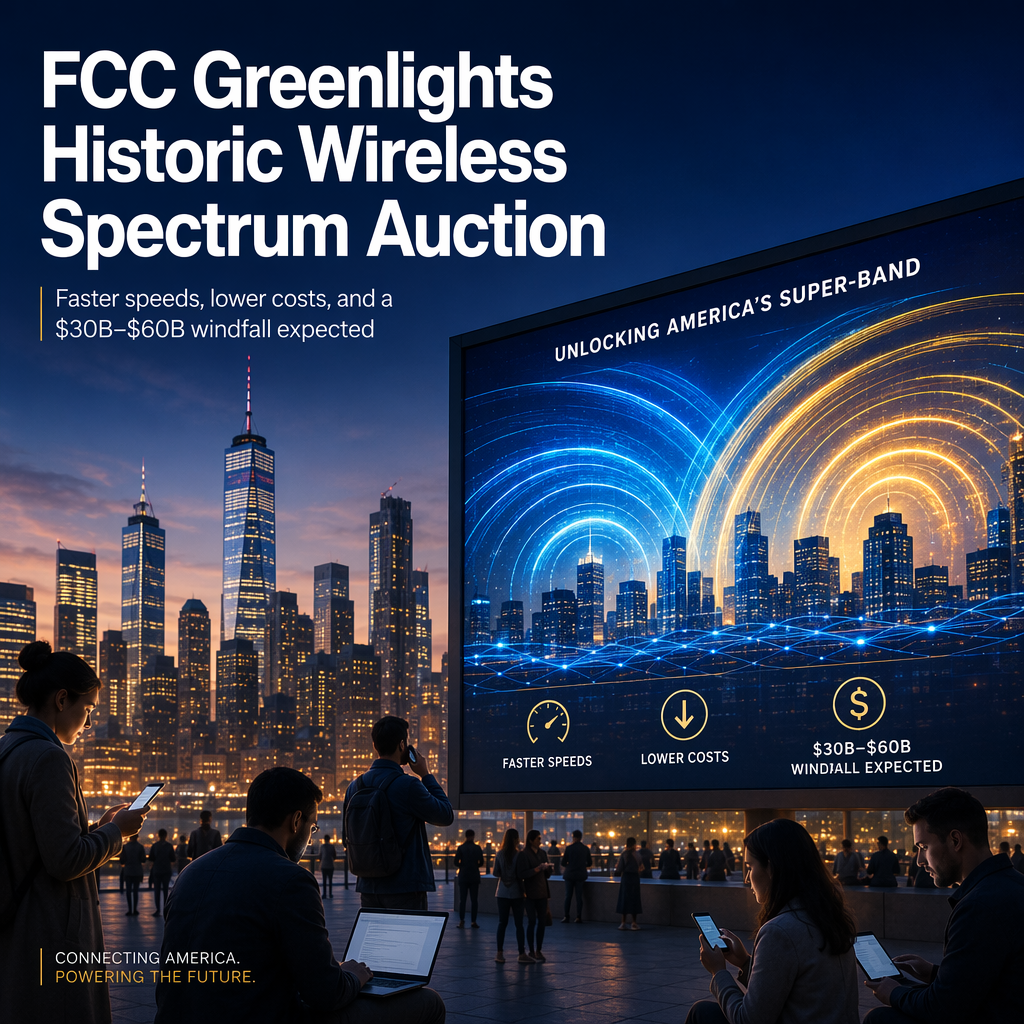
The Federal Communications Commission (FCC) has voted to adopt rules for auctioning 160 megahertz of spectrum in the Upper C-Band by July 2027, a move that Chairman Brendan Carr asserts will make wireless services faster and cheaper for U.S. consumers while raising significant revenue for the U.S. Treasury [1]. This auction will combine terrestrial wireless operations across the entire C-Band, creating a 'super-band' that spans 440 megahertz (3.70-4.14 GHz) of prime, mid-band spectrum [1].
Chairman Carr emphasized that this initiative is a continuation of the Trump administration’s agenda to restore U.S. leadership in wireless technology, noting that the U.S. had fallen behind countries like China during the 5G rollout under the Biden administration [1]. The passage of Trump’s Working Families Tax Cut authorized the FCC to bring more airwaves into the commercial marketplace, aiming to increase speeds and reduce prices for consumers [1].
The order establishes competitive bidding procedures, allowing wireless providers to bid on licenses, which is expected to generate between $30 billion and $60 billion or more for the U.S. Treasury, according to Carr [1]. Senate Commerce Committee Chairman Ted Cruz also praised the move, stating it will result in better coverage and faster speeds for consumers [1].
The FCC’s order reconfigures 160 megahertz of the Upper C-band (3.98–4.14 GHz) for terrestrial wireless flexible use, with a 20-megahertz guard band at 4.14–4.16 GHz. It also consolidates the Lower and Upper C-band into a single 3.7 GHz Service (3.7–4.14 GHz) for flexible use and harmonizes licensing, operating, and technical rules across the entire band [1]. The FCC stated that these measures promote successful coexistence with adjacent band radio altimeters through specific technical measures [1].
CONCLUSION
The FCC's decision to auction a significant portion of the C-Band spectrum is expected to enhance wireless speeds, lower consumer costs, and generate substantial revenue for the U.S. Treasury. This move is positioned as a strategic effort to regain U.S. leadership in wireless innovation and foster increased competition in the market.