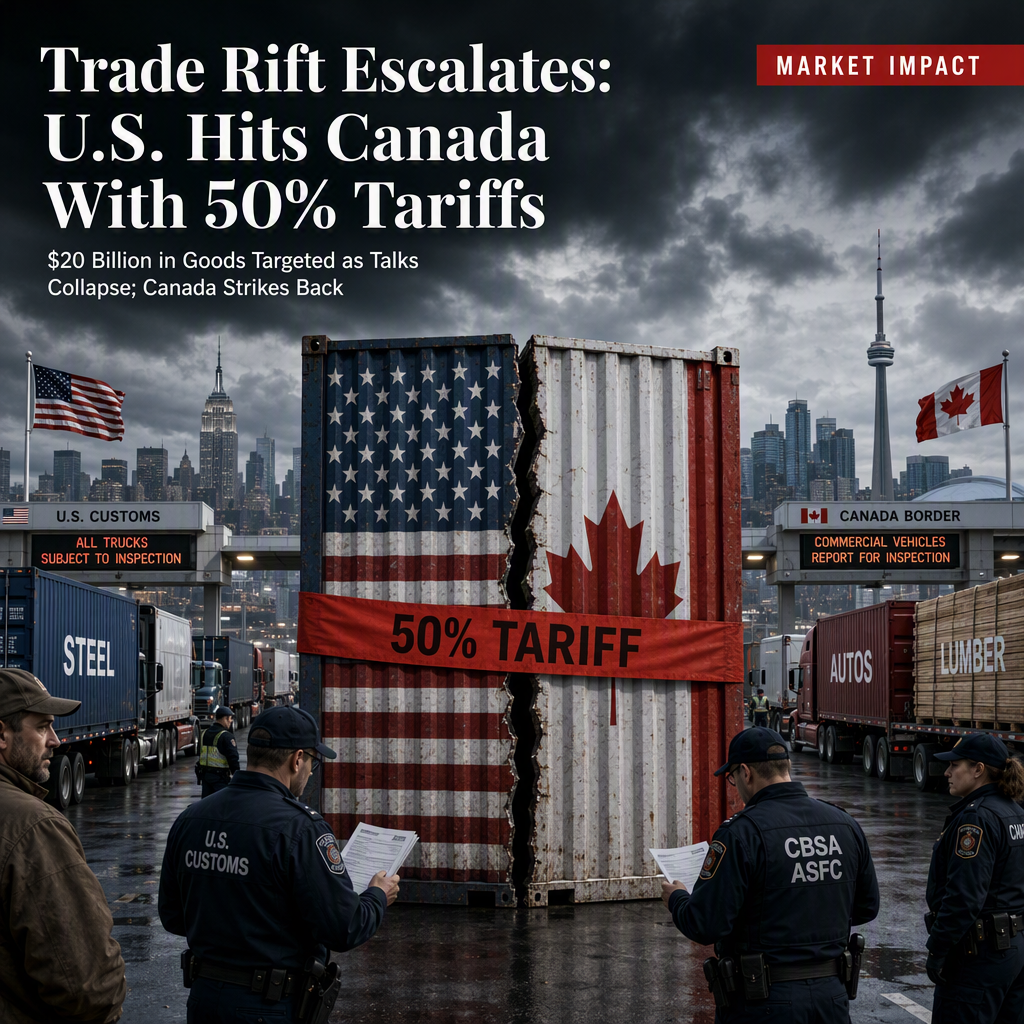
U.S. Trade Representative Jamieson Greer announced that the United States has implemented new 50% tariffs on approximately $20 billion worth of Canadian imports following the breakdown of trade negotiations between the two countries [1]. Greer stated that Canada walked away from 'the best deal' in order to maintain its trade barriers against American goods, and confirmed that no further trade talks are currently scheduled [1]. The tariffs affect key Canadian exports such as steel, autos, and lumber, which Greer described as 'sensitive' sectors for Canada [1].
Canadian Prime Minister Mark Carney suspended trade negotiations with the U.S. late Friday, citing 'unfair' last-minute changes to the proposed terms by Washington [1]. In response, Carney announced that Canada would impose retaliatory tariffs against the United States, matching the U.S. tariffs 'dollar for dollar to protect our workers and businesses' [1]. Carney emphasized that Canada will not allow any nation to determine its future and will set its own course to strengthen the country [1].
Greer indicated uncertainty about the resumption of trade talks, stating it is 'hard to say' whether negotiations will restart in the near future [1]. He also noted that, in addition to Canada, only the People's Republic of China has retaliated against the United States in response to President Trump's trade policies aimed at reshoring American production and protecting American jobs [1].
In related developments, 25 U.S. states have filed lawsuits to block separate labor tariffs, and President Trump has temporarily waived duties on 300,000 tons of ground beef for 90 days [1].
CONCLUSION
The collapse of U.S.-Canada trade negotiations has resulted in significant new tariffs on both sides, escalating trade tensions between the two countries. With no further talks planned and both governments taking retaliatory measures, the market impact is expected to be high, particularly in sectors like steel, autos, and lumber.