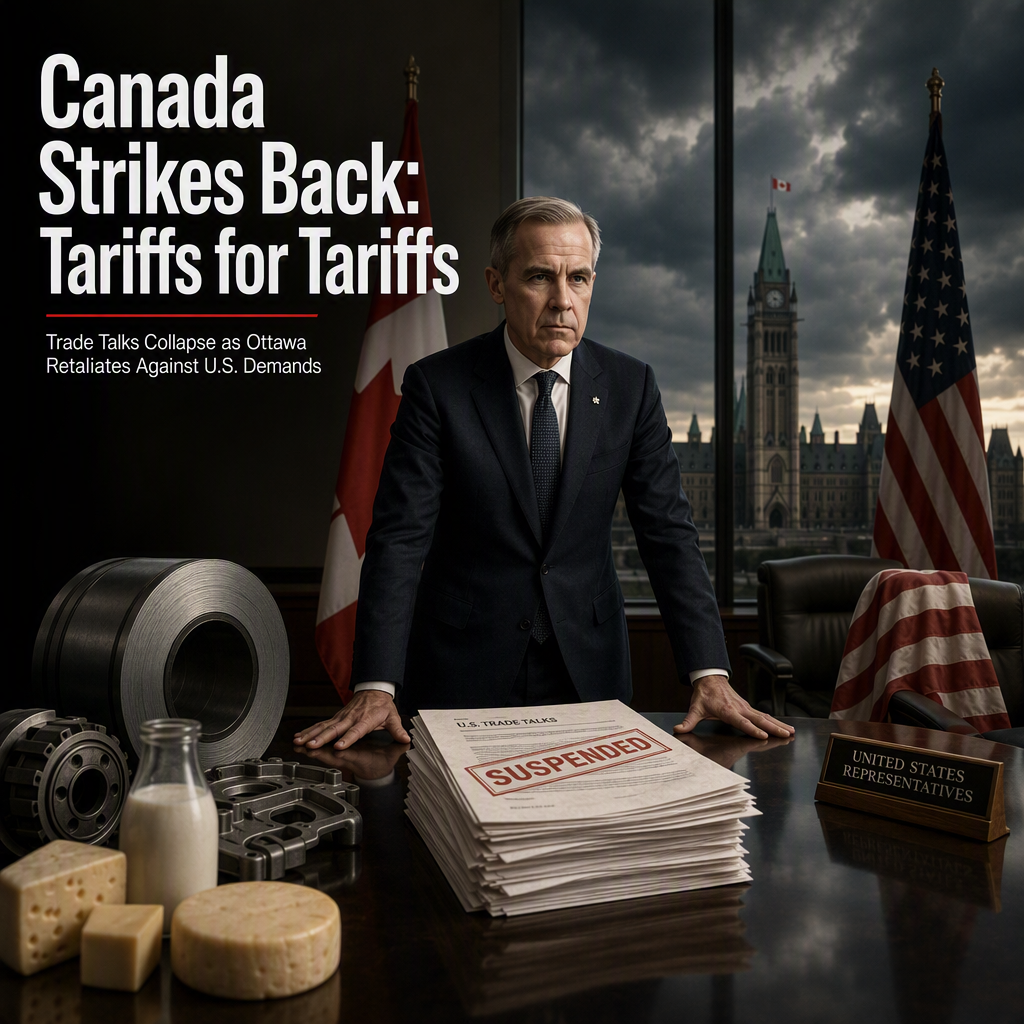
Canadian Prime Minister Mark Carney announced the collapse of trade negotiations with the United States, accusing the U.S. of making a last-minute 'power play' by introducing new demands that would restrict Canada's ability to strike trade deals with other countries, as well as changes involving the auto sector and protections for Canadian culture and the French language [1]. Carney stated, 'The U.S. introduced at the last hours, in the last hour, efforts to restrict our ability to have other trade deals,' and characterized the move as a question of sovereignty [1].
The breakdown in talks occurred after President Donald Trump imposed 50% tariffs on roughly $28 billion in Canadian goods, which took effect the day before Carney suspended negotiations and recalled Canada's trade team to Ottawa [1]. In response, Carney announced that Canada would implement retaliatory tariffs matching the U.S. measures dollar for dollar, targeting sectors such as steel, dairy, appliances, agricultural equipment, pulp and paper, and electronics. These retaliatory tariffs are set to take effect the Tuesday after Labor Day, on September 8 [1].
There is a dispute between the two sides regarding the cause of the breakdown. While Carney claims the U.S. asked too much and offered too little, U.S. Trade Representative Jamieson Greer asserted that Canada declined to finalize terms agreed to earlier in the week, instead making new demands and walking back previous commitments [1]. Greer stated that the U.S. had offered significant tariff reductions on steel, aluminum, autos, and lumber, as well as a broader economic and national security partnership covering digital trade, critical minerals, aerospace, and export controls [1].
Autos were a major sticking point, with disagreements over tariff levels, the treatment of Canadian content, and which vehicles would be covered by a potential agreement. The U.S. also sought changes to Canada's protections for culture and the French language, which Carney said Ottawa would not accept [1]. The collapse came just days after Trump paused the 50% tariffs for three days and announced a deal had been reached, subject to final documentation [1].
CONCLUSION
The collapse of U.S.-Canada trade talks and the imposition of reciprocal tariffs mark a significant escalation in trade tensions between the two countries. With both sides blaming each other for the breakdown and major sectors targeted for tariffs, the market impact is expected to be high and uncertainty remains over future negotiations.