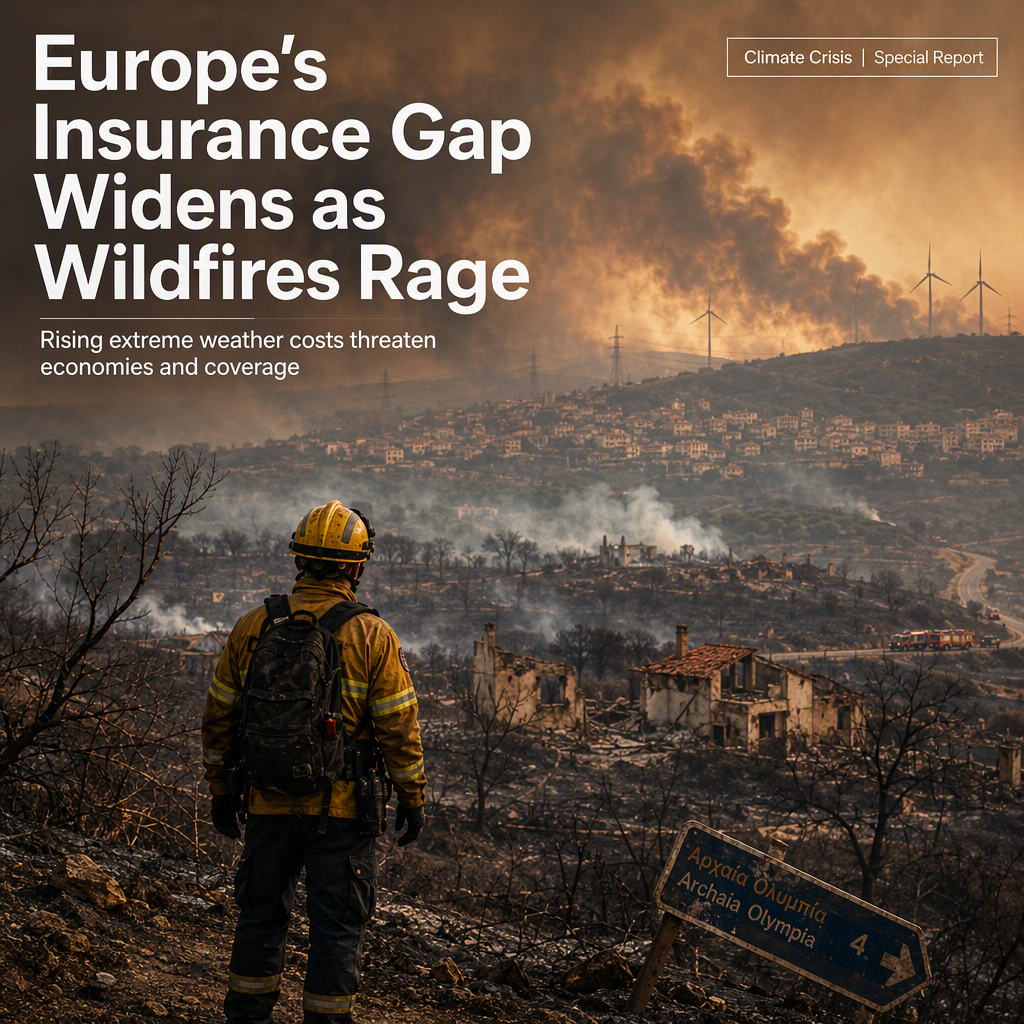
Europe's largest insurance companies have raised alarms that the costs of recovering from wildfires and heatwaves are now outpacing the level of insurance coverage available, creating a growing 'protection gap' across the region [1]. As wildfires and extreme heat become a recurring feature of European summers, governments are increasingly burdened with expenses for cooling, infrastructure recovery, and healthcare, as well as other emergency measures [1]. A massive wildfire that began in July has destroyed over 300,000 acres in France and Spain, described as a 'clap of thunder' for local economies, while Greece has faced severe outbreaks exacerbated by 100 km per hour winds [1]. Throughout the summer, Europe has experienced multiple heatwaves, with temperatures regularly exceeding 104 degrees Fahrenheit, prompting red alerts and drought warnings [1].
Zurich Insurance Group CEO Mario Greco stated that while all weather risks are technically insurable, the costs are rising sharply. Greco emphasized that effective prevention and mitigation require systemic intervention, which many governments are not yet prepared to undertake due to a lack of risk awareness [1]. The fiscal strain from extreme weather extends beyond insurance, impacting national budgets through increased spending on healthcare, emergency infrastructure, transportation, and agriculture [1].
According to a June report from Allianz Commercial, insurance companies paid out $56.3 billion in wildfire losses during the 2010s, a sixfold increase from the $8.7 billion paid in the 2000s [1]. The most affected sectors include utilities, energy, real estate, construction, agriculture, and transportation [1]. The article also references the devastating Los Angeles wildfires in January of the previous year, which resulted in a combined $1.9 billion in losses for Munich Re and Hannover Re in the first quarter of 2025, and total insured losses of $40 billion, making it the costliest wildfire event globally according to the Swiss Re Institute [1].
The growing protection gap signals that a substantial share of financial damage from wildfires and extreme weather remains uninsured, raising concerns about the resilience of both the insurance sector and broader European economies [1].
CONCLUSION
Europe's insurance industry is facing mounting pressure as wildfire and heatwave recovery costs surge past available coverage, exposing a significant protection gap. With losses escalating and governments shouldering more of the financial burden, insurers are calling for systemic intervention to mitigate future risks. The market takeaway is clear: without coordinated action, both insurers and economies remain vulnerable to the rising costs of climate-driven disasters.