
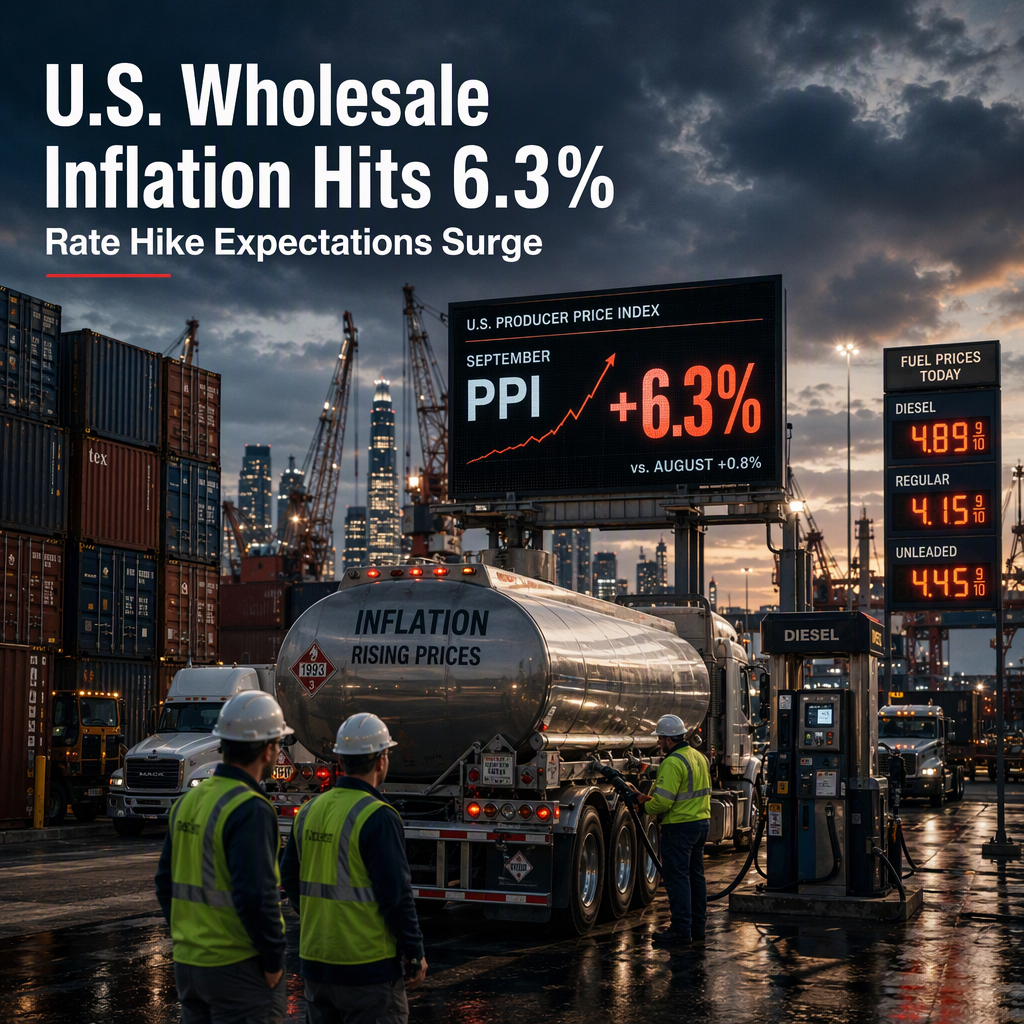
The latest U.S. wholesale inflation report revealed that businesses faced inflation at levels not seen since late 2022, with the Producer Price Index (PPI) for September rising sharply to 6.3% on an annual basis. Month-over-month, prices increased by 0.6% according to the PPI report, which is often viewed as a leading indicator for future consumer price trends [1]. This spike in wholesale prices followed a Consumer Price Index (CPI) report earlier in the week that also showed a significant jump in consumer prices, signaling that inflation is once again on the rise across the U.S. economy [1].
The report highlighted that the current wave of inflation is affecting a broad range of sectors, not just those directly impacted by energy prices. The Bureau of Labor Statistics noted that 'half of the September increase' in producer prices was attributable to rising gas costs, with additional notable increases in diesel fuel, fresh and dry vegetables, jet fuel, residential electric power, and crude petroleum [1]. Economists pointed out that diesel price hikes are particularly concerning due to their widespread impact on farming, transportation, and shipping, which can drive up costs across nearly all consumer goods [1].
Despite months of efforts by the Trump administration to curb inflation, these measures have not succeeded in significantly reducing price pressures [1]. The PPI report's key figures exceeded economists' and analysts' expectations, with 'core' PPI (excluding food and energy) rising 0.7% from August and 5% year-over-year [1]. These unexpectedly high numbers have reinforced market expectations that the Federal Reserve may raise interest rates sooner than anticipated, possibly at its October 27-28 meeting [1]. Such a move would further increase borrowing costs for consumers, who are already contending with high interest rates, as evidenced by the average 30-year fixed mortgage rate reaching 7.45% [1].
In response to the inflation data, bond yields fell sharply in early trading on Thursday. This was attributed to investors reallocating funds from interest rate-sensitive tech stocks into bonds, as tech companies have become increasingly vulnerable to rising rates due to their heavy borrowing for global data center expansion [1].
CONCLUSION
September's sharp rise in wholesale inflation has heightened concerns about persistent price pressures across the U.S. economy and increased the likelihood of a near-term Federal Reserve rate hike. The broad-based nature of the inflation and its impact on key sectors like transportation and consumer goods suggest continued challenges for both businesses and consumers. Market reactions indicate heightened sensitivity to interest rate changes, particularly among tech stocks.