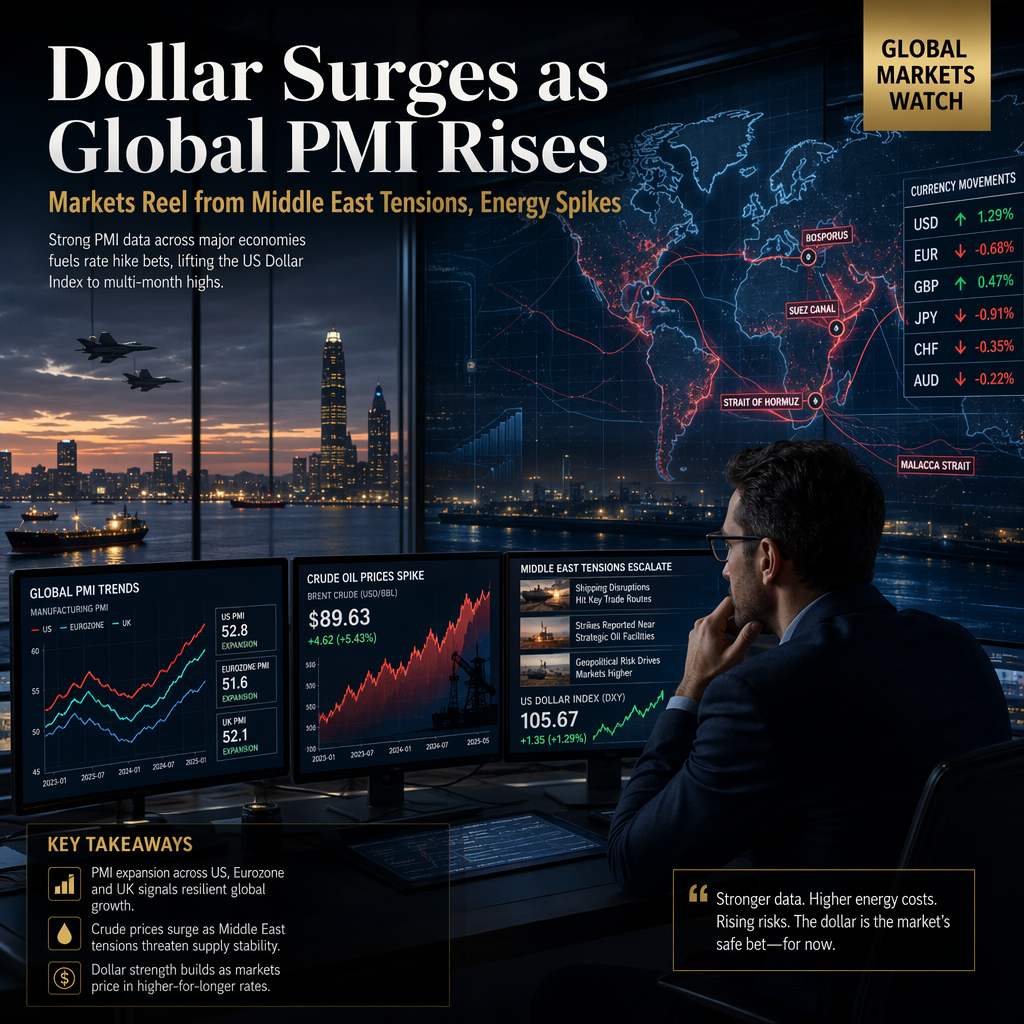
The release of preliminary S&P Global Purchasing Managers' Indices (PMIs) for July across the US, Eurozone, UK, and Japan has highlighted steady business growth and resilient economic activity, despite escalating geopolitical tensions in the Middle East. In the US, the S&P Global Services PMI is expected to decline slightly to 51.0 from 51.2 in June, while the Manufacturing PMI is forecast to rise to 54.5 from 53.9, both remaining above the expansion threshold of 50 [1]. TD Securities analysts anticipate improvements in both manufacturing and services PMIs, with manufacturing rebounding to 54.5 and services improving to 51.5 [1]. The PMI reports are scheduled for release at 13:45 GMT on Friday [1].
Eurozone and UK PMI data also exceeded expectations. Germany's Manufacturing PMI surged to 52.2 in July from 50.3, beating the consensus forecast of 50.1, and its Composite PMI returned to expansion at 51.2 [2]. Across the Eurozone, Manufacturing PMI accelerated to 52 from 51.4, and Services PMI returned to expansion at 51.6, lifting the Composite PMI to 51.9 [2]. The UK saw Retail Sales rise by 1% MoM in June, defying expectations for a 0.3% decline, while its Services PMI returned to expansion at 51.8 and Manufacturing PMI climbed to 52.8, pushing the Composite PMI to 52.1 [2]. Despite these positive releases, currency moves remained limited due to risk aversion stemming from Middle East tensions and higher energy prices [2].
Geopolitical developments have significantly impacted market sentiment. The US military completed another round of strikes against Iran, marking the 13th consecutive night of operations, while Iran and its allies retaliated against US-linked assets in Kuwait, Bahrain, and Jordan [4]. Iran-aligned Houthis extended the conflict to a second major shipping chokepoint, striking two Saudi oil tankers in the Red Sea and enforcing a naval blockade [4]. The closure of the Strait of Hormuz and these actions have exacerbated supply disruption concerns, pushing crude oil prices to fresh highs since June 11 [4]. Elevated energy prices are fueling expectations of further central bank tightening, with markets pricing in a nearly 80% probability of at least a 25 basis points Fed rate hike by September [1]. ING's Chris Turner notes that the US Dollar Index (DXY) is close to breaking above June’s 101.80 high, supported by Fed credibility and rising real USD swap rates [3].
The Japanese Yen remains near a 40-year low against the US Dollar, despite a recent Bank of Japan rate hike to 1%, the highest since 1995 [4]. The carry trade remains active due to Japan's relatively low borrowing costs, and energy supply disruptions have contributed to the Yen's underperformance [4]. US Jobless Claims fell to the lowest level since September 1969, reinforcing expectations of a resilient labor market and further Fed tightening [4]. Traders are cautious ahead of the upcoming FOMC policy meeting, but spot prices for USD/JPY are on track for strong weekly gains [4].
ECB Governing Council member Martin Kocher stated there is no hard evidence of second-round inflation effects but acknowledged oil market developments as a concern, emphasizing the ECB's vigilance [2]. ING does not expect the Fed to hike next week but warns that it is dangerous to fight the trend of dollar strength, given the current environment [3].
CONCLUSION
Global PMI data points to robust business activity in the US, Eurozone, and UK, but escalating Middle East tensions and surging energy prices are driving expectations of further central bank tightening, particularly in the US. The US Dollar remains supported by resilient economic indicators and hawkish sentiment, while the Japanese Yen continues to underperform amid carry trade dynamics. Market participants are closely watching upcoming central bank meetings and geopolitical developments for further direction.