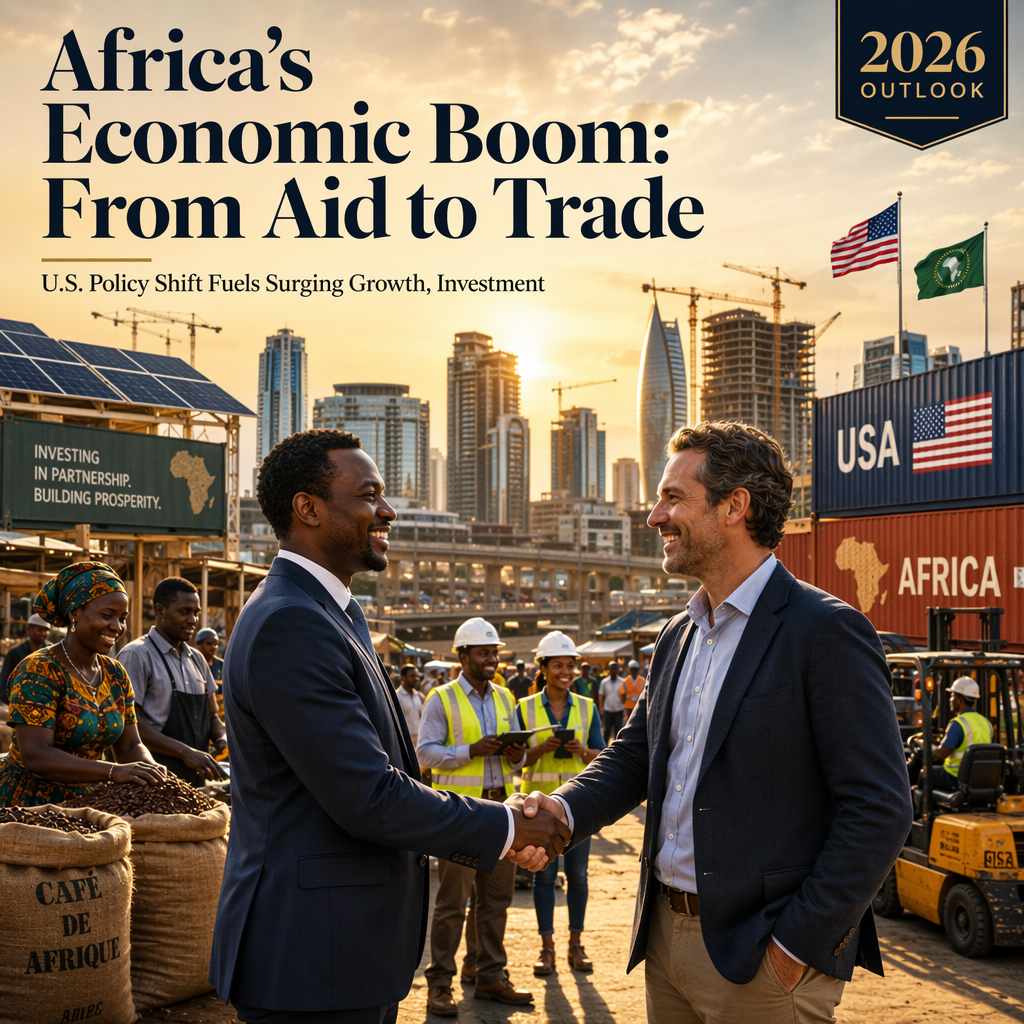
A significant acceleration in African economic growth has followed the Trump Administration's policy shift from aid to trade, according to a senior State Department official. The Commercial Diplomacy Strategy, introduced at the beginning of President Trump's second term, is credited with this transformation. Assistant Secretary for the Bureau of African Affairs Frank Garcia stated that 'nine of the 20 fastest-growing economies (in the world) are in Africa' and highlighted that U.S. exports to sub-Saharan Africa increased by 23% to $22.6 billion in 2025, with continued growth into the current year [1].
Despite initial predictions of economic collapse in countries heavily dependent on foreign donors—such as Ethiopia, South Sudan, and Malawi—after an 83% cut in USAID funding early last year, the outcome was unexpectedly positive. Anna Mahjar-Barducci, Project Director at the Middle East Media Research Institute (MEMRI), noted that the African continent proved more resilient than anticipated, with Ethiopia revising its 2026 growth forecasts upward despite the funding cuts [1].
According to International Monetary Fund (IMF) projections cited in the article, Sub-Saharan Africa is expected to grow between 4.3% and 4.6% in 2026, surpassing Asia's forecasted growth of around 4.1%. This growth is driven by large-scale investments in hydroelectric power, construction, mining, and expanding coffee exports [1].
The U.S. strategy focuses on fostering private investment and sustainable growth by treating African nations as commercial partners rather than aid recipients. U.S. embassies in Africa are working directly with the private sector to identify and address policy, legal, and regulatory barriers to trade and investment, collaborating with partner governments on practical reforms and technical assistance where needed [1].
CONCLUSION
The Trump Administration's pivot from aid to trade has coincided with robust economic growth across Africa, defying earlier predictions of collapse. With U.S. exports to sub-Saharan Africa rising sharply and IMF forecasts projecting continued outperformance, the market outlook for the region appears increasingly positive.