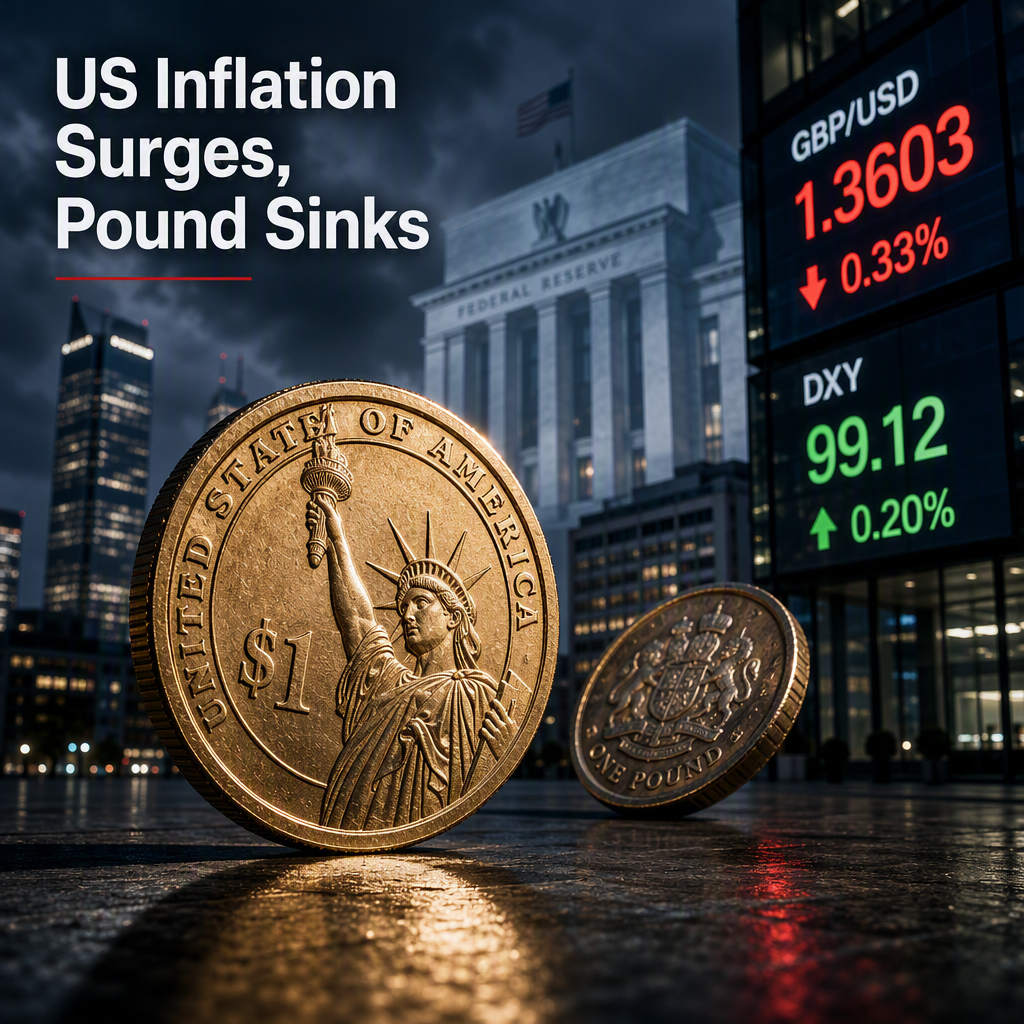
The British Pound weakened against the US Dollar, with GBP/USD falling to a five-day low of approximately 1.3603, down about 0.33% on the day, following the release of the latest US Personal Consumption Expenditures (PCE) Price Index data [1]. The headline PCE Price Index increased by 0.2% month-on-month in July, surpassing the 0.1% forecast and reversing the 0.1% decline seen in June. On a year-on-year basis, headline inflation remained steady at 3.7%, above market expectations of 3.6% [1]. The core PCE Price Index, which is the Federal Reserve’s preferred measure of underlying inflation, rose 0.2% month-on-month, matching forecasts and accelerating from June’s 0.1% rise. Annual core inflation was unchanged at 3.3%, in line with expectations [1].
The stronger-than-expected headline inflation readings contributed to a rebound in the US Dollar, with the US Dollar Index (DXY) rising to around 99.12, up 0.20% on the day [1]. This move followed recent weakness in the Dollar, which had been triggered by the US Treasury’s surprise announcement to increase buybacks of longer-dated government securities [1]. Despite the hotter headline numbers, market expectations for the Federal Reserve’s upcoming policy meeting remained largely unchanged, as traders focused on the in-line core inflation readings. The CME FedWatch Tool indicated a 65% probability that the Fed will keep interest rates unchanged at its September meeting [1].
Strategists at Scotiabank observed that the Pound is consolidating within a tight range in the mid-1.36s, with price action limited by a sparse data calendar and a period of relative silence from Bank of England policymakers in August. They noted that yield spreads have narrowed, reducing a key source of support for the Pound, while fiscal risks are expected to remain elevated ahead of the Autumn Statement scheduled for October 28 [1].
Market participants are now looking ahead to Fed Chair Kevin Warsh’s speech at the Jackson Hole Symposium on Friday for further guidance on the US interest-rate outlook [1].
CONCLUSION
The British Pound declined against the US Dollar after US headline PCE inflation exceeded forecasts, boosting the Dollar. However, market expectations for Federal Reserve policy were largely unchanged due to stable core inflation readings. Investors are now awaiting further signals from upcoming central bank communications.