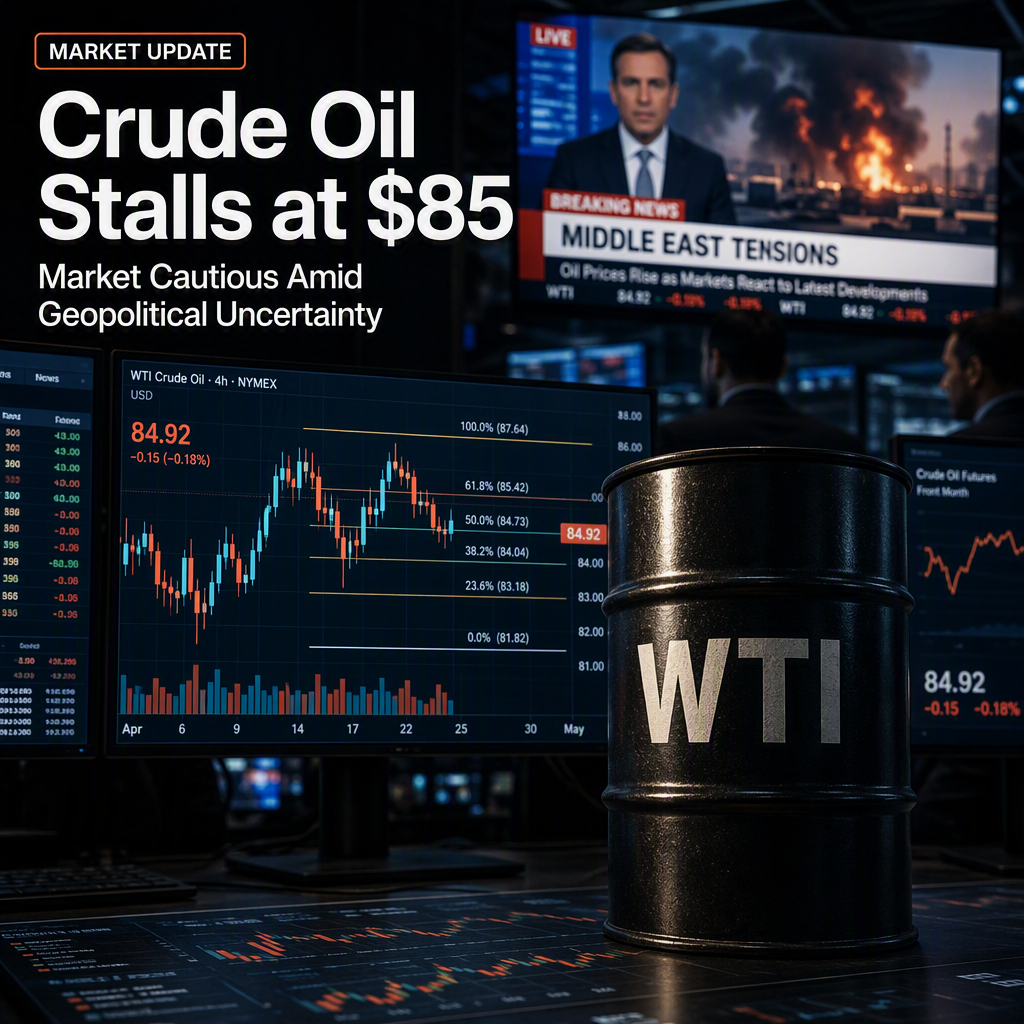
West Texas Intermediate (WTI), the benchmark US crude oil price, continued its consolidative movement for the third consecutive day, trading around $84.30 during the Asian session on Thursday [1]. Market participants appear cautious, with bulls hesitant to push prices above the key $85.00 psychological level and the 61.8% Fibonacci retracement hurdle, as they await further developments regarding the Middle East crisis before committing to an extended rally [1].
From a technical standpoint, WTI has struggled to gain acceptance above $85.00 and the 61.8% Fibonacci retracement of the July-August decline, despite maintaining a bullish near-term bias above the 200-period Exponential Moving Average (EMA) on the 4-hour chart and the 50.0% retracement level at $80.78 and $82.95, respectively [1]. The Moving Average Convergence Divergence (MACD) indicator has slipped slightly into negative territory, while the Relative Strength Index (RSI) stands at 58.97, indicating bullish but not overbought conditions. This suggests that upside momentum is moderating rather than reversing, and any corrective pullback may still be viewed as a buying opportunity, with downside likely to remain limited [1].
Immediate support is identified at the 50.0% retracement level of $82.95, with a broader demand cluster formed by the 200-period EMA at $80.78 and the 38.2% retracement at $80.73. A deeper correction could expose the 23.6% retracement at $77.98 before reaching the structural low around $73.55. On the upside, resistance is seen at the 61.8% Fibonacci retracement at $85.17, followed by a stronger barrier at the 78.6% retracement near $88.33, with the cycle high at $92.35 acting as a major cap if buyers extend the rally [1].
No specific analyst opinions or forward-looking statements beyond the technical outlook were provided in the article. The market remains focused on geopolitical developments and technical levels as key drivers for the next move in WTI prices [1].
CONCLUSION
WTI crude oil is consolidating below key resistance levels, with market participants awaiting further clarity on the Middle East situation before making decisive moves. Technical indicators suggest a moderating but still bullish bias, with limited downside expected unless key support levels are breached. The market impact is medium, as traders remain cautious and focused on both geopolitical and technical factors.