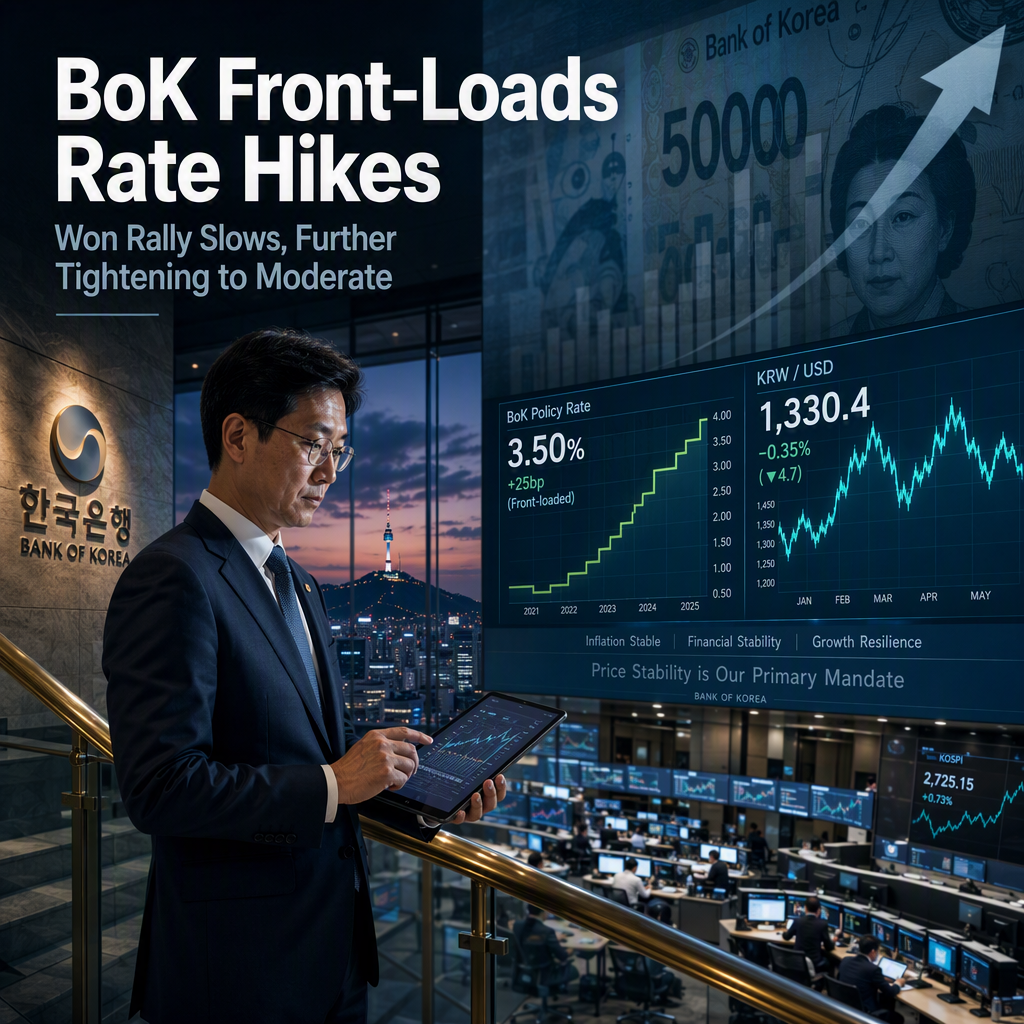
The Bank of Korea (BoK) has implemented consecutive 25 basis point interest rate hikes, bringing its policy rate to 3.0% in a move described as front-loading tightening in response to rising growth and core inflation forecasts, according to Commerzbank’s Charlie Lay [1]. This cumulative 50 basis point increase since July reflects the central bank’s proactive stance amid strong economic fundamentals and a significant current-account surplus [1].
BoK has provided forward guidance through its new six-month rate projections, with the median forecast at 3.25%. This implies the likelihood of one additional 25 basis point hike over the next six months [1]. However, the central bank is expected to pause in October and possibly November to assess the effects of the recent tightening measures before considering further action [1].
Despite a notable 12% rally in the South Korean won (KRW) against the US dollar, Commerzbank anticipates that further gains will be more gradual. The KRW is expected to consolidate in the near term, with the USD/KRW exchange rate likely to stabilize around the 1,360-1,400 range [1].
The market implication is that while the BoK maintains a tightening bias, the pace of rate hikes is set to slow, and the recent strong appreciation of the KRW is likely to moderate, leading to a period of consolidation rather than continued rapid gains [1].
CONCLUSION
The Bank of Korea’s recent front-loaded rate hikes signal a proactive approach to inflation and growth concerns, but further tightening is expected to proceed at a slower pace. The South Korean won’s strong rally is likely to consolidate, with the central bank pausing to assess the impact of its measures. Market participants should anticipate more gradual currency movements and a cautious monetary policy outlook.