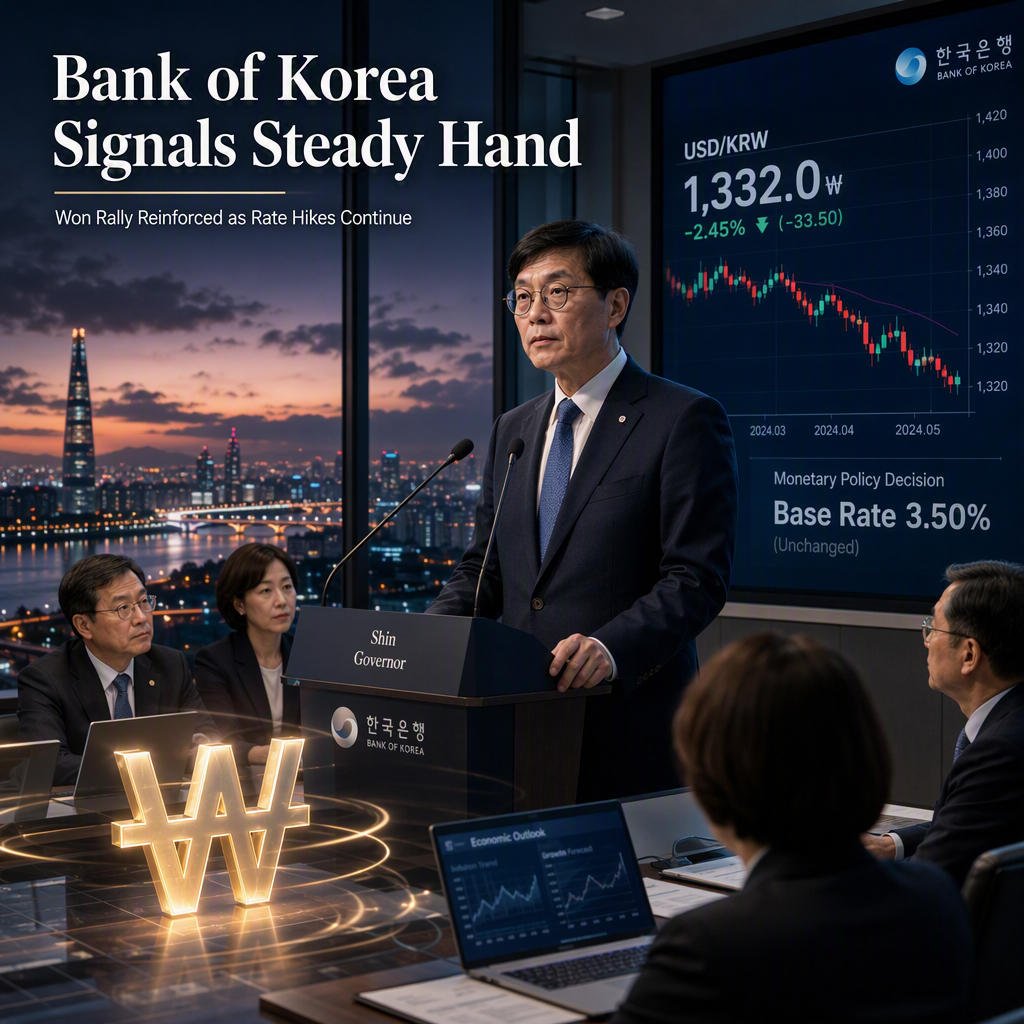
The Bank of Korea (BoK) delivered a second consecutive 25 basis point interest rate hike, raising the base rate to 3.0% and maintaining a tightening bias, according to Commerzbank’s Charlie Lay [1]. This move comes after the South Korean won (KRW) experienced a sharp appreciation since June, with the USD/KRW exchange rate falling from above 1,560 in June to around 1,378 following the decision [1]. The cumulative tightening since July totals 50 basis points, and the BoK signaled that the pace of further hikes is likely to slow [1].
Of the 21 policy 'dots,' 10 are at 3.25%, six at 3.50%, and five at 3.00%, with Governor Shin noting that the median implies one additional 25 basis point hike over the next six months [1]. Commerzbank expects the BoK to pause at the next meeting to assess the impact of the recent hikes but retains the possibility of raising the base rate to 3.25% if growth and core inflation remain firm [1].
The decision and continued tightening bias are seen as supportive for the KRW, though monetary policy is expected to play a less dominant role after the currency's recent 12% gain against the US dollar since the end of June [1]. The bank anticipates USD/KRW to consolidate in the 1,360–1,400 range in the near term [1]. Governor Shin also highlighted that, despite the recent rally, the KRW remains weak relative to historical levels and that pre-emptive tightening is helping to support currency stability [1].
Additionally, the BoK expects South Korea's current-account surplus to reach a record USD450 billion in 2026, driven by exceptionally strong semiconductor exports [1]. A large external surplus, reduced financial-account outflows, and a hawkish BoK are cited as positives for the KRW, though further appreciation is expected to be more gradual given the magnitude of the recent move [1].
CONCLUSION
The Bank of Korea's continued tightening stance has supported the won's sharp appreciation, though further gains are expected to be more gradual. Market participants anticipate a near-term pause in rate hikes, with the possibility of additional tightening if economic conditions warrant. The outlook for the KRW remains constructive, underpinned by strong external balances and a proactive central bank.