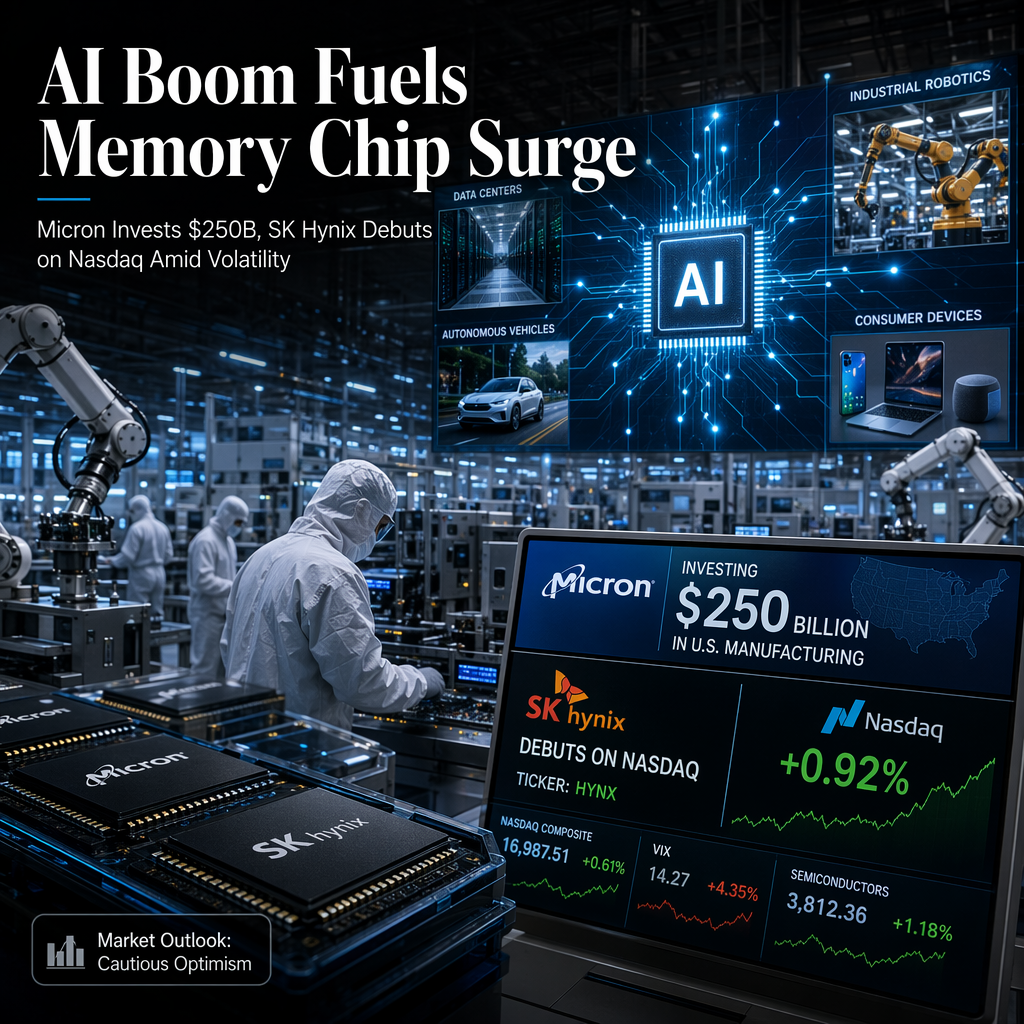
Micron Technology announced a $250 billion investment in the United States to address what CEO Sanjay Mehrotra described as 'unprecedented' demand for memory storage driven by artificial intelligence (AI) applications [1]. The company aims to produce 40% of its DRAM chips domestically and is expanding its manufacturing footprint with a new site in central New York, in addition to existing facilities in Idaho and Virginia [1]. Mehrotra emphasized that memory is in deep shortage and is a critical enabler for AI, with data centers accounting for more than 50% of current demand [1]. He also highlighted that the need for memory extends to consumer devices, automotive, industrial, defense, and aerospace sectors, noting that advanced technologies such as robotics and self-driving cars will further increase demand [1]. Micron expects its initiative to create thousands of jobs and strengthen America's semiconductor manufacturing base, but Mehrotra cautioned that supply is struggling to keep pace with surging demand [1].
Meanwhile, SK Hynix, another major player in the memory chip industry, is set to begin trading on the Nasdaq through American depositary receipts (ADRs), offering U.S. investors direct access to the South Korean company [2]. The $26.5 billion offering is expected to be one of the largest ever, and SK Hynix's shares have surged approximately 2,550% since the launch of ChatGPT in November 2022, pushing its market value above $1 trillion [2]. Despite this rally, Jim Cramer noted that SK Hynix trades at just over seven times this year's earnings, suggesting the stock remains inexpensive relative to its growth [2]. Cramer described the memory chip business as 'on fire' due to AI-driven demand but warned of the sector's historical volatility, with memory stocks often experiencing boom and bust cycles [2].
Recent market activity reflects this volatility, as SK Hynix shares have fallen about 25% from their June 25 peak, mirroring a broader sell-off in memory stocks that has also affected Samsung and Micron, despite strong earnings reports [2]. Cramer advised investors to approach SK Hynix with caution, suggesting small initial positions and readiness to buy more if prices weaken [2]. He stressed that the long-term outlook depends on whether AI has fundamentally altered the cyclical nature of the memory chip industry, a question that remains unresolved [2].
Both articles underscore the transformative impact of AI on memory demand, with Micron and SK Hynix making significant moves to capitalize on the trend. However, while Micron's CEO projects continued growth and investment, Cramer highlights the risks of potential market corrections as supply eventually catches up with demand [1][2].
CONCLUSION
The AI-driven surge in memory demand is prompting major investments and market activity from industry leaders like Micron and SK Hynix. While the outlook appears strong, both sources acknowledge the sector's historical volatility and the risk that supply could eventually outpace demand. Investors are advised to remain cautious amid the current boom.