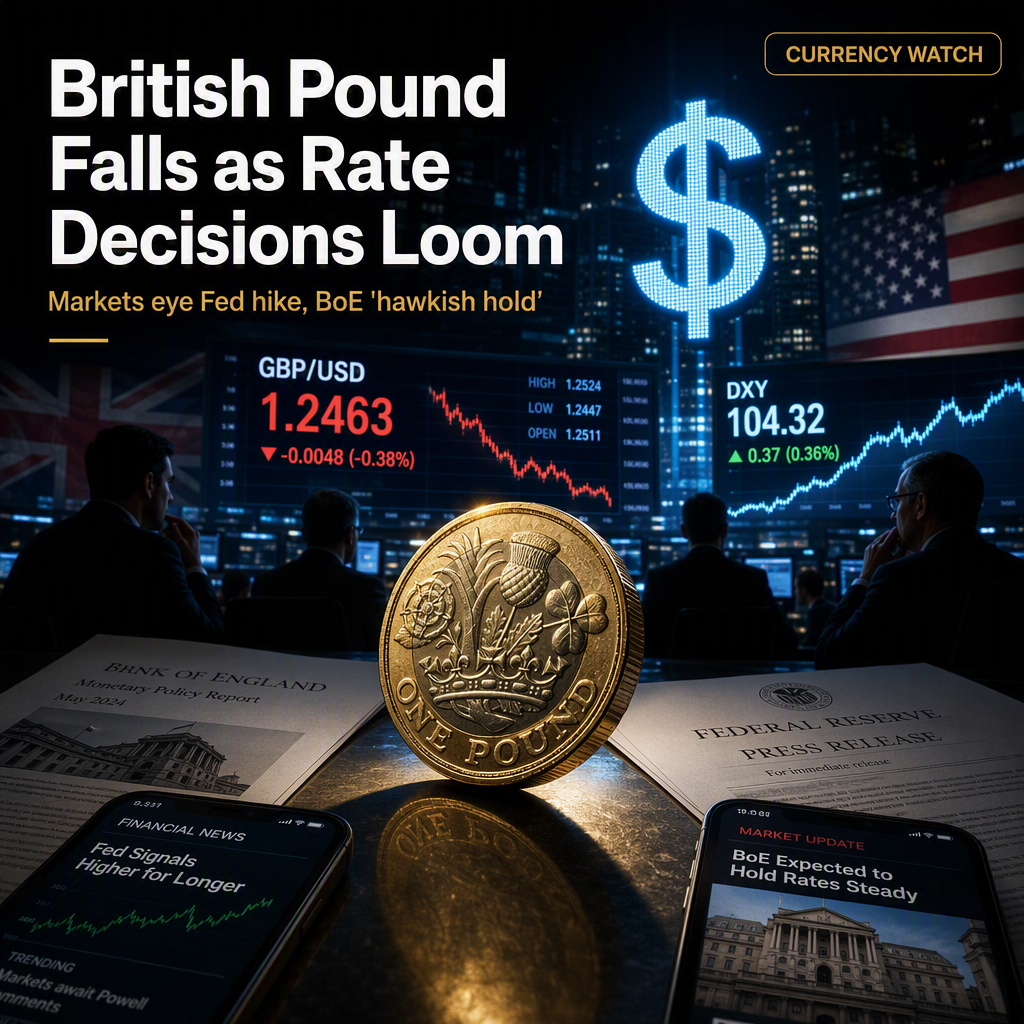
The British Pound (GBP) extended its decline against the US Dollar (USD) on Monday, with GBP/USD trading around 1.3470, down 0.38% on the day and near the lower end of its monthly range [1]. This weakness is attributed to renewed demand for the US Dollar ahead of major monetary policy decisions from both the US Federal Reserve (Fed) and the Bank of England (BoE) [1][3]. The US Dollar outperformed its major peers, with the US Dollar Index (DXY) rising 0.55% on the day to 99.63, its highest level since September 2 [2]. Against the Pound, the USD gained 0.85% on the day [2].
Investor focus is on the Fed's interest rate decision due Wednesday, with markets pricing in an 88% (according to [1]) or 86% (according to [2]) probability of a 25-basis-point rate hike, following stronger-than-expected US inflation data. The Fed's guidance, particularly from Chair Kevin Warsh's press conference, is expected to influence the USD's trajectory, with any indication of further rate increases likely to keep GBP/USD under pressure [1][2].
On the UK side, the BoE is set to announce its monetary policy decision on Thursday. Most economists expect the BoE to keep its policy rate unchanged at 3.75% [1]. BoE Governor Andrew Bailey has emphasized that any future rate hikes will depend on economic and geopolitical developments, rather than being automatic [1]. Scotiabank strategists expect a 'hawkish hold' from the BoE, with markets leaning toward a possible 25-basis-point hike at the next meeting in November [3]. The GBP remains supported by relatively strong UK economic data, including a 0.4% GDP expansion in July and better-than-expected industrial production and services activity [1].
Despite the GBP's softness, it is still outperforming most G10 currencies in a risk-off environment, supported by a clear uptrend in UK-US yield spreads since early July [3]. Technical analysis points to support for GBP/USD around 1.3450–1.3420 and resistance above 1.3550 [1][3]. The upcoming UK data releases—jobs on Tuesday, CPI on Wednesday, and retail sales on Friday—are seen as important for the Pound's near-term direction [3]. Political developments, such as potential higher taxes on banks and the fall budget scheduled for October 28, are noted but have had limited immediate impact [3].
CONCLUSION
The British Pound has weakened against the US Dollar as markets await key monetary policy decisions from the Fed and BoE, with expectations of a Fed rate hike and a BoE 'hawkish hold' dominating sentiment. While UK economic data remains supportive, the GBP's near-term direction will be shaped by central bank guidance and upcoming domestic data releases. Market participants are closely monitoring these events for further cues on the Pound's trajectory.