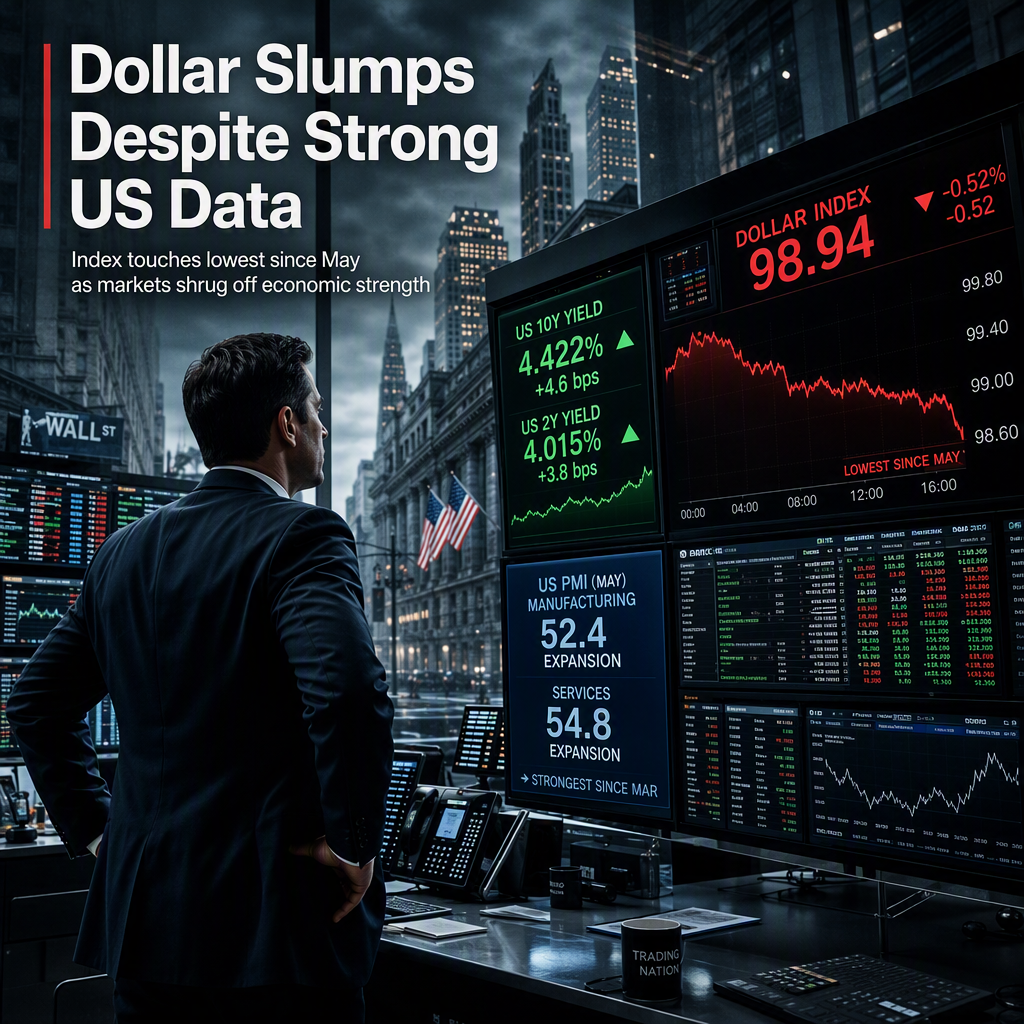
The Dollar Index traded just beneath 99.00, remaining unchanged on the session and marking its weakest level since May. The trading range for the day was confined to 35 pips between the 98.50 area and a high just short of the 99.00 handle, reflecting subdued activity despite notable developments in US bond yields and economic data [1]. US long-end yields rose this week, with the thirty-year Treasury yield climbing back above 5.25% and the ten-year above 4.70%. However, the Dollar Index failed to recover, even as yields reversed a previous decline engineered by the Treasury's liquidity-support buybacks, which doubled from $2 billion to at least $4 billion per operation and initially knocked nine basis points off the thirty-year yield, causing the Dollar Index to drop nearly a point in a single session [1].
The market's reaction to rate expectations was also muted. Futures put the odds of a September rate hike near a third, down from a peak above 80% in late July. The Dollar Index continued to lose ground throughout this repricing, indicating that rate expectations and yield levels are no longer the primary drivers of the currency's performance [1].
On the economic front, the preliminary August composite Purchasing Managers Index (PMI) printed at 56, up from 54.5 prior, marking the strongest reading since April 2022. The services PMI came in at 56.8 against a 54 consensus, representing the sharpest expansion in that sector since December 2024. Manufacturing missed expectations at 53.2 versus 53.9, with goods output at a 13-month low, but services, which account for roughly three quarters of the economy, delivered a significant domestic growth surprise. Despite this, the Dollar Index only briefly touched the 99.00 handle and failed to sustain gains, suggesting that even robust economic activity is not enough to support the currency in the current environment [1].
The article concludes that the Dollar is no longer trading on its own economic fundamentals or policy path, but rather on who is willing to fund it and at what price, as everything that is not the Dollar is being bid [1].
CONCLUSION
Despite rising US yields and strong PMI data, the Dollar Index remains at its weakest since May, failing to respond to traditional drivers such as rate expectations and domestic growth. The market appears to be pricing the Dollar based on risk premiums and funding willingness rather than economic fundamentals. This signals a shift in market dynamics, with the Dollar losing its bid even amid positive US data.