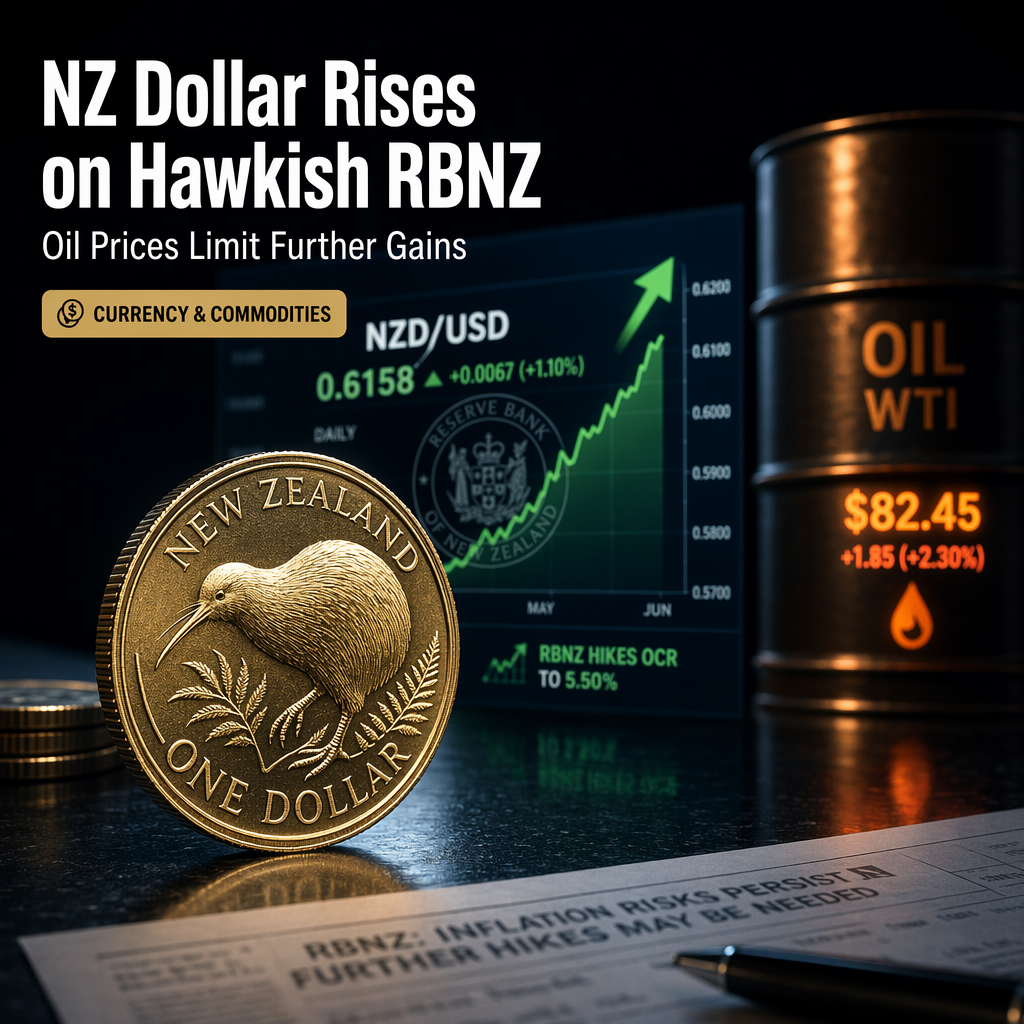
The New Zealand Dollar (NZD) experienced a strengthening following a hawkish rate hike by the Reserve Bank of New Zealand (RBNZ), according to Christopher Wong of OCBC. The RBNZ raised the Official Cash Rate by 25 basis points to 2.50%, marking its first rate hike since May 2023. The central bank's forward guidance was described as hawkish but data-dependent, with officials indicating that further rate increases may be necessary to bring inflation back to target levels [1].
Despite the positive impact of the RBNZ's tightening cycle, the NZD's gains have been limited by renewed terms-of-trade headwinds stemming from higher oil prices. Wong notes that elevated fuel costs are currently a drag on the economy, but domestic data suggest a rebound in GDP growth is expected in the second half of 2026 as these costs fade and both business and consumer confidence recover [1].
The analysis also highlights that, with the RBNZ beginning a tightening cycle while the Reserve Bank of Australia (RBA) appears closer to ending its own, relative rate dynamics suggest the AUD/NZD currency pair is nearing a peak. However, Wong cautions that a more sustained decline in AUD/NZD would require clearer evidence of stronger New Zealand growth momentum and a more favorable energy backdrop, which would particularly benefit the energy-importing NZD. Additionally, any disruption to energy flows through the Strait of Hormuz could further increase energy prices and potentially derail New Zealand's economic recovery [1].
CONCLUSION
The RBNZ's hawkish rate hike has provided some support for the New Zealand Dollar, but higher oil prices are constraining further gains. Market participants are watching for stronger domestic growth and a more favorable energy environment to drive a more sustained NZD rally.