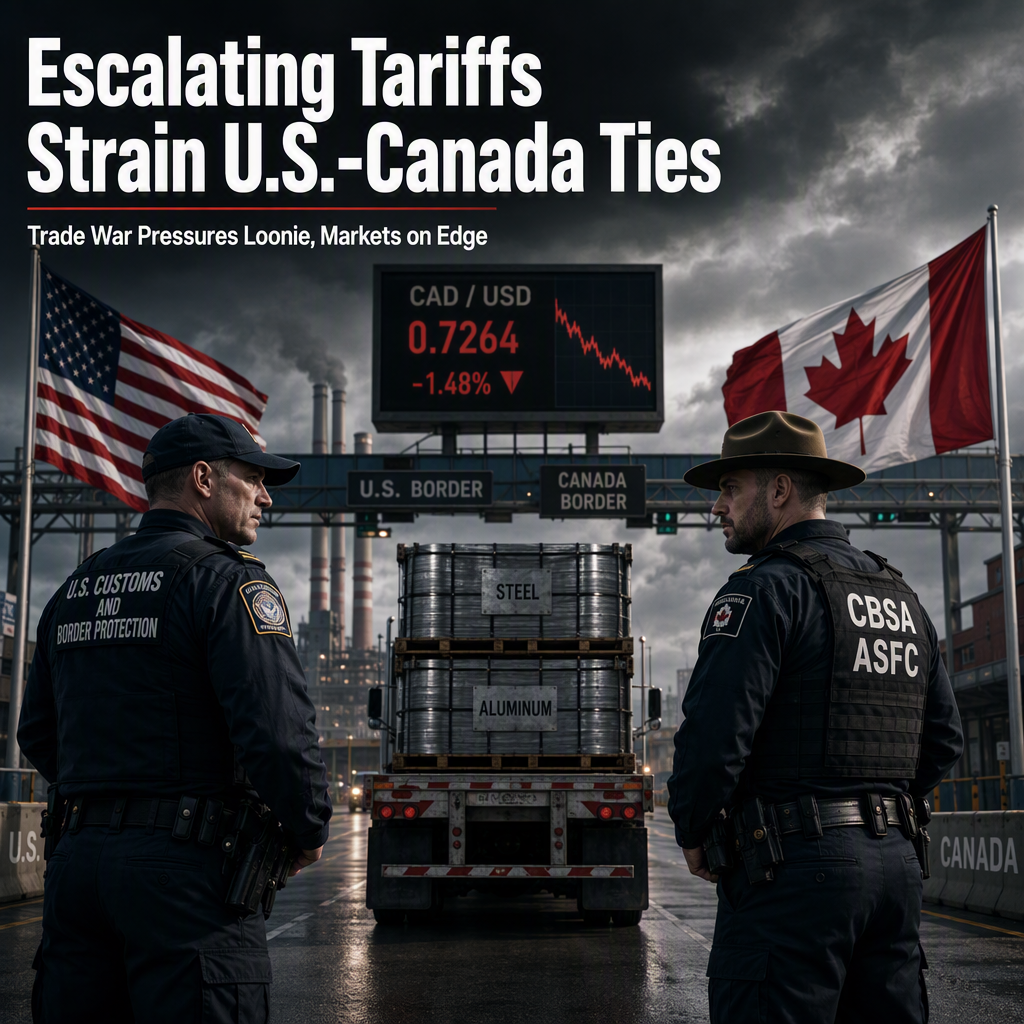
The trade relationship between the United States and Canada has sharply deteriorated following the collapse of recent trade talks, according to BNY’s Geoff Yu. Washington is now considering further trade penalties against Canada after Ottawa announced a dollar-for-dollar retaliation to new U.S. tariffs, significantly raising the risk of a broader bilateral trade conflict [1].
Canada has responded by doubling its counter-tariffs on U.S. steel and aluminum to 50% and imposing new 50% duties on a range of U.S. goods, including dairy, furniture, clothing, and electronics. These measures are expected to impact approximately USD 20 billion of annual U.S. exports [1]. In response, the U.S. is weighing higher tariffs and other measures, having already threatened to impose 50% tariffs on Canadian autos starting in January [1].
The escalation of tariffs is exerting pressure on the Canadian Dollar and could create domestic political challenges in U.S. manufacturing states that are heavily exposed to Canadian retaliation [1]. The ongoing dispute marks a significant downturn in bilateral relations and introduces heightened uncertainty for both economies [1].
CONCLUSION
The intensifying trade dispute between the U.S. and Canada, marked by escalating tariffs and retaliatory measures, is placing significant pressure on the Canadian Dollar and increasing risks for both economies. Market participants are likely to remain cautious as the situation develops and further trade penalties are considered.