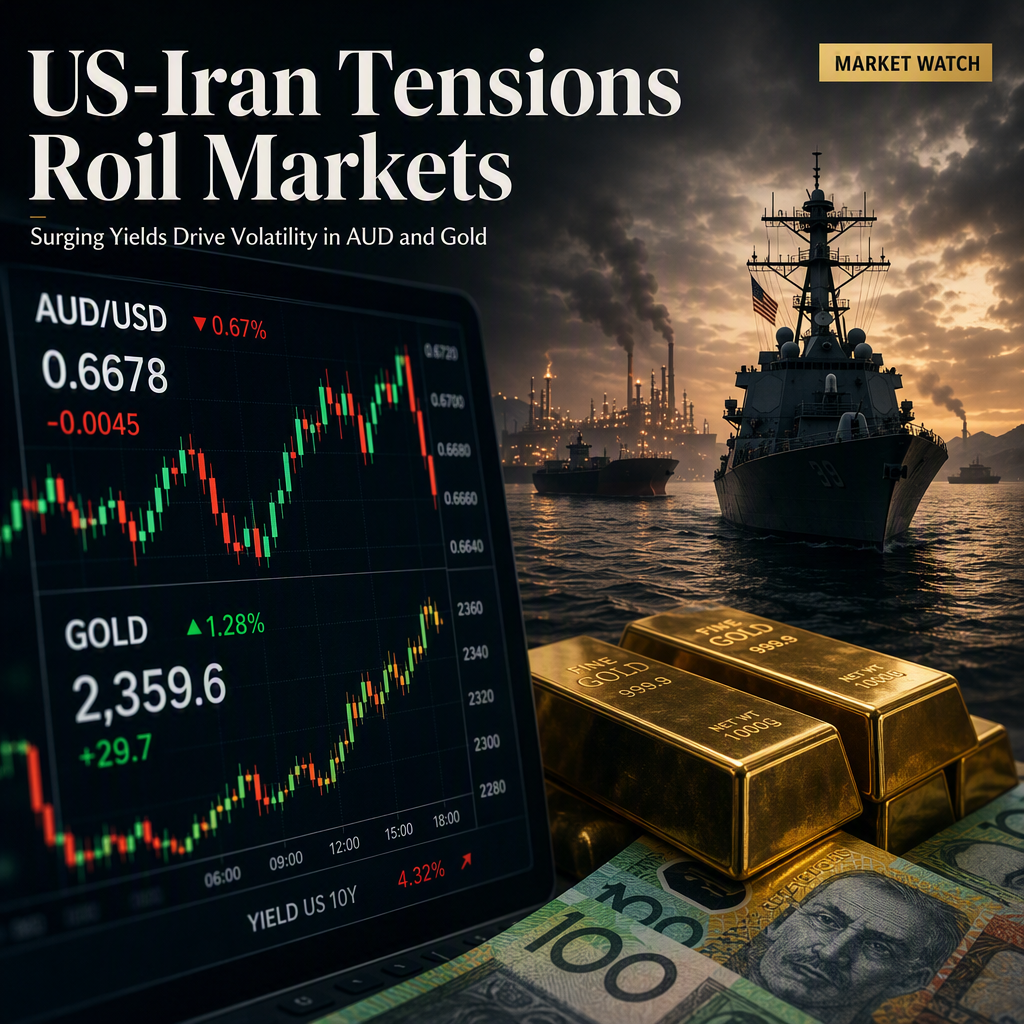
Geopolitical tensions between the US and Iran have heightened market uncertainty, impacting both currency and commodity markets. The Australian Dollar (AUD) reversed its gains against the US Dollar (USD), trading at 0.7080 after reaching a high of 0.7119, as investors reacted to the risk of escalating conflict in the Middle East and its potential to push energy prices higher. This environment has increased expectations that major central banks may need to tighten monetary policy, further supporting the USD [1]. US President Donald Trump confirmed that no talks are underway or scheduled with Iran, and the US Navy blockade remains active, according to CNN reports cited in both articles [1][2]. MarineTraffic data indicated that commercial vessel traffic through the Strait of Hormuz and Bab al-Mandeb remains depressed, adding to concerns about energy supply disruptions [2].
US economic data released on Tuesday was mixed, with Housing Starts falling 12.4% month-over-month from 1.415 million in June to 1.239 million in July, attributed to high prices and elevated mortgage rates. Industrial Production also slowed, rising only 0.2% month-over-month versus the expected 0.3% [1]. In Australia, Moody’s affirmed the country’s Aaa credit rating with a stable outlook, projecting real GDP growth of 1.9% for this year and 1.6% for 2027, but highlighted challenges such as weak productivity, housing affordability, higher debt, and exposure to external shocks [1].
In the gold market, XAU/USD held steady near $4,335 after pulling back from an early-June top near $4,450. The precious metal faced selling pressure as long-term borrowing costs in the US, Japan, and Germany surged to their highest levels in decades, with US 30-year bond yields reaching their highest since 2007. Rising yields undermine non-yielding gold, while ongoing US-Iran tensions and uncertainty around the Strait of Hormuz have pushed energy prices higher, stoking inflation concerns and weighing on bullion [2]. Peter Grant, vice president and senior metals strategist at Zaner Metals, noted that the steepening yield curve and firmer oil prices are key factors behind gold's weakness [2].
Despite these headwinds, softer US inflation data has led investors to scale back expectations for a Federal Reserve rate hike, with markets now pricing in a near-65% chance of a hold in September. This could potentially weaken the USD and support gold prices. BNY strategists observed that investors are increasingly favoring gold as a direct hedge against rising price pressures, but warned that sharply higher yields could limit gold's near-term upside unless monetary policy becomes more dovish than expected [2].
Technical analysis for AUD/USD shows the pair maintaining a mildly bullish near-term bias above the 50-day simple moving average, with immediate support at 0.7081 and resistance at 0.7307. For gold, the near-term bias remains bearish as the price stays below the 100-day simple moving average, though a corrective bounce is suggested by its position above the 20-day Bollinger middle band [1][2].
CONCLUSION
Escalating US-Iran tensions and surging global yields have created significant volatility in both the AUD/USD and gold markets. While the Australian Dollar reversed gains and gold faced selling pressure, softer US inflation data has tempered expectations for further Fed rate hikes, providing some support to risk assets. The market remains highly sensitive to geopolitical developments and central bank policy signals.