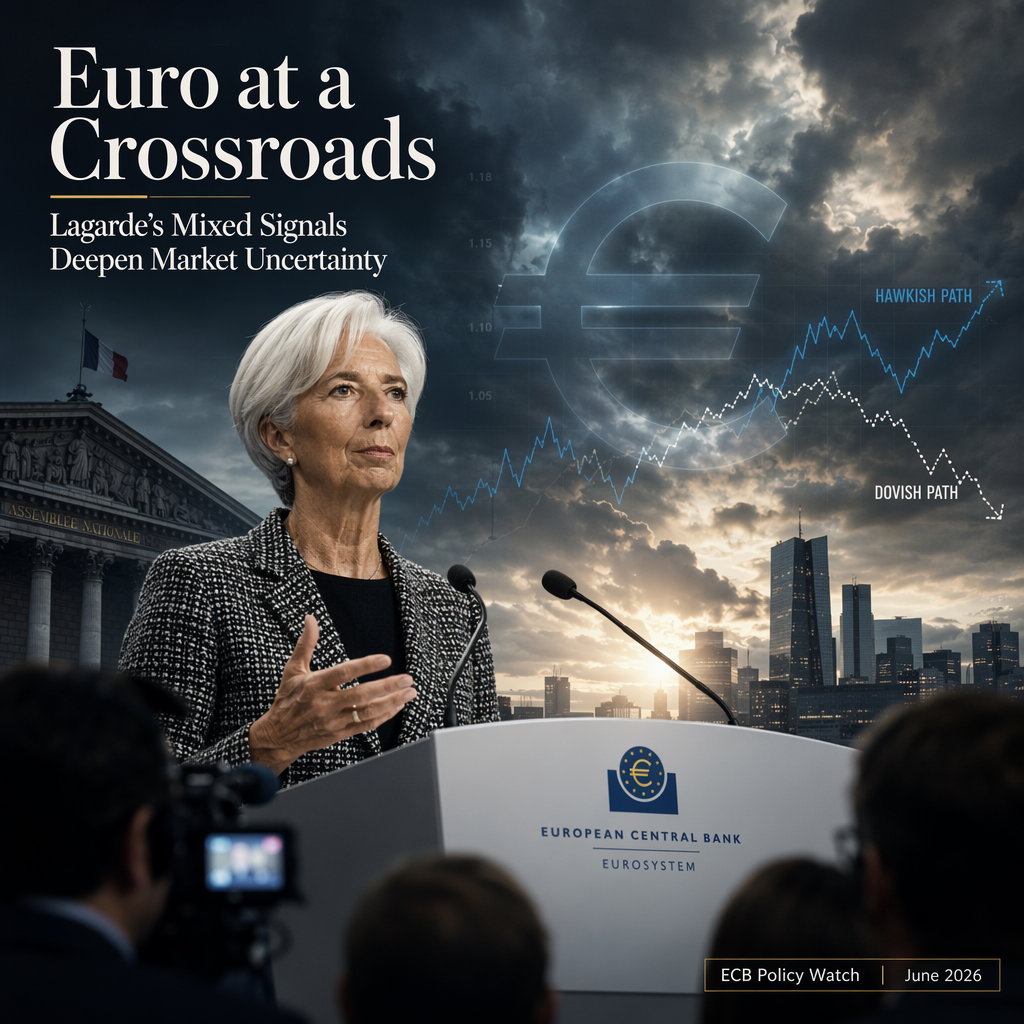
Recent commentary from European Central Bank (ECB) President Christine Lagarde has generated mixed signals regarding the future direction of Eurozone monetary policy and the Euro (EUR). According to HSBC, dovish remarks from Lagarde on June 22, combined with falling oil prices following the reopening of the Strait of Hormuz, have led the bank's economists to expect the ECB to hold rates through 2026, abandoning previous expectations for two additional hikes. HSBC anticipates that EUR/USD will drift lower in the coming months, citing persistent regional growth concerns and rising French political risks ahead of the April 2027 presidential election. The bank warns that any perceived weakening in fiscal discipline or reform momentum could increase risk premia, slow capital inflows, and further pressure the Euro. HSBC also notes that both the EUR and GBP are likely to face headwinds from political uncertainty and growth risks, with Lagarde's dovish tone and lower oil prices supporting the case for an ECB rates hold [1].
However, in a speech at the ECB Forum on Central Banking 2026, Lagarde adopted a more hawkish stance, warning that the Eurozone is likely to face more frequent shocks in the coming years that could push inflation away from the ECB’s target. She emphasized that the resilience Europe has built means the effects of rate hikes on the economy are more contained, allowing the ECB to raise rates to address inflation without fear of causing financial stress. The FXS Speechtracker assigned Lagarde's speech a 7.3/10 score, indicating a clear hawkish tilt compared to her historic 5.6/10 baseline. This suggests a stronger conviction on the need to confront inflation risks and reinforces a bias toward keeping policy tight and being ready to re-hike if price pressures reemerge. This hawkish interpretation is likely to underpin Euro demand as markets reassess the ceiling for future ECB tightening [2].
The two sources present a notable discrepancy: HSBC interprets Lagarde's recent comments as dovish and expects a prolonged rates hold, while the ECB Forum speech is characterized as hawkish, with Lagarde expressing readiness to raise rates if inflation risks intensify. Both sources agree that political and growth risks, particularly in France, remain significant factors for the Euro's outlook [1][2].
CONCLUSION
Conflicting signals from ECB President Lagarde have left markets uncertain about the Euro's trajectory, with HSBC expecting a rates hold and downside for the EUR, while Lagarde's recent speech suggests readiness to tighten policy if inflation risks rise. Political and growth risks, especially in France, continue to weigh on sentiment. The market impact is medium as investors weigh these opposing signals and reassess the Euro's prospects.