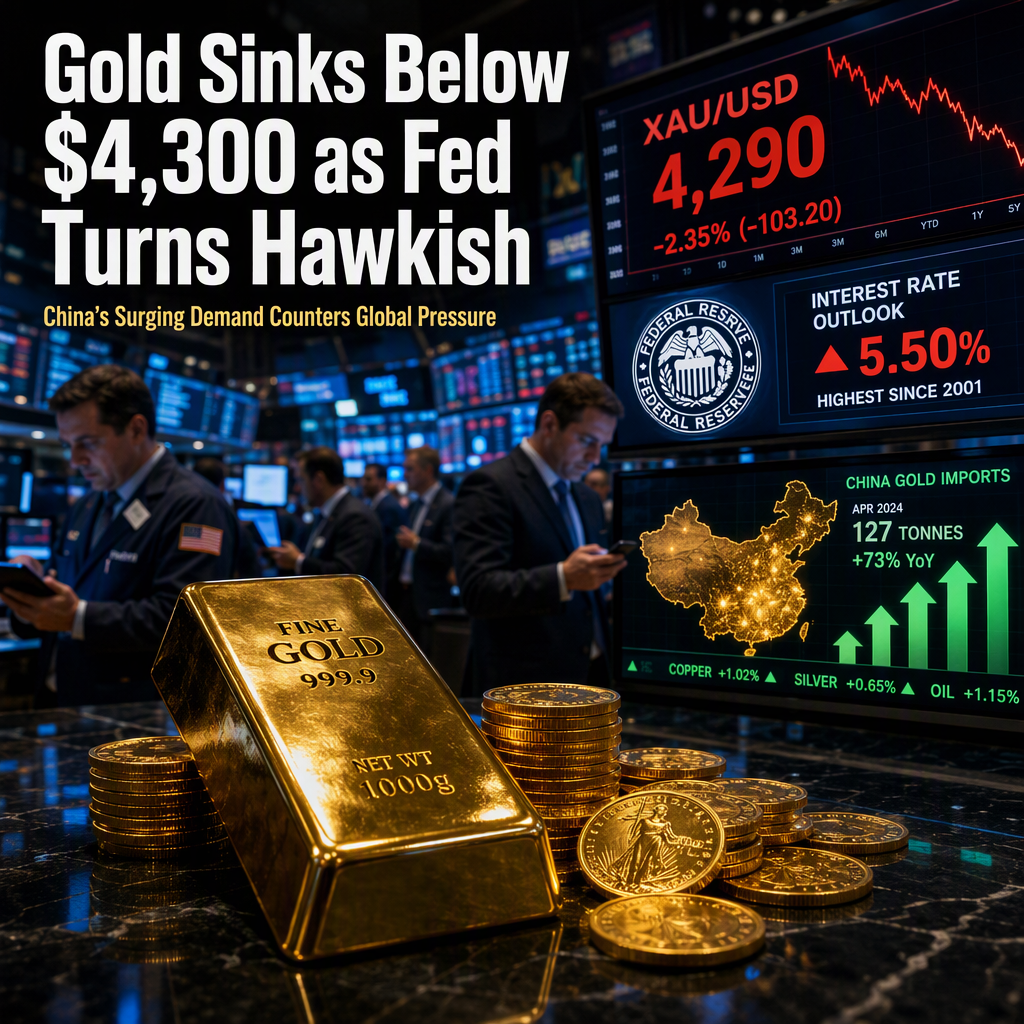
Gold prices (XAU/USD) fell to near $4,290 during the early Asian session on Thursday, pressured by hawkish signals from Federal Reserve policymakers that increased expectations for further interest rate hikes in the United States [1]. Fed Governor Michael Barr stated on Wednesday that 'further policy adjustments are likely to be needed' to control inflation, while Richmond Fed President Tom Barkin and Boston Fed President Susan Collins both supported the recent rate increase, citing ongoing inflationary pressures [1].
Following these developments, the probability of a quarter percentage point rate hike by the US central bank in October rose to approximately 69.7%, up from 48.7% a week earlier, according to the CME FedWatch tool [1]. Higher interest rates typically weigh on gold, as the non-yielding asset becomes less attractive compared to yield-bearing alternatives [1]. Peter Grant, vice president and senior metals strategist at Zaner Metals, commented, 'Post-FOMC Fed speak has been fairly hawkish. So the market is building in expectations of at least one more rate hike before the end of the year. And that's putting gold under pressure' [1].
Despite the global pressure on gold prices, demand in China has surged. Analysts at ING reported that Chinese gold imports rose 39.3% year-on-year to 141.7 tonnes in August, bringing year-to-date imports to a record 1,141.2 tonnes, up 72.2% [1]. This increase is attributed to lower gold prices, a stronger yuan, and persistent domestic price premiums, as well as banks utilizing remaining import quotas under the licensing regime introduced by the People's Bank of China in June [1]. Additionally, Chinese gold ETFs added around 44 tonnes through August, an 18% increase from the start of the year, while global ETF holdings remained broadly unchanged, highlighting the China-focused nature of the recent demand [1].
Fed's Barr maintained a distinctly hawkish tone, with the FXS Speechtracker score at 8/10, above the 7/10 historical average, indicating a stronger-than-usual tightening bias. Barr emphasized that 'further rate hikes likely needed to ensure timely return to 2% inflation,' and noted that inflation risks have increased while labor market risks have receded, reinforcing the Fed's preference for additional policy tightening [1].
CONCLUSION
Gold prices have come under significant pressure due to hawkish signals from the Federal Reserve, which have raised expectations for further US rate hikes. However, robust demand from China, both in physical imports and ETF inflows, has provided a counterbalance to the global weakness. The market remains focused on upcoming Fed communications for further direction.