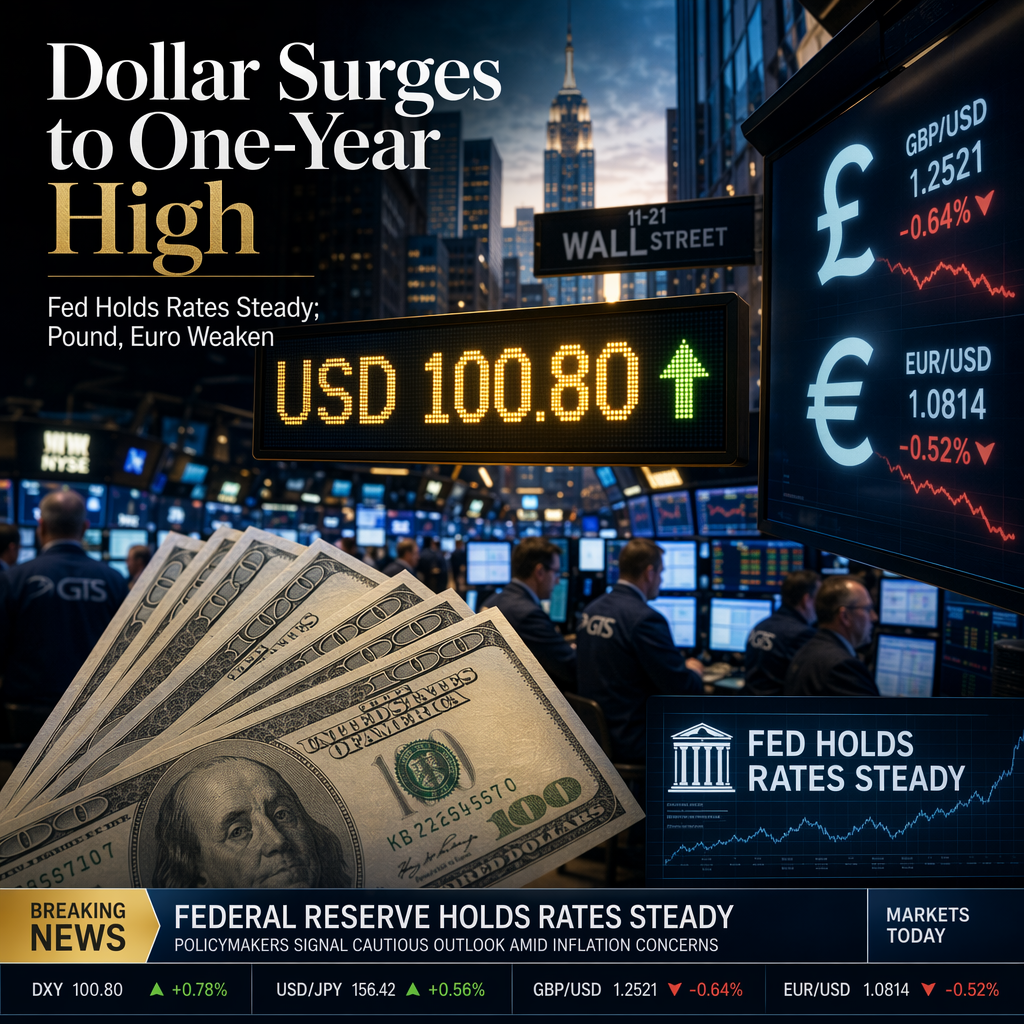
The US Dollar Index (DXY) surged to 100.80 on Thursday, marking its highest level since May 2025, following the Federal Reserve's decision to keep interest rates unchanged in the 3.50%-3.75% range during Kevin Warsh’s first policy meeting as Fed Chair on Wednesday [1]. The Fed also removed its previous reference to 'additional rate adjustments,' signaling a more cautious and data-dependent approach going forward [1].
Labor market data showed that Initial Jobless Claims fell by 4,000 to 226,000 for the week ending June 13, aligning closely with market expectations of 225,000 and indicating limited layoffs. However, Continuing Jobless Claims rose to 1.81 million, suggesting some softness among those already receiving unemployment benefits [1].
Currency market movements reflected the US Dollar's strength, with the USD gaining 0.65% against the British Pound, 0.34% against the Euro, and 0.42% against the Japanese Yen. The British Pound was notably weaker, trading near a two-month low at 1.3210 against the USD after the Bank of England (BoE) left its interest rate unchanged at 3.75% in a 7-2 vote. While most BoE policymakers favored patience due to uncertainty over inflation and energy prices, two members supported raising the rate to 4.00%, highlighting ongoing inflation concerns [1].
The Euro remained under pressure near 1.1460, with European Central Bank (ECB) officials expressing caution about energy price uncertainty, inflation transmission, and potential second-round effects on wages [1]. Meanwhile, USD/JPY traded firmly in intervention territory at 161.40, a level not seen since July 2024, benefiting from renewed demand for the US Dollar [1].
CONCLUSION
The US Dollar's rally to a one-year high reflects market confidence following the Fed's steady rate decision and cautious outlook. The British Pound and Euro weakened amid central bank policy holds and ongoing inflation uncertainties. Overall, the market reaction underscores the USD's dominance and persistent concerns about inflation and energy prices in other major economies.