
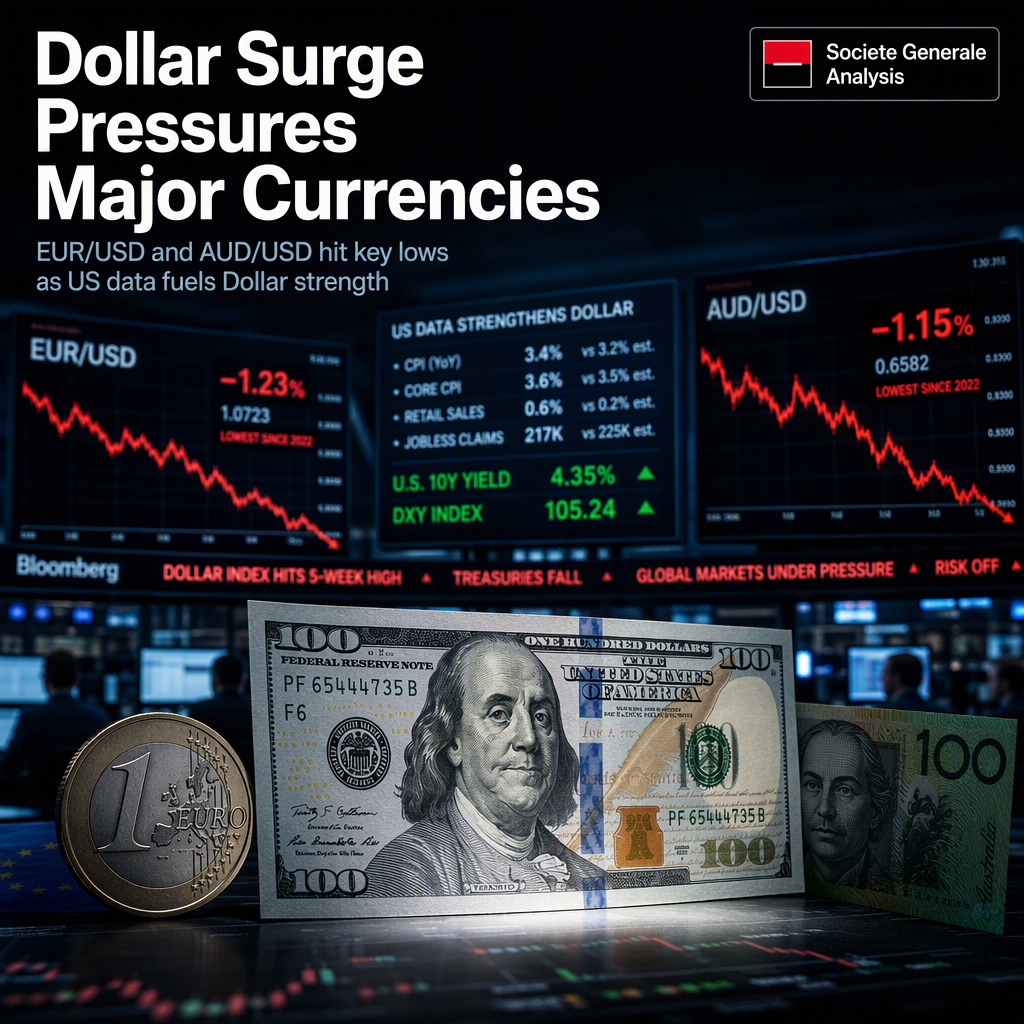
Societe Generale analysts report that persistent US Dollar strength is prompting repeated downward revisions to EUR/USD forecasts. At the start of the year, consensus expected EUR/USD to reach 1.20, but this has shifted to 1.16, with Societe Generale now projecting 1.15. Market sentiment appears even more Dollar-bullish than these forecasts, driven by elevated oil and commodity prices, robust US economic data, and a risk-averse global environment. Higher inflation and resilient real-economy data could push the Dollar Index to a near-2026 high, just 0.7% away, or EUR/USD to a new low, only 0.5% away [1][2].
While the longer-term outlook for the Dollar is deteriorating due to US political uncertainties and changing global savings patterns, the short-term picture remains constructive. Societe Generale notes that energy importers, such as the euro and yen, are under pressure, and the US economy shows few signs of a meaningful slowdown. The US data calendar includes JOLTS, ADP employment, personal income and spending, trade, ISM surveys, and labor market data. There is a possibility that the August core PCE deflator will come in higher at 3.4%, amid stronger inflation prints elsewhere. These factors could further propel the Dollar Index and drive EUR/USD to fresh lows [2].
In the context of Dollar strength, AUD/USD is also testing key support levels. Societe Generale’s Kenneth Broux highlights AUD/USD trading near its 200-day moving average at 0.7024, a historically important support. The pair is at the lower boundary of a descending channel with support at 0.6975 and resistance at 0.7090. Failure to hold above 0.6975 could deepen the pullback towards 0.6920 and the June lows near 0.6860. With an RBA rate hike expected and October seasonally weaker for the Australian Dollar, a deeper retracement is possible [3].
Analyst opinions from Societe Generale suggest that while structural headwinds may weaken the Dollar in the longer term, immediate market conditions favor continued Dollar strength, with both EUR/USD and AUD/USD at risk of further declines if US data and inflation remain robust [1][2][3].
CONCLUSION
Persistent US Dollar strength, supported by robust economic data and higher inflation, is driving EUR/USD and AUD/USD toward key lows. Societe Generale analysts highlight immediate downside risks for both pairs, with market sentiment notably Dollar-bullish. While longer-term Dollar headwinds exist, the short-term outlook remains positive for the Dollar, suggesting continued pressure on major currency pairs.