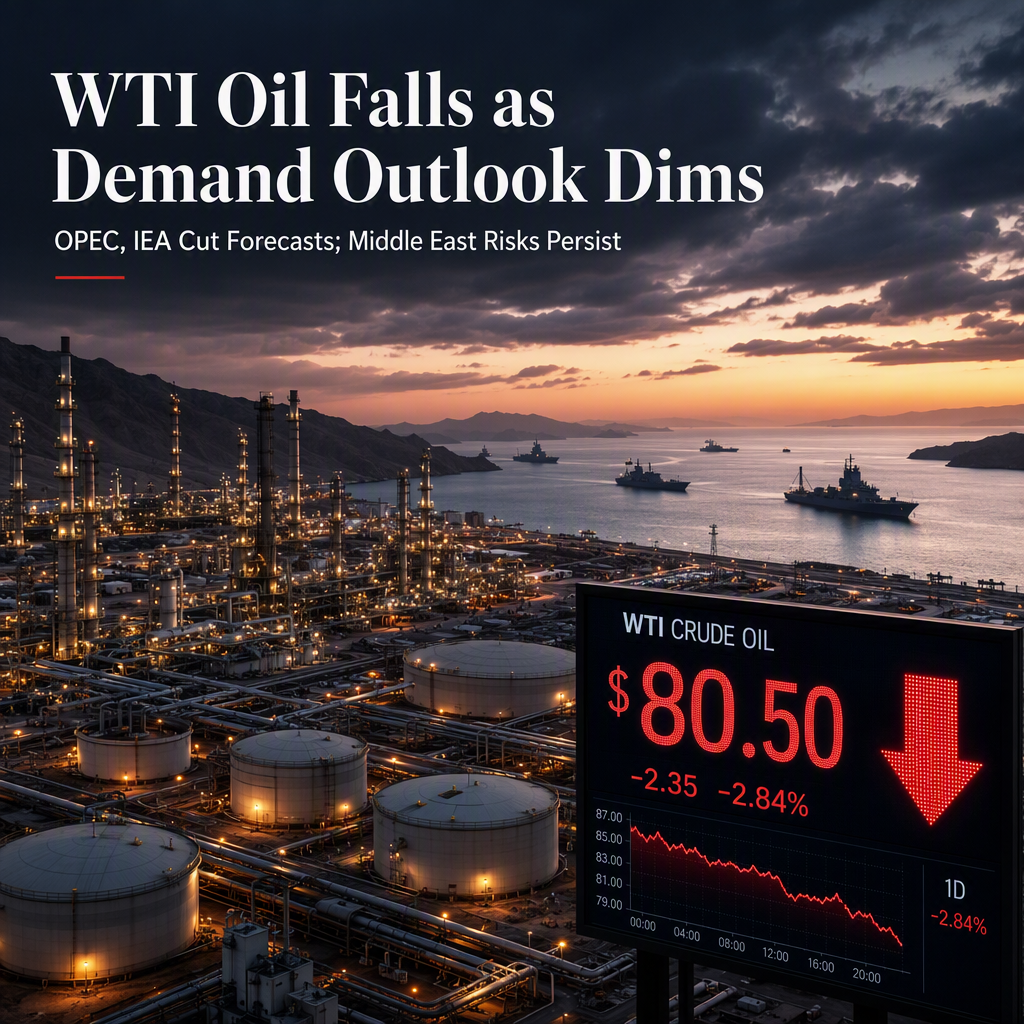
West Texas Intermediate (WTI) Oil traded modestly lower on Thursday, with prices around $80.50 per barrel, marking a 1.35% decline for the day as traders responded to weaker demand forecasts from both OPEC and the International Energy Agency (IEA) alongside ongoing supply disruptions in the Middle East [1]. OPEC revised its global oil demand growth forecast for 2026 down to 580,000 barrels per day (bpd), a reduction from its previous estimate of 780,000 bpd. In contrast, the IEA presented a more bearish outlook, projecting a demand fall of 1.6 million bpd over the same period [1].
Despite the price drop, geopolitical risks remain elevated due to the continued closure of the Strait of Hormuz, with both the United States and Iran asserting control over the strategic waterway. Commercial shipping activity remains significantly below pre-war levels, which has kept a geopolitical risk premium embedded in energy prices and limited further declines in WTI [1].
From a technical perspective, WTI Oil shows neutral momentum, trading below the 20-day Bollinger Band Simple Moving Average (SMA) at $81.63. The Bollinger Bands have expanded, indicating increased volatility, with the upper band at $90.13 and the lower band at $73.12. The Relative Strength Index (RSI) is near the neutral 50 mark, and the MACD indicator is flat around the zero line, both suggesting limited directional momentum despite heightened price swings [1].
Immediate resistance is identified at the 20-day SMA ($81.63), with a potential move higher exposing the upper Bollinger Band at $90.13. On the downside, the lower band at $73.12 serves as the next notable support if the decline continues [1].
CONCLUSION
WTI Oil prices are under pressure due to downgraded demand forecasts from OPEC and the IEA, but geopolitical risks in the Middle East are preventing a steeper decline. Technical indicators point to neutral momentum and increased volatility, suggesting that traders remain cautious amid mixed signals.