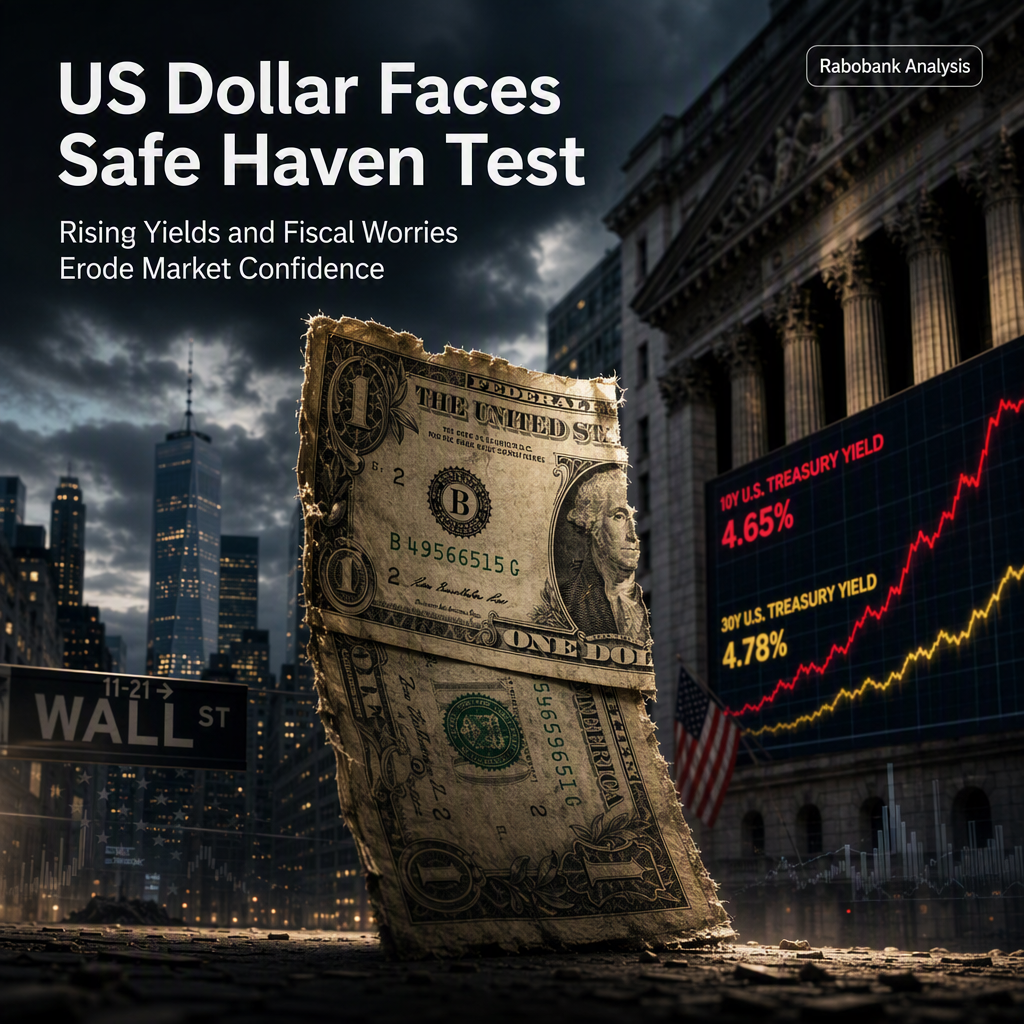
Rabobank’s Senior FX Strategist Jane Foley highlights that the US Dollar (USD) and US Treasuries are facing mounting challenges to their traditional safe haven status due to rising global bond yields and concerns over US fiscal discipline [1]. Foley notes that the US 30-year Treasury yield has surged to its highest level since 2007, with other G10 bond yields also reaching multi-year highs [1]. Last week, demand for both the US 10-year note and 30-year bond auctions was described as 'decent,' but yields had to rise to multi-year levels to attract buyers [1].
Foley points out that the US has a significant budget deficit and currently lacks a clear plan to address it [1]. Additionally, the ownership structure of US Treasuries has shifted, with a higher proportion now held by hedge funds, which may be more sensitive to price changes, potentially making the Treasury market less protected by its traditional 'privilege' [1].
While the USD continues to benefit from its dominance in the global payments system, which should afford it a safe haven bid, Foley warns that a more vulnerable Treasury market is not positive for the USD [1]. She also mentions that gradual de-dollarisation could slowly erode the USD’s dominance in the coming decades, a process that could accelerate if the Treasury market’s safe haven status becomes less anchored [1].
No specific market reactions or analyst forecasts are provided in the article, but the overall tone suggests caution regarding the medium-term outlook for the USD and US Treasuries if current trends persist [1].
CONCLUSION
Rabobank’s analysis underscores growing risks to the US Dollar’s safe haven status amid rising yields and fiscal uncertainty. While the USD retains some support from its global payments dominance, vulnerabilities in the Treasury market could have negative implications over time. Investors may need to monitor these evolving dynamics closely.