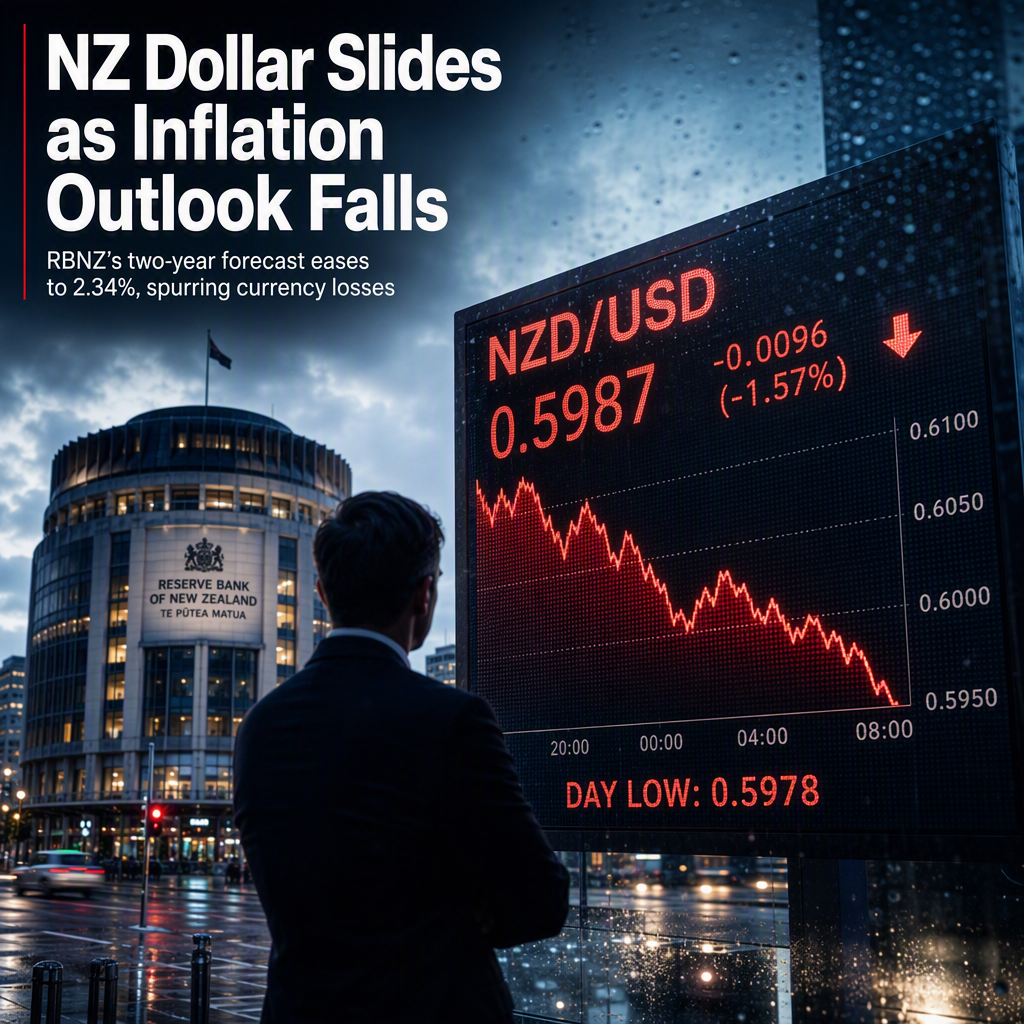
The New Zealand Dollar (NZD) continued its decline, with NZD/USD trading around 0.5840 during Asian hours on Thursday, marking its fourth consecutive day of losses following the release of the Reserve Bank of New Zealand's (RBNZ) latest inflation expectations survey [1]. According to the RBNZ's monetary conditions survey, two-year inflation expectations in New Zealand eased to 2.34% in the third quarter of 2026, down from 2.53% in the previous quarter, while one-year forward inflation projections settled at 2.6% [1][2]. This two-year timeframe is considered key for assessing how RBNZ policy actions filter through to consumer prices [1][2].
The market responded negatively to the slowdown in inflation expectations, with NZD/USD trading 0.37% lower at around 0.58357 at the time of reporting [2]. Despite the subdued performance, there is speculation that the NZD could find support if the RBNZ opts for another quarter-point rate hike next month, though this is presented as a possibility rather than a confirmed policy direction [1].
Broader market context also played a role, as the US Dollar (USD) recovered daily losses amid escalating geopolitical tensions between the US and Iran, further pressuring the NZD/USD pair [1]. In the US, consumer price inflation matched expectations in July, with the headline index rising 0.1% month-on-month, supported by retreating energy prices and slowing food inflation [1].
Both sources emphasize the importance of inflation expectations for central bank policy and currency valuation, noting that lower inflation typically leads to a weaker currency as it reduces the likelihood of aggressive rate hikes [2].
CONCLUSION
The easing of New Zealand's two-year inflation expectations to 2.34% in Q3 2026 has weighed on the NZD, pushing the NZD/USD pair lower. Market sentiment remains cautious, with attention turning to the RBNZ's next policy move and ongoing global geopolitical developments. The immediate market reaction has been negative, reflecting concerns about softer inflation and its implications for future monetary tightening.