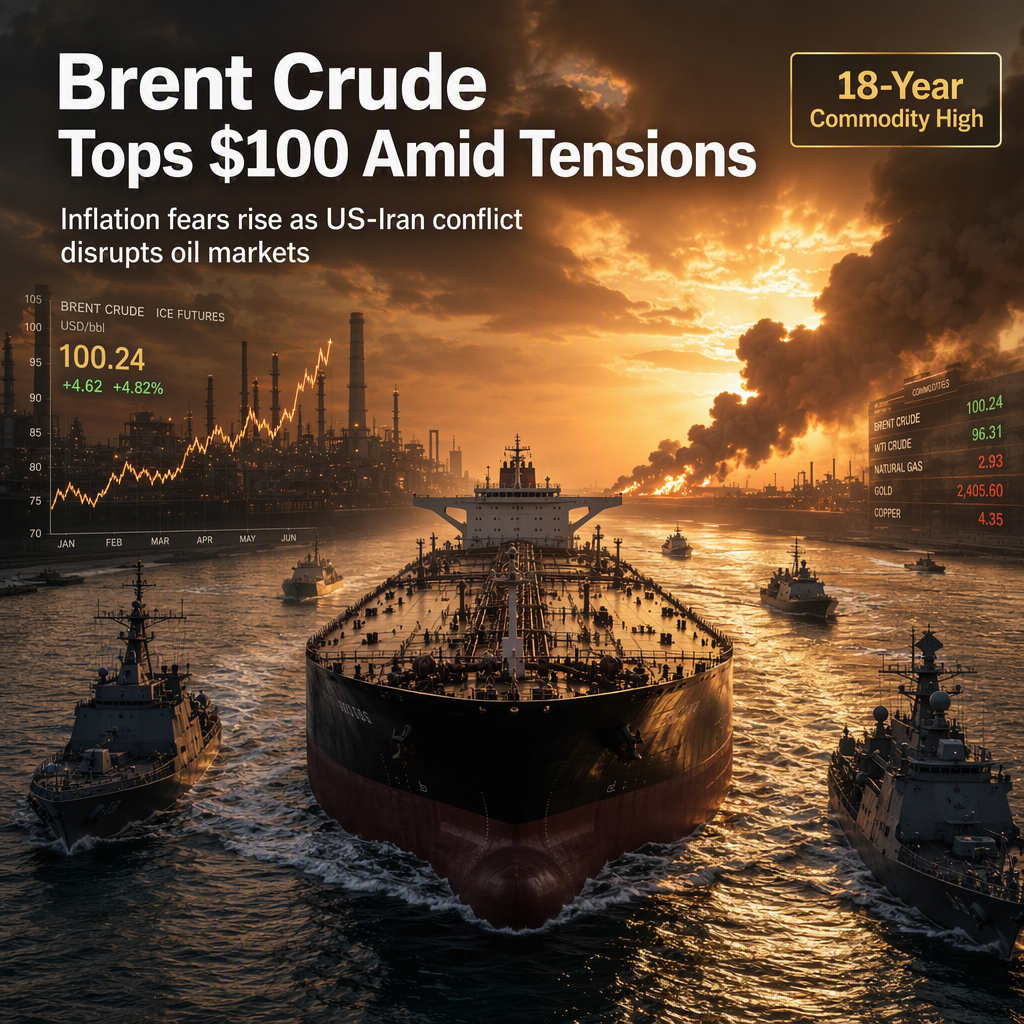
Brent crude futures have surged above the $100-per-barrel mark, a significant psychological and technical milestone for global oil markets, as fighting between the U.S. and Iranian militaries intensifies in the Middle East [1]. The escalation of conflict has raised concerns over potential disruptions to oil logistics, particularly through critical routes such as the Strait of Hormuz, prompting traders to price in a risk premium [1].
A key commodity price index has reached an 18-year high, reflecting the severity of the current price moves and stoking global inflation fears as energy costs ripple through supply chains and consumer prices [1]. Market analysts note that the rise in Brent prices is contributing to mounting inflation concerns worldwide, with investors closely monitoring for spillover effects into broader financial markets [1].
Technical analysis indicates that Brent futures have broken through previous resistance at $98-$99 per barrel, with the next major resistance forecast at $105 and support seen around $95 [1]. Trading volumes have surged, reflecting heightened investor activity and speculation [1]. A Tokyo-based energy strategist commented that 'logistics disruptions or even the threat of supply interruption are pushing Brent futures above $100, a level seen as both a resistance and a trigger for greater volatility' [1].
Traders are advised to closely monitor developments in the Middle East, particularly regarding the U.S.-Iran conflict, as further escalation could drive prices even higher. Technical indicators suggest continued upward momentum for Brent, but volatility is expected to remain elevated [1].
CONCLUSION
Brent crude's rise above $100 per barrel, driven by escalating US-Iran tensions, has triggered inflation concerns and increased market volatility. With commodity price indices at an 18-year high and technical signals pointing to further gains, investors are bracing for continued uncertainty in energy and broader financial markets.