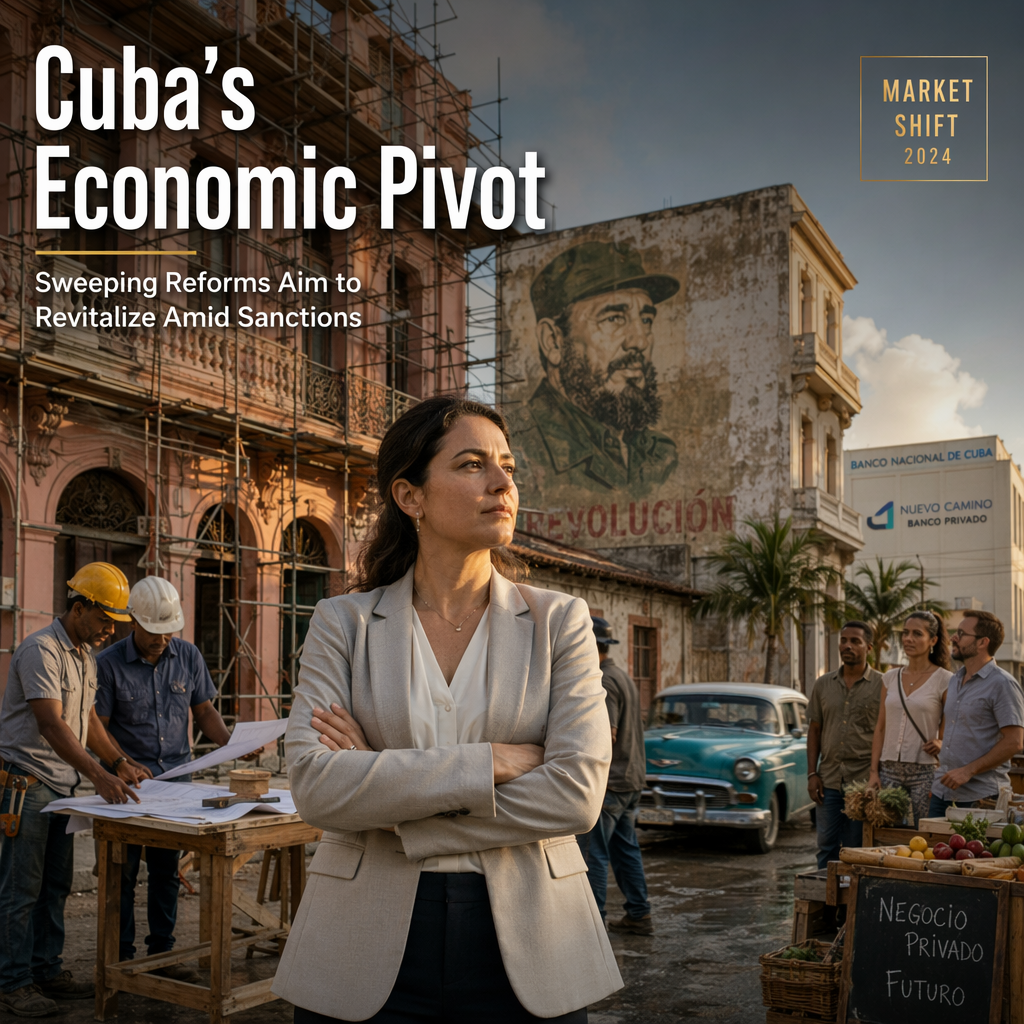
Cuba's prime minister, Manuel Marrero, presented lawmakers with a comprehensive package of economic reforms aimed at privatizing significant portions of the country's socialist economy, marking what would be the largest shift in Cuba's economic model since Fidel Castro's 1959 revolution [1]. The proposed measures, backed by the Communist Party and former leader Raul Castro, include opening the door to private real estate development, transforming state-owned enterprises into private commercial ventures with shares and equity stakes, and permitting private banks to operate within Cuba's traditionally state-dominated financial sector [1].
The reforms also aim to drastically reduce bureaucratic hurdles for privately held businesses and entrepreneurs, signaling a move towards a more market-oriented economy while maintaining loyalty to socialist principles, according to party officials [1]. President Miguel Diaz-Canel emphasized the urgency of these measures in response to intensified U.S. sanctions, stating, "We need to unleash production, to have more output and less restriction" [1]. The list of 175 measures was detailed in a nearly two-hour speech to lawmakers and now awaits a vote by the National Assembly, which typically approves government proposals unanimously [1].
Raul Castro, who was indicted in May in the United States on murder charges, expressed his support for the reforms in a letter to the politburo, describing them as "beneficial" and urging their swift implementation [1]. The reforms have been described as sweeping but consistent with the government's socialist roots, and many of the proposals have been under consideration for months or years but have gained renewed urgency due to escalating U.S. pressure [1].
The Trump administration's sanctions have severely impacted Cuba's economy, leading to shortages of fuel, water, and medicine, days-long blackouts, soaring inflation, and a collapse in the tourism sector, resulting in widespread hardship for the population [1].
CONCLUSION
Cuba's proposed economic reforms represent a historic pivot towards market mechanisms in response to crippling U.S. sanctions and economic hardship. While the measures await legislative approval, their scope and urgency signal a significant potential transformation of the Cuban economy with high market implications.