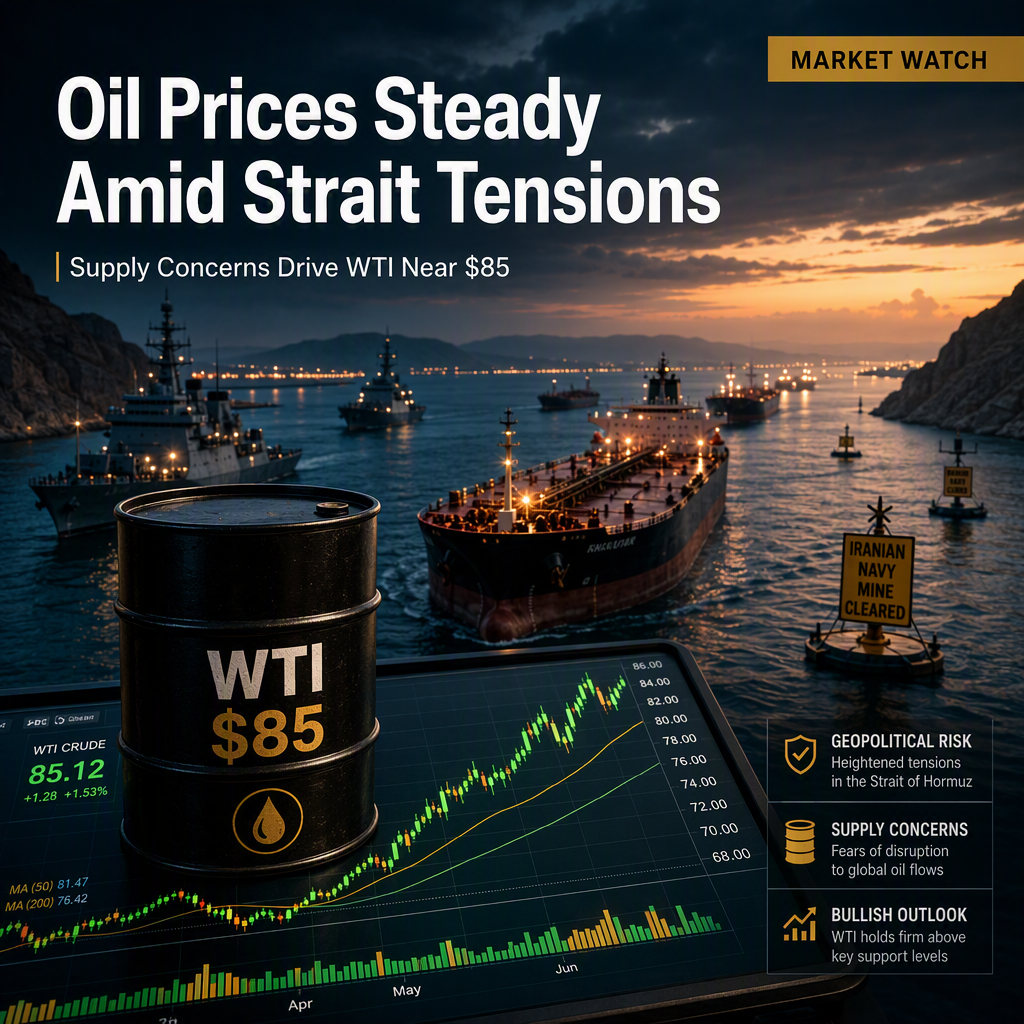
West Texas Intermediate (WTI) crude oil futures on NYMEX traded 0.55% higher at approximately $84.80 during the European session on Wednesday, reflecting ongoing concerns about energy supply disruptions due to the unresolved situation between the United States and Iran regarding the reopening of the Strait of Hormuz, a critical passage for nearly one-fifth of global energy supply [1]. US President Donald Trump stated on Truth Social that there are currently no talks or scheduled discussions with Iran about reopening the strait, and confirmed that the naval blockade remains in effect, though the Strait of Hormuz is open and all water mines have been cleared or detonated [1].
Shipping data from Kpler, as reported by Reuters, indicated that six commodity vessels crossed the strait on Tuesday, a decrease from nine the previous day and well below the 10-day daily average of 11. This figure is significantly lower than pre-war levels, which saw 130 to 140 ships passing through daily [1].
From a technical perspective, WTI is trading at $84.61, maintaining a bullish near-term bias as it remains above the 20-day Exponential Moving Average (EMA) at $81.22. The Relative Strength Index (RSI) stands at 56.95, suggesting continued upside momentum without overbought conditions. Immediate support is identified at $84.61, with the 20-day EMA at $81.22 providing additional support. For further gains, a decisive break above $85 is needed, which could open the path to $90.00 and potentially the two-week high at $92.25 [1].
The article highlights that WTI oil prices are influenced by supply and demand dynamics, geopolitical instability, and OPEC decisions, with the current market focus on the unresolved US-Iran standoff and its impact on shipping through the Strait of Hormuz [1].
CONCLUSION
WTI oil prices remain supported by ongoing supply concerns linked to the US-Iran deadlock over the Strait of Hormuz, with technical indicators pointing to a bullish bias. A break above $85 could trigger further gains, but shipping activity remains well below historical norms, underscoring persistent market uncertainty.