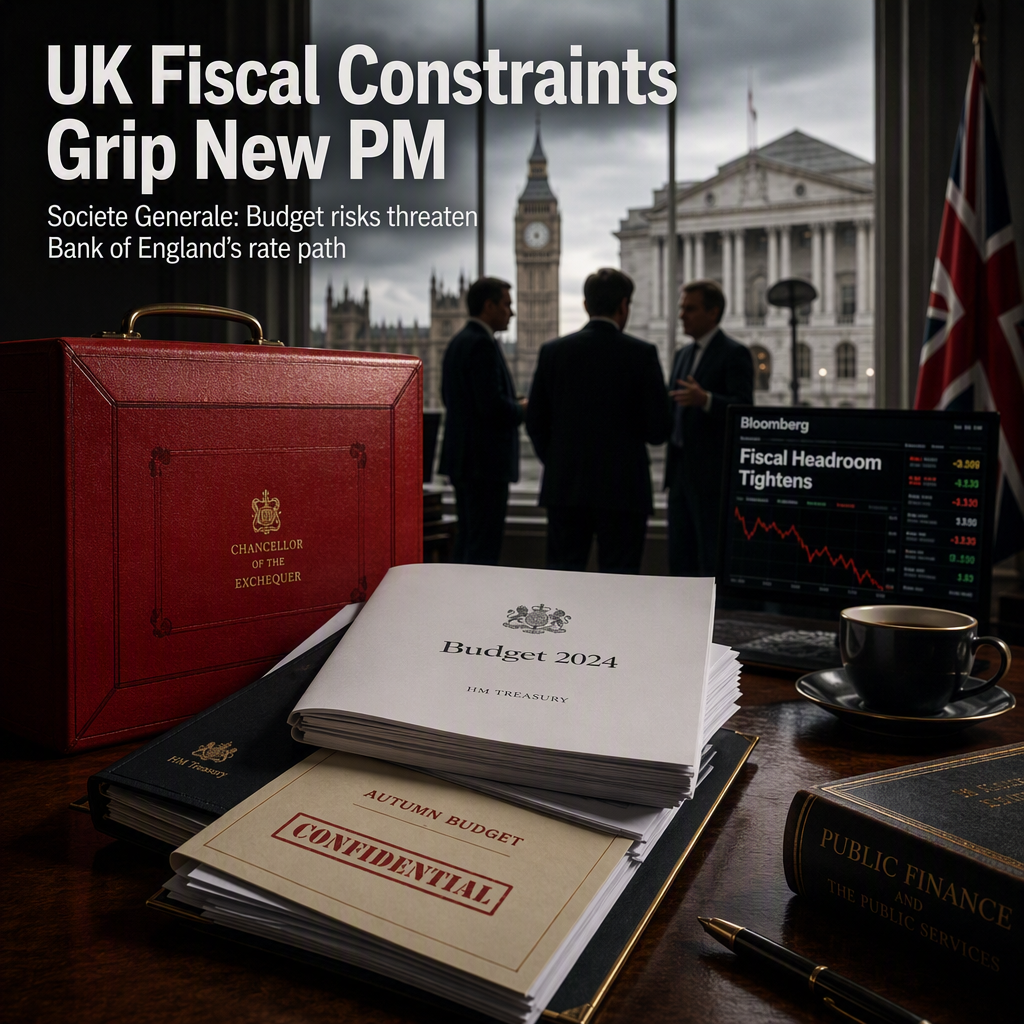
Societe Generale’s Sam Cartwright asserts that the appointment of a new UK Prime Minister has not altered the country's constrained fiscal backdrop, which continues to limit ambitions on housebuilding, social care, investment, and defence spending. The upcoming Autumn Budget is expected to focus primarily on a defence spending uplift to 3% of GDP and reversing the planned slowdown in day-to-day spending, while larger social care reforms are likely to be delayed [1].
Cartwright notes that fiscal headroom at the Autumn Budget could be £11.5bn lower than projected in March, primarily due to the US-Iran conflict's negative impact on growth and higher interest rates. However, a favourable revision to wage growth could boost headroom by around £10bn. If the geopolitical situation improves, the deterioration in headroom could be as little as £5bn, but if it worsens, it could rise to between £23bn and £43bn [1].
To offset the costs associated with increased defence and day-to-day spending, the government may rely on welfare reform, spending reprioritisation, modest tax rises, and the use of remaining fiscal headroom. Cartwright warns that a 0.3% of GDP annual increase in borrowing to fund capital spending could raise gilt yields by just under 20 basis points and challenge the Bank of England's rate-cut path. Societe Generale currently forecasts the Bank Rate to remain unchanged at 3.75% in 2026, followed by 75 basis points of easing in 2027. However, their macro model suggests that higher borrowing could raise the Bank Rate and 10-year gilt yields by around 10-20 basis points over the first three years, making a fall to 3% less likely and 3.25% a plausible alternative [1].
There is also a risk that the government may loosen fiscal rules in the future to accommodate housing and investment ambitions, potentially by switching the debt target to public sector net worth, exempting defence spending, or extending the horizon for meeting the target [1].
CONCLUSION
Societe Generale highlights that the UK's fiscal constraints remain significant despite a new Prime Minister, with limited scope for major spending increases. The potential for higher borrowing poses risks to the Bank of England's rate-cut trajectory and could lead to higher gilt yields, while any loosening of fiscal rules would further impact the fiscal and monetary outlook.