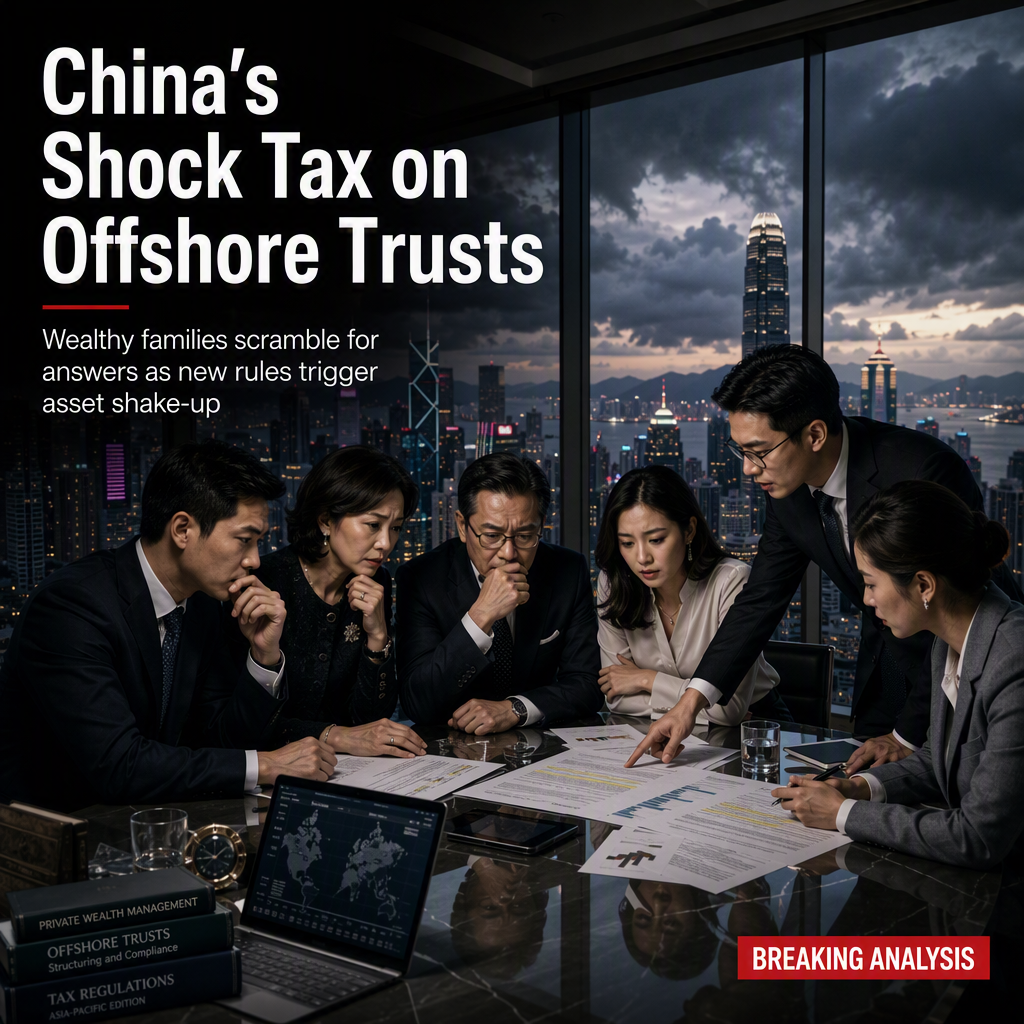
China's Ministry of Finance and tax authority issued new rules on July 24, 2026, imposing a 20% tax at nearly every stage of an offshore trust's life, including establishment, profit distribution, and termination, with a 90-day window for compliance ending on October 22, 2026 [1]. The rules require families to declare and pay tax owed on assets moved into trusts since the start of 2023, with surcharges possible for late declarations or non-payments [1]. This announcement has caused a scramble among wealthy Chinese families, who are urgently seeking legal and financial advice to determine their exposure and settle potential tax bills before the deadline [1].
Industry experts describe the move as a 'watershed moment for China-linked private wealth planning,' with lawyers and private bankers in Hong Kong and Singapore reporting a surge in inquiries from clients, trustees, and advisors [1]. Clifford Ng, a partner at Zhong Lun law firm in Hong Kong, noted that 'many clients, trustees, and advisors are still in shock' [1]. Kia Meng Loh, COO and senior partner at Dentons Rodyk in Singapore, stated that some clients are already considering which assets to sell to meet their tax obligations [1].
The sums involved are potentially massive, as assets held under trusts in Hong Kong alone reached HK$5.2 trillion ($667 billion) in 2023, with 55% of the underlying investments located in mainland China and Hong Kong, according to a KPMG and Hong Kong Trustees' Association report [1]. Singapore, the British Virgin Islands, and the Cayman Islands have also been popular jurisdictions for Chinese high-net-worth families to hold offshore assets, with some clients perceiving less political risk in Singapore than in Hong Kong, as noted in a 2025 KPMG report [1].
The market implications are significant for the offshore trust industry, which has been built on decades of Chinese capital. The new tax rules could prompt asset sales and restructuring as families seek to comply, potentially impacting financial markets and legal service providers in key hubs such as Hong Kong and Singapore [1].
CONCLUSION
China's surprise 20% tax on offshore trusts has sent shockwaves through the country's ultra-wealthy, prompting a rush for legal and financial advice and potential asset sales. With a tight compliance window and large sums at stake, the move marks a major shift in China-linked private wealth planning and could have far-reaching effects on the offshore trust industry.