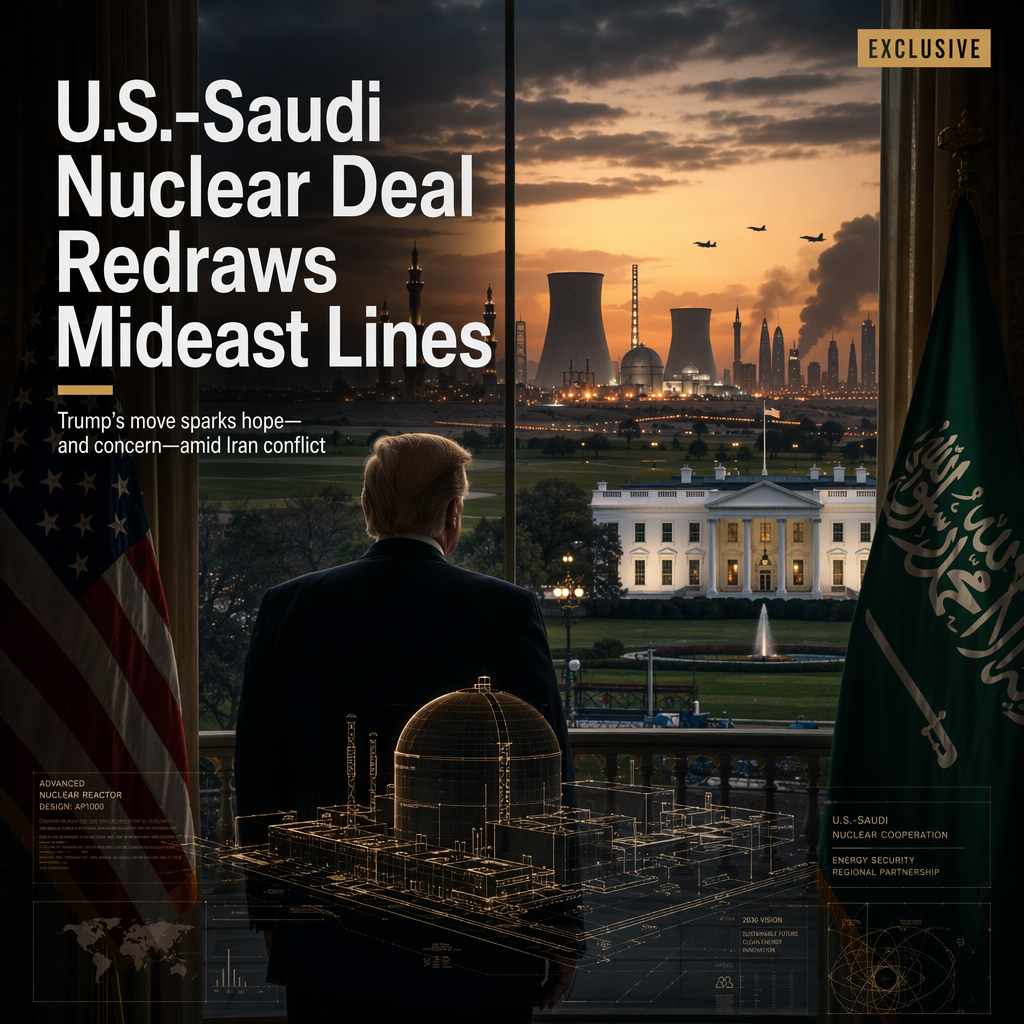
President Donald Trump has approved a landmark civilian nuclear deal between the United States and Saudi Arabia, according to a senior administration official cited by NBC News. The agreement, expected to be announced Wednesday, will involve the U.S. supporting the creation of a nuclear power program in Saudi Arabia, with American companies set to build the program within the kingdom [1].
Congressional approval is required for the agreement to proceed, but a veto-proof majority would be necessary to block it [1]. The deal could enable Saudi Arabia to pursue its own uranium enrichment, which has raised concerns about potential nuclear proliferation. Addressing these concerns, Secretary of State Marco Rubio stated that the U.S. would not “reach any agreement with any country in the world that leads to the risk of proliferation” [1].
The timing of the deal is significant, as it comes during the ongoing war against Iran, launched by the U.S. and Israel. President Trump has maintained that Iran should not be allowed to develop a nuclear weapon, despite Iran's consistent denials of such intentions [1].
Previously, the U.S. had required a normalization agreement between Israel and Saudi Arabia as a precondition for any deal permitting Saudi uranium enrichment. However, Saudi leaders have insisted that such normalization would not be possible without meaningful progress toward a Palestinian state [1].
CONCLUSION
The approval of the U.S.-Saudi nuclear deal marks a significant development in Middle Eastern geopolitics and U.S. foreign policy. While the agreement could open new opportunities for American companies, it also raises concerns about nuclear proliferation and regional stability, especially amid ongoing conflict with Iran.