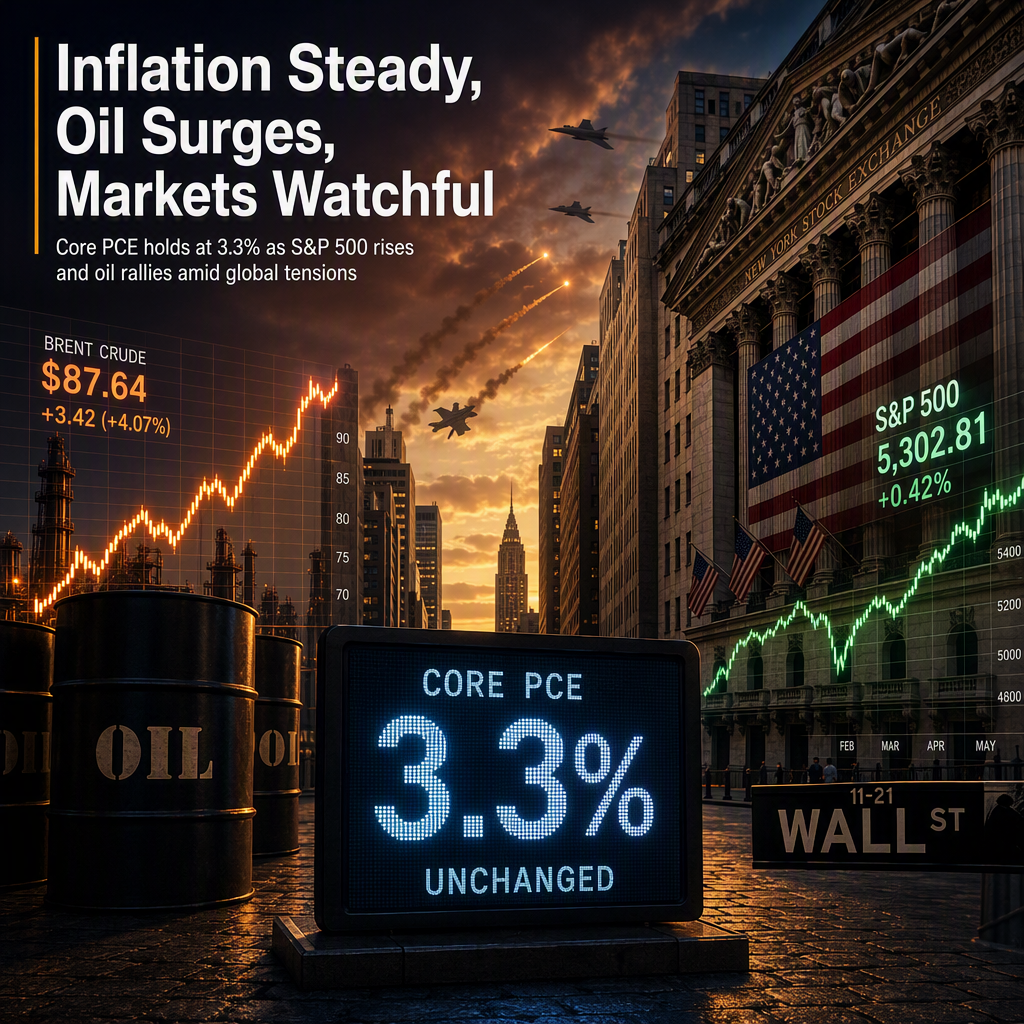
On August 26, 2026, financial markets were influenced by three major catalysts: the release of the Federal Reserve’s preferred inflation gauge (Core PCE), a revision to U.S. Q2 GDP, and a Bloomberg report indicating Russia is preparing to escalate attacks on Ukraine after peace talks stalled [1]. The U.S. Core PCE Price Index for July 2026 held steady at 3.3% year-over-year, slightly below the monthly forecast, and did little to alter expectations for a September rate hike, though markets continued to price in at least one hike by year-end [1]. The Q2 2026 U.S. GDP growth rate was revised to 1.5% quarter-over-quarter, matching forecasts but down from the previous estimate of 2.1% [1].
Market reactions were notable: the U.S. dollar closed as one of the top-performing major currencies, oil prices surged—finishing 'well in the green'—while gold experienced one of its sharpest single-session drops in recent weeks [1]. The S&P 500 index fluctuated throughout the session, initially dipping on the open before recovering, and ultimately closed near 7,688, up approximately 0.13% for the day [1]. This cautious trading was attributed to anticipation of Nvidia’s after-hours earnings, with analysts projecting a near-doubling of the company’s revenue year-over-year [1].
Other key data included a 1.1% month-over-month increase in U.S. durable goods orders for July 2026 (versus a 0.5% forecast), U.S. personal income rising 0.4% month-over-month (0.2% forecast), and personal spending up 0.2% month-over-month (0.3% forecast) [1]. U.S. MBA mortgage applications fell by 1.0%, and the 30-year mortgage rate edged up to 6.78% [1]. Oil market volatility was further heightened by the geopolitical news regarding Russia and Ukraine, with API crude oil stock change at 4.2M and EIA crude oil stocks change at 0.1M for the week ending August 21, 2026 [1].
Money markets reflected the persistence of inflation above the Fed’s target and resilient consumer spending, reinforcing expectations for further monetary tightening by December [1].
CONCLUSION
The combination of steady but elevated inflation, resilient consumer spending, and renewed geopolitical tensions drove significant market moves, with oil and the U.S. dollar outperforming while equities posted modest gains. Investors remain focused on upcoming Fed decisions and Nvidia’s earnings as key drivers for future market direction.