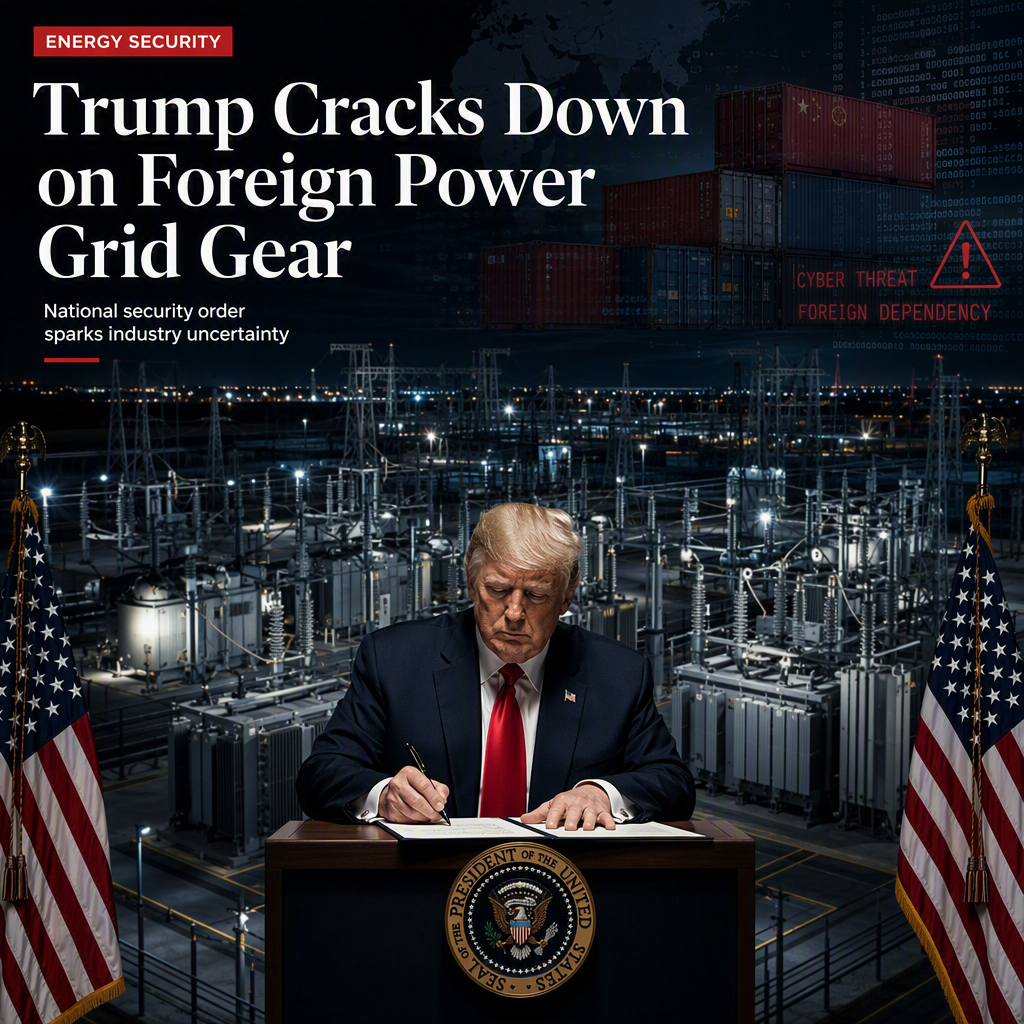
President Donald Trump has issued a national emergency declaration and signed an executive order that could restrict U.S. utilities from purchasing and importing certain foreign-made power grid equipment, citing national security risks to the electric system [1]. The Energy Department is empowered to prohibit the acquisition, importation, transfer, or installation of foreign-produced bulk-power equipment if officials determine the transaction involves a covered foreign entity and poses an unacceptable security risk [1].
The executive order extends its reach to equipment already operating on the U.S. grid, allowing the energy secretary to require foreign-manufactured or operated equipment to be identified, isolated, monitored, secured, disconnected, replaced, or removed. This could force utilities and infrastructure operators to make significant changes to existing systems, with potential financial and operational consequences for the power sector. However, the order does not estimate potential costs or specify which equipment or vendors may be affected [1].
The administration argues that foreign-produced equipment may contain vulnerabilities, such as digital backdoors, which could provide remote access to critical infrastructure. Additionally, reliance on foreign suppliers is seen as a risk for potential equipment shortages due to trade disruptions or supply shocks. The order highlights increased stakes as artificial intelligence, data centers, advanced manufacturing, and defense production drive greater demand for reliable electricity [1].
Covered equipment includes major grid infrastructure components like transformers, generators, battery energy storage systems, grid-connected inverters, turbines, industrial control systems, and associated software, firmware, and remote-access capabilities. The Energy Department is directed to consider reliability, safety, availability of secure replacement equipment, and continuity of essential service before mandating changes. Compliance may be phased in, and the department can establish a list of pre-qualified equipment and vendors. The Energy Department has 120 days to publish implementing rules or regulations, which will clarify which suppliers and equipment could face restrictions. Trump also directed the federal government to reconsider its energy infrastructure purchasing within 180 days [1].
CONCLUSION
Trump's executive order introduces significant uncertainty for U.S. utilities and the power sector, with potential operational and financial impacts depending on forthcoming Energy Department regulations. The move is driven by national security concerns and aims to reduce reliance on foreign suppliers, but the exact scope and affected entities will be determined in the coming months.