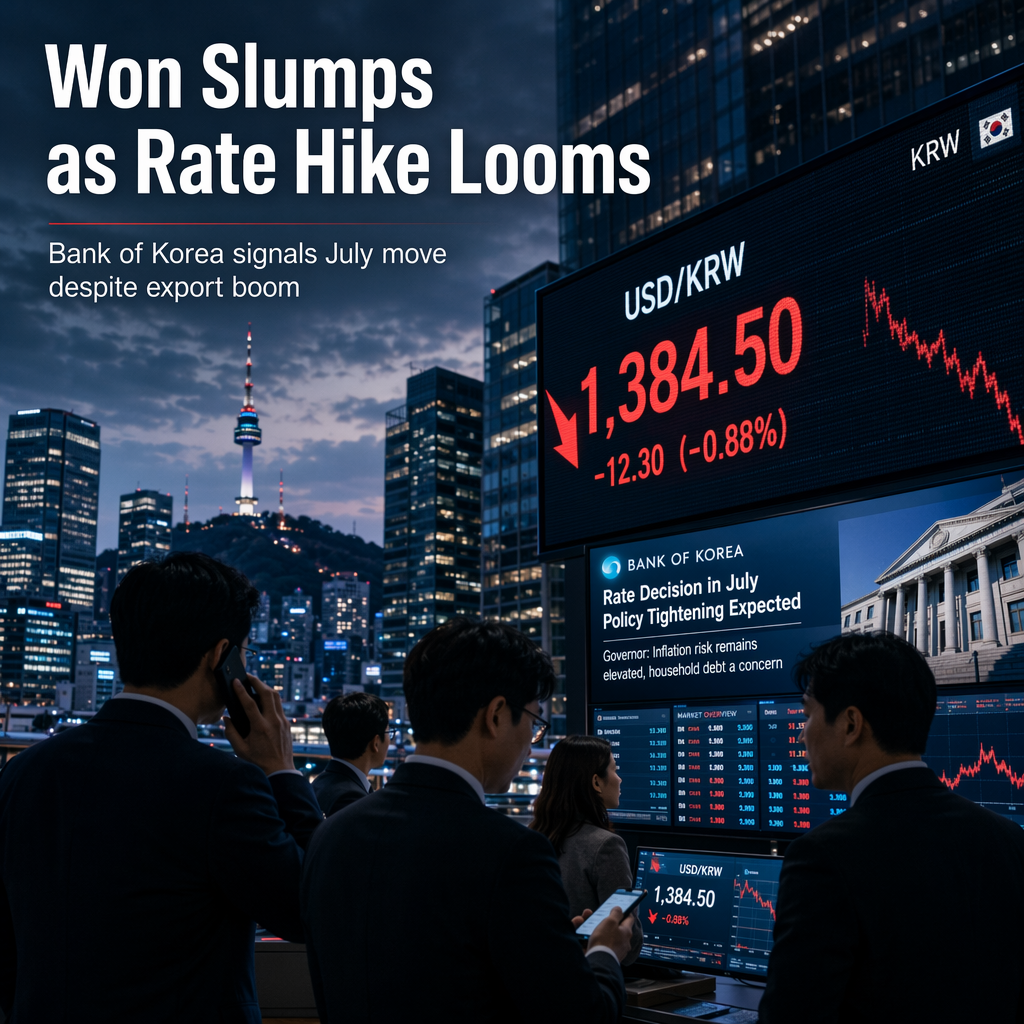
Commerzbank reports that the South Korean Won (KRW) remains one of Asia’s weakest currencies against the US Dollar, despite robust export momentum led by the semiconductor and petroleum sectors [1]. The KRW has depreciated 6.4% versus the USD this year, making it the second-weakest performing Asian currency, while the average decline for Asian currencies excluding Japan stands at -2.9% [1]. On the foreign exchange front, the USD/KRW pair rose 0.4% to 1,537 yesterday, attributed to a stronger US Dollar [1].
In response to mounting financial stability and inflation risks, the Bank of Korea (BoK) has adopted a more hawkish stance. The central bank is expected to raise its policy rate by 25 basis points to 2.75% at its next meeting scheduled for 16 July [1]. BoK Governor Shin Hyun-song emphasized the urgency of tightening policy, stating that the BoK should raise rates 'before it's too late' [1]. Meeting minutes further reveal that several BoK members believe inflationary risks now outweigh growth risks, with the strong performance of the semiconductor sector helping to offset negative impacts from the Middle East conflict [1].
The combination of a weak KRW and expectations for a rate hike reflects ongoing concerns about financial and housing market stability, as well as persistent inflationary pressures [1]. While export strength provides some support to the economy, currency weakness and the central bank’s hawkish pivot are key market-moving factors.
CONCLUSION
Despite strong export performance, the South Korean Won continues to underperform regional peers, prompting the Bank of Korea to signal a rate hike in July. Market participants are closely watching the BoK’s policy response to inflation and financial stability risks, as these factors drive currency and rate expectations.