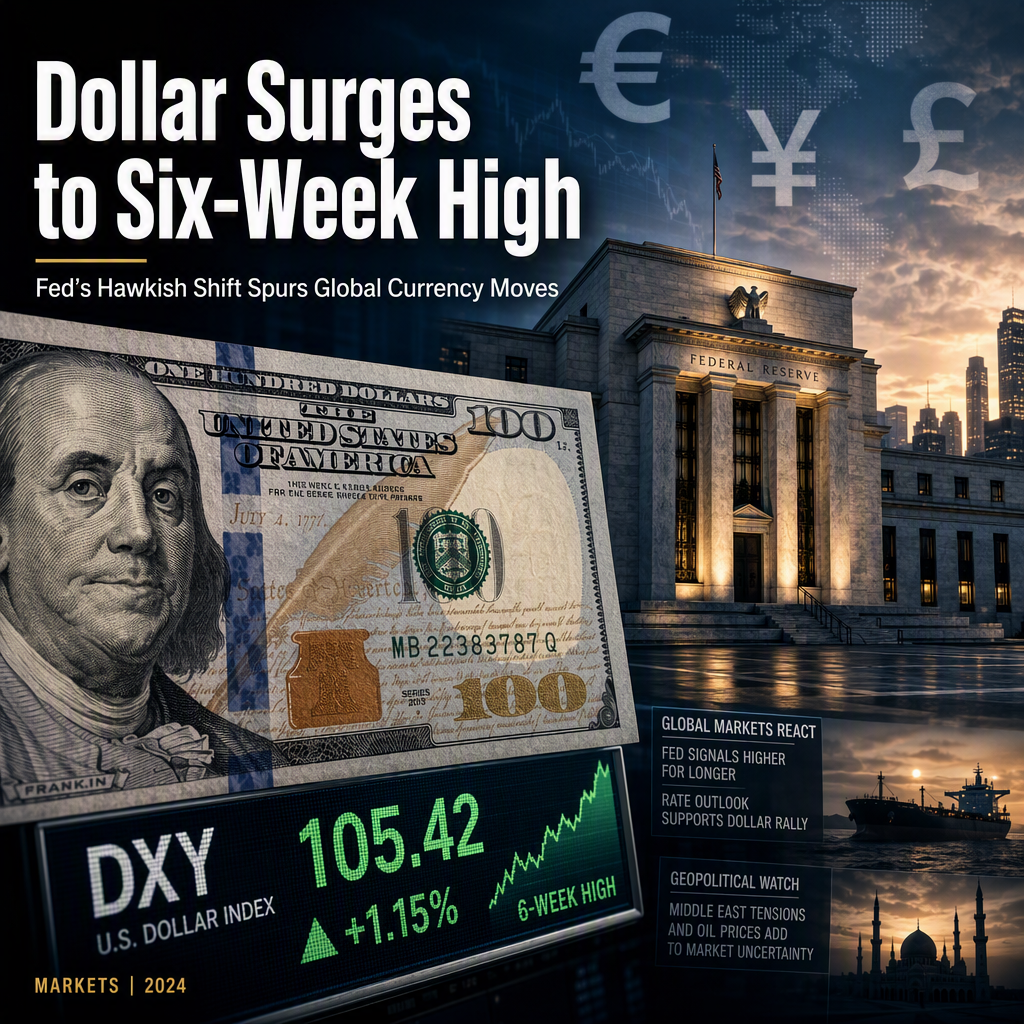
The US Dollar Index (DXY) climbed to near 100.35, testing its highest level since late July, as the Federal Reserve adopted a more hawkish stance at its September policy meeting, raising interest rates for the first time since 2023 and signaling the likelihood of at least one more hike this year [1][3]. The Fed's dot plot and post-meeting commentary from Chair Kevin Warsh emphasized the ongoing challenge of high inflation, with Warsh stating that inflation remains too high and has persisted for too long [1]. UOB Group economists now expect two further Fed rate hikes, suggesting that the narrowing of US rate differentials relative to G-10 peers is likely to reverse, underpinning the DXY going forward and presenting upside risks to USD forecasts against both G-10 and Asian currencies [1][3].
Geopolitical tensions in the Middle East, including an incident involving Iran's Islamic Revolutionary Guard Corps and a Togo-flagged tanker, as well as comments from US President Donald Trump about potential actions against Iran, have further supported the safe-haven appeal of the US Dollar [1]. Technical analysis indicates that the DXY maintains a bullish bias above key moving averages, with resistance at 100.57 and 101.12, and support at 100.18 and 99.69 [1].
The Euro (EUR) flattened against the US Dollar at around 1.1485 after hitting a six-week low near 1.1456, as traders digested hawkish moves from both the ECB and the Fed [3]. The ECB raised its key policy rates by 25 basis points last week and signaled ongoing inflation risks, with money markets now fully pricing in four additional 25-basis-point hikes over the next 12 months [3]. Despite these moves, the US Dollar outperformed all major currencies this week, with the strongest gains against the Japanese Yen and notable strength versus the Euro and Pound Sterling [3].
The British Pound (GBP) saw a modest uptick to 1.3372 against the US Dollar following stronger-than-expected UK Retail Sales data for August, which rose 0.5% month-on-month versus an expected -0.2% [2]. However, the GBP underperformed over the week, as the Bank of England kept its policy rate unchanged at 3.75% in a 6–3 vote and acknowledged a challenging inflation outlook, expecting CPI to rise to around 3.75% in Q4 2026 and slightly above 4% in early 2027 [2]. Technical analysis for GBP/USD suggests a bearish near-term tone, with the pair trading below key moving averages and resistance levels, and the Relative Strength Index indicating selling pressure is nearing exhaustion [2].
Analysts at UOB Group highlighted that the Fed's updated dot plot and economic projections point to a more hawkish policy trajectory, reinforcing expectations for further tightening and supporting the US Dollar's strength [1][3].
CONCLUSION
The US Dollar has surged to a six-week high, buoyed by the Federal Reserve's hawkish policy shift and ongoing geopolitical risks. Despite positive UK retail data and ECB tightening, the Dollar outperformed major peers, with analysts and technical indicators pointing to continued upside risks for the Greenback. Market sentiment remains bullish for the USD as central banks signal further rate hikes and inflation concerns persist.