
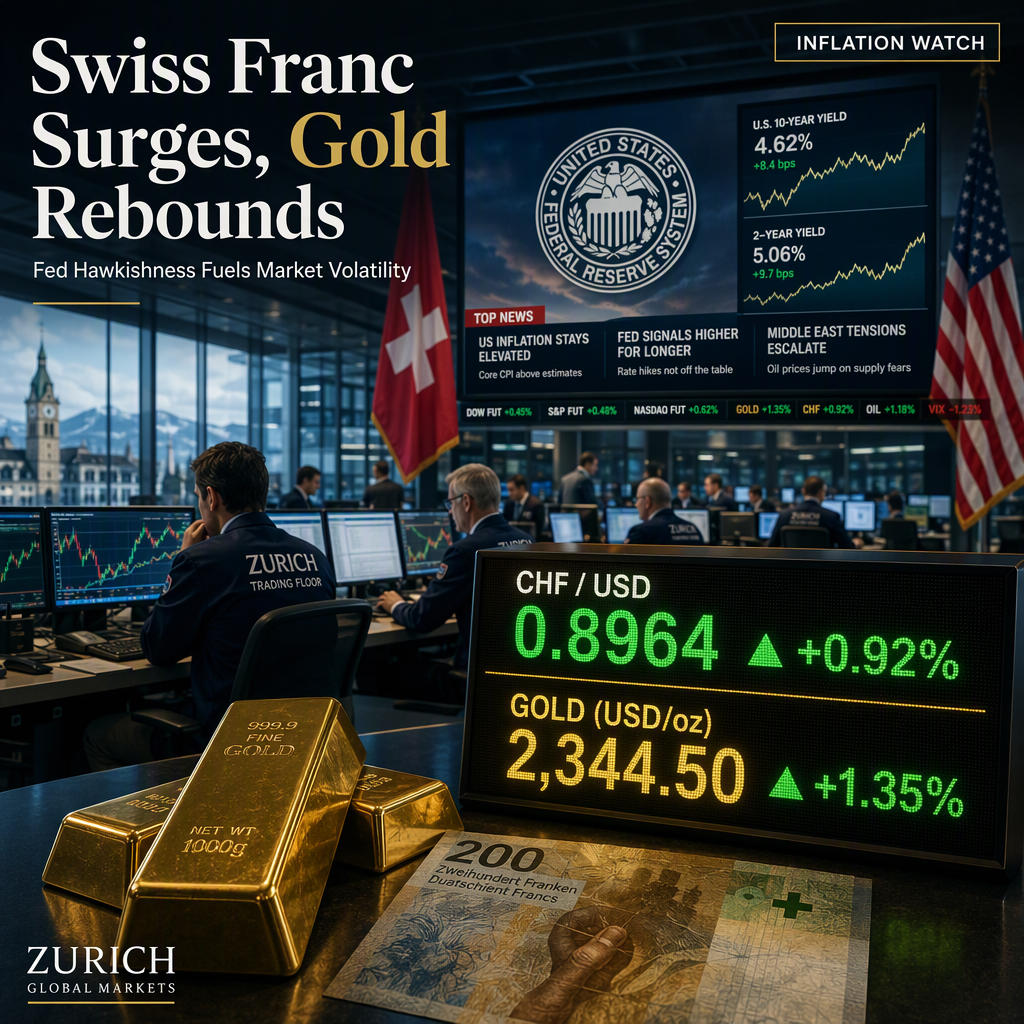
The Swiss Franc (CHF) gained against the US Dollar (USD), with the USD/CHF pair halting its three-day winning streak and trading around 0.8330 during Asian hours on Thursday [1]. This movement comes despite the US Dollar receiving solid support from the Federal Open Market Committee's (FOMC) hawkish stance, as revealed in the minutes from the Federal Reserve’s September meeting. All 19 policymakers unanimously supported the September rate hike, and a majority indicated that another increase would likely be appropriate by year-end [1][2]. The CME FedWatch tool shows traders are pricing in a 78.3% probability of a December rate increase according to [1], while [2] reports this probability at around 80%.
US Treasury bond yields have rebounded to multi-decade highs, with the 10-year and 30-year Treasury notes trading around 5.31% and 5.70%, respectively [1]. This has contributed to the bullish tone for the USD, although some profit-taking has occurred as markets expect the Fed to pause at its October meeting [1][2]. Investors are now awaiting remarks from key Fed officials, including Christopher Waller and Alberto Musalem, as well as the release of US Weekly Initial Jobless Claims data, for further guidance on the interest rate trajectory [1][2].
On the Swiss side, the Franc faces headwinds from expectations that the Swiss National Bank (SNB) will hold its policy rate at 0% over the coming years, despite money markets attempting to price in up to three rate hikes next year [1]. Swiss inflation accelerated to 1.0% in September, reaching the midpoint of the SNB’s target band, but remains within the central bank's price-stability threshold, reducing immediate pressure for policy tightening [1].
Meanwhile, gold (XAU/USD) has rebounded from a two-month low, rising to the $4,130-$4,135 region during the Asian session [2]. The upside for gold appears limited as persistent inflation risks, elevated US bond yields, and a generally bullish USD continue to cap gains [2]. Geopolitical uncertainties, particularly ongoing conflicts in the Middle East, are also supporting the safe-haven appeal of the USD and contributing to volatility in global financial markets [2]. The technical outlook for gold remains bearish in the near term, with the pair trading below key daily Simple Moving Averages and momentum indicators signaling continued caution [2].
Traders are closely monitoring upcoming US economic data and speeches from influential FOMC members, as well as geopolitical developments, for further direction in both currency and commodity markets [1][2].
CONCLUSION
The Swiss Franc's recent gains come amid a hawkish Fed and persistent inflation risks, while gold has rebounded but remains under pressure from strong US yields and a resilient USD. Market participants are awaiting further signals from Fed officials and key US data releases, with ongoing geopolitical tensions likely to sustain volatility. The overall market sentiment remains cautious, with limited upside seen for both the Swiss Franc and gold in the near term.