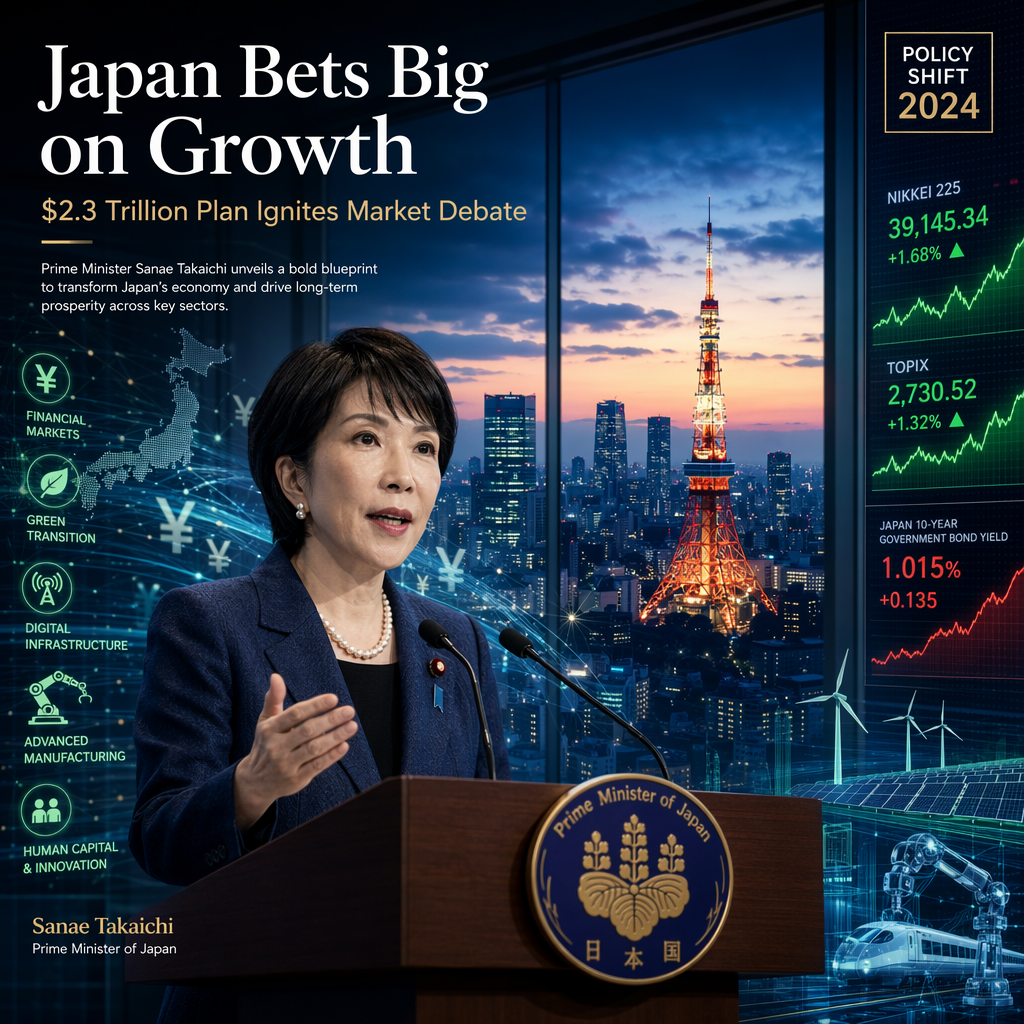
Japanese Prime Minister Sanae Takaichi's cabinet has approved an annual economic and fiscal policy blueprint that marks a significant shift in Japan's economic strategy. The new plan aims to boost long-term growth by leveraging substantial public spending—specifically, a $2.3 trillion investment package—to stimulate private sector investment in high-growth sectors such as green technology, digital infrastructure, and advanced manufacturing [1]. This approach departs from previous policies that emphasized strict fiscal discipline, instead prioritizing aggressive investment to break the cycle of low growth and deflation [1].
The blueprint redefines fiscal discipline, with the government prepared to tolerate higher deficits in the short term as long as spending is targeted toward productivity-enhancing projects. While the administration will continue to monitor debt levels, it asserts that the potential for long-term growth justifies the increased fiscal risk [1]. Takaichi emphasized, "Our strategy is to ignite Japan's animal spirits with a $2.3 trillion plan," underscoring the scale and ambition of the initiative [1]. A senior cabinet official added, "Fiscal discipline will not be ignored, but growth cannot wait" [1].
Market reactions have been mixed. On one hand, foreign investors have shown strong confidence in the government's growth agenda, purchasing a half-year record $60 billion in Japanese stocks [1]. On the other hand, Japanese bond yields are approaching 3% as fiscal fears escalate, reflecting investor concerns about the sustainability of rising government debt [1]. Analysts warn that the rise in bond yields may require closer monitoring of fiscal risks, especially if the anticipated productivity gains do not materialize [1].
The blueprint sets ambitious growth and productivity targets, with the administration betting that targeted public spending will yield multiplier effects and foster innovation and structural transformation in the Japanese economy [1].
CONCLUSION
Japan's new economic blueprint signals a bold pivot toward growth-oriented public investment, with markets responding both positively and cautiously. While foreign investors are optimistic about the government's ability to deliver sustained growth, rising bond yields highlight ongoing concerns about fiscal sustainability. The success of the plan will depend on whether the targeted investments translate into the projected productivity gains.